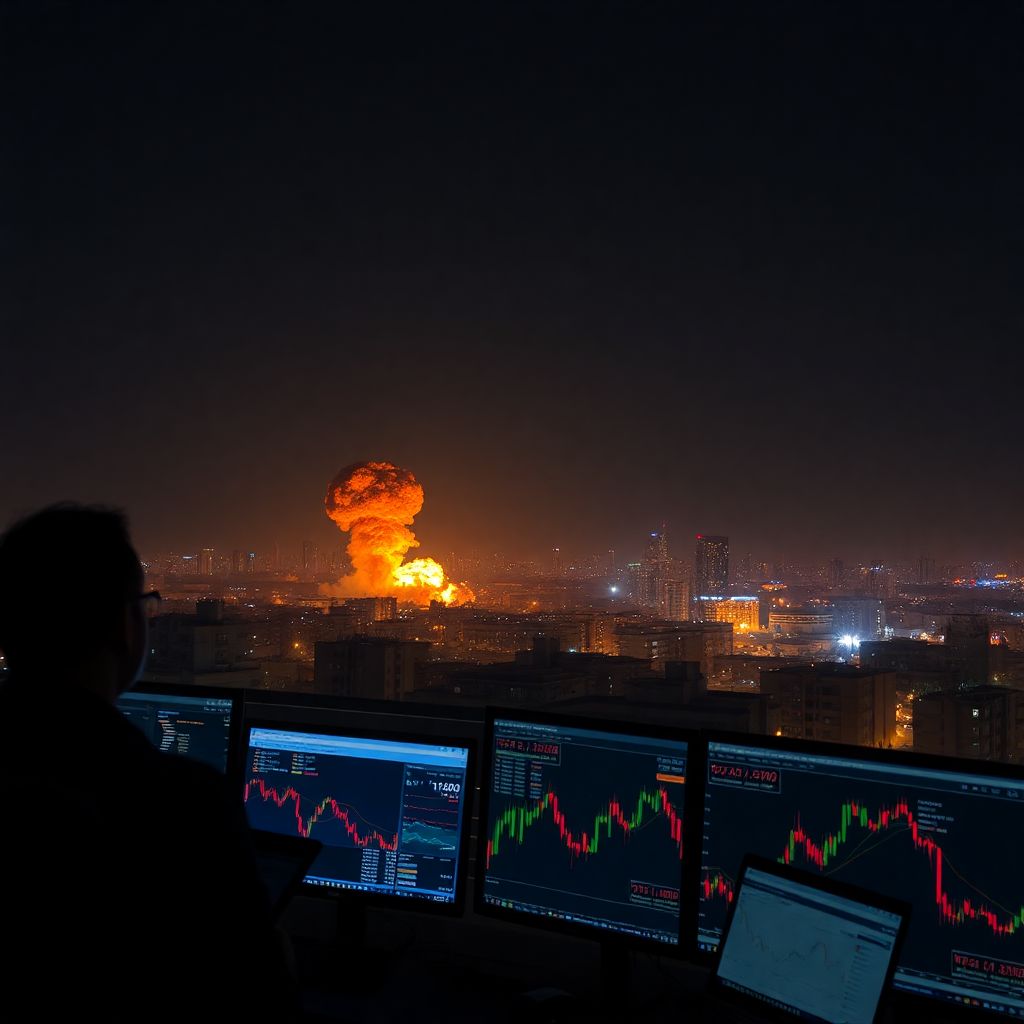
Crypto market whipsaws as Tehran explosions trigger $128B selloff, swift Bitcoin and Ethereum rebound
—————————————————————————————————
Bitcoin and Ethereum endured a violent intraday swing after reports of explosions in Tehran and a wave of missile strikes across the Middle East sent traders scrambling for safety, briefly wiping out roughly 128 billion dollars from the global crypto market before a sharp rebound.
Within hours of the first reports out of Iran, Bitcoin (BTC) slid to an intraday low of 63,062 dollars, only to recover to around 66,201 dollars later in the session. Ethereum (ETH) followed a similar pattern, dropping to 1,837 dollars before bouncing back to approximately 1,940 dollars as risk appetite cautiously returned.
Missile exchanges trigger “risk‑off” move
The selloff was sparked by reports of large explosions in Tehran as the United States and Israel carried out strikes across Iranian territory. In response, Iran launched retaliatory missile attacks against several regional targets, including Israel, Qatar, the United Arab Emirates, and Bahrain, while threatening additional strikes on bases in Iraq linked to U.S. interests.
The escalation immediately fueled a broader “risk‑off” mood across global markets. Crypto, which has increasingly traded in correlation with other risk assets like tech stocks, was hit hard in the initial wave of panic selling. Within a short window, the crypto market shed about 128 billion dollars in paper value, underscoring how sensitive digital assets remain to geopolitical shocks.
UAE intercepts missiles, limits physical damage
Despite the intensity of the exchange, the United Arab Emirates Ministry of Defence reported that it successfully intercepted Iranian missiles heading toward the country. While fragments of the destroyed projectiles fell across several areas of Abu Dhabi, including Saadiyat Island, Khalifa City, Bani Yas, Mohammed bin Zayed City, and Al Falah, authorities confirmed there were no injuries and no major damage.
Officials emphasized that the UAE’s defense systems remain fully prepared to address any ongoing or future threats and reiterated that all necessary measures are being taken to protect national security and stability. This swift military response and the absence of casualties helped calm investors’ nerves, contributing to the partial recovery in crypto prices.
Bitcoin’s intraday range reflects extreme volatility
The 24‑hour trading range for Bitcoin captured the severity of the initial shock and subsequent rebound. BTC moved between 63,062 and 66,108 dollars over the period, ultimately stabilizing near 66,201 dollars by the time markets began to digest the news flow more rationally.
From the 24‑hour high to the intraday low, Bitcoin saw a drawdown of about 4.6 percent before recouping its losses. On a shorter timeframe, the asset managed to post a gain of around 1.12 percent over one hour and 1.28 percent across the full day, indicating that dip‑buyers stepped in aggressively once it appeared that the military escalation, while serious, might be contained.
Ethereum holds key psychological levels
Ethereum’s price action mirrored Bitcoin’s, but with its own critical thresholds in play. ETH traded between 1,837 and 1,946 dollars across the same 24‑hour period, reclaiming the 1,900‑dollar region after briefly testing support below 1,850 dollars.
By the end of the observed window, Ethereum hovered near 1,940 dollars, having logged a 1.42 percent gain over the preceding hour. The quick move back above 1,900 dollars suggested that market participants still view this zone as a pivotal battleground for medium‑term sentiment.
Markets reassess the scale of the conflict
The speed of the rebound in both leading cryptocurrencies highlights a familiar pattern: initial algorithmic or panic‑driven selling on headline risk, followed by more measured positioning once the true scope of events becomes clearer.
Traders appeared to conclude that, although the strikes and missile exchanges represent a serious geopolitical flare‑up, the immediate risk of a region‑wide conflict spiraling out of control might be lower than initially feared. As confirmation emerged that missile interceptions were largely successful and that casualties were avoided in some key locations, speculative selling eased and opportunistic buyers moved in.
Political rhetoric amplifies uncertainty
The geopolitical backdrop remains tense. The strikes began on Saturday with explosions reported in Tehran, while political leaders traded increasingly heated rhetoric. U.S. President Donald Trump publicly called on Iranian citizens to topple their government once the military campaign concludes, adding another layer of uncertainty to an already volatile situation.
Such statements can influence market psychology even when they do not translate directly into new military actions. For crypto traders, strong political language tends to raise questions about sanctions, energy markets, and broader macroeconomic stability – all factors that can reverberate through digital asset pricing.
Why crypto reacts so sharply to geopolitical shocks
The latest episode underscores how the narrative around Bitcoin has evolved. While some still frame BTC as “digital gold” capable of acting as a haven in times of crisis, market behavior often tells a more nuanced story. In acute, unexpected crises, correlations between Bitcoin, equities, and other risk assets frequently rise, as investors rush to raise cash and reduce exposure across the board.
Only once the immediate wave of de‑risking subsides do any potential “safe‑haven” dynamics emerge, such as in situations where currency devaluation, inflation, or capital controls become central concerns. The rapid selloff and equally rapid rebound in this case fit neatly into that pattern: an initial liquidity shock followed by selective re‑entry.
Key levels traders are watching now
For Bitcoin, the 63,000-64,000‑dollar area has once again proven to be a short‑term support zone, with buyers stepping in aggressively when prices dipped toward that range. On the upside, the ability to hold above 66,000 dollars will be closely watched as a signal of whether bullish momentum can reassert itself or whether the market remains vulnerable to further geopolitical headlines.
Ethereum traders, meanwhile, are focused on the 1,850‑dollar support region and resistance in the mid‑1,900s. Sustained closes above 1,900 dollars would strengthen the case for a renewed push toward 2,000 dollars and beyond, while a break back below 1,850 dollars could invite another wave of selling.
Implications for broader altcoin and DeFi markets
Sharp volatility in Bitcoin and Ethereum tends to cascade into the wider crypto ecosystem. When BTC and ETH drop quickly on macro news, altcoins and DeFi tokens often see exaggerated moves to the downside as traders consolidate into more liquid majors or exit the market altogether.
The partial recovery in the two largest cryptocurrencies offers some breathing room for the broader market, but it does not erase the underlying fragility. Smaller-cap tokens remain particularly exposed to any further shocks, especially if funding rates, leverage, or on‑chain liquidity are stretched.
Risk management becomes critical for investors
For both short‑term traders and longer‑term investors, the latest events serve as a reminder of the need for robust risk management. Geopolitical events are inherently unpredictable; they can erupt without warning outside of normal trading hours and trigger large moves in illiquid conditions.
Practical steps include using stop‑loss orders, avoiding excessive leverage, maintaining diversification across asset classes, and keeping a portion of capital in stable or low‑volatility instruments. For long‑term holders, clearly defined time horizons and position sizes can help reduce the temptation to react emotionally to every headline.
What could move the market next
Going forward, crypto markets will likely track three main factors:
1. Further military escalation or de‑escalation
Any additional strikes, missile launches, or shifts in military posture across the Middle East could trigger fresh waves of volatility. Clear signs of de‑escalation, on the other hand, may support a more sustained recovery in risk assets.
2. Diplomatic developments and sanctions risk
Announcements related to ceasefire negotiations, new sanctions, or changes in regional alliances can alter the macroeconomic landscape. For crypto, sanctions affecting energy exports, banking, or cross‑border payments can indirectly shape investor sentiment.
3. Macro data and central bank policy
Even amid geopolitical turmoil, markets will still respond to inflation readings, employment data, and interest‑rate expectations. If central banks signal looser policy in response to heightened global risk, that could provide a tailwind for assets like Bitcoin and Ethereum.
Lessons from past geopolitical episodes
Historically, major geopolitical crises often generate an initial spike in volatility followed by a period of re‑pricing as markets digest the new reality. In some past episodes, Bitcoin eventually benefited from narratives around monetary debasement or capital flight, particularly in regions facing currency instability or capital controls.
However, the timing and magnitude of those effects are unpredictable. The current situation reinforces that crypto is not insulated from global events; rather, it is deeply intertwined with broader financial and political dynamics. Traders who treat digital assets as part of a global macro ecosystem – instead of a separate, isolated arena – are often better positioned to navigate such shocks.
A fragile equilibrium
For now, Bitcoin’s recovery above 66,000 dollars and Ethereum’s return to levels near 1,940 dollars suggest that the worst of the immediate panic has passed. Yet the underlying drivers of the selloff – military confrontation, political uncertainty, and nervous global sentiment – remain unresolved.
As the situation in the Middle East continues to evolve, crypto markets are likely to remain on edge, with headlines from Tehran, Tel Aviv, Washington, and Gulf capitals capable of moving prices within minutes. In this environment, discipline, flexibility, and a clear understanding of one’s own risk tolerance may matter more than any single technical pattern or short‑term price target.