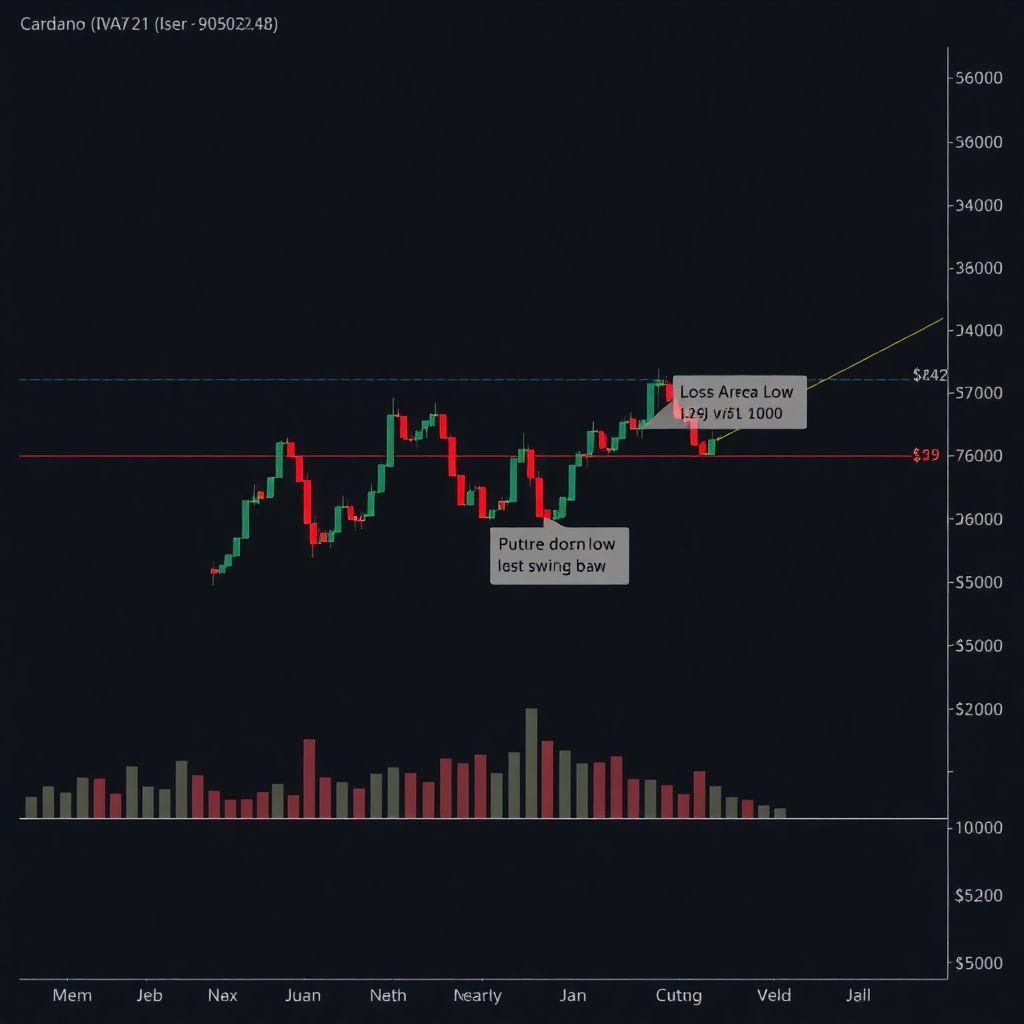
Cardano price maintains bearish bias as technical structure points to further losses
Cardano’s price action continues to lean decisively to the downside, with the broader market structure firmly bearish. Every attempt at recovery has been quickly sold into, producing a clear pattern of lower highs and lower lows that underlines sustained selling pressure and a lack of committed buyers.
Market structure: sellers still dictate the trend
From a structural point of view, ADA remains locked in a downtrend. Each short-lived bounce has failed to reclaim meaningful resistance zones, confirming that upward moves are corrective counter‑trends rather than the start of a new bullish phase. This behavior is typical of markets where sellers are in control and where rallies primarily offer better entry points for shorts rather than evidence of accumulation.
The sequence of consecutive lower swing highs and lower swing lows has not been broken. As long as this pattern persists, the dominant trend remains bearish, and traders are more likely to fade strength than to buy dips aggressively.
Rejection at $0.48 confirms strong supply zone
A key development in the recent move was Cardano’s rejection from the high‑time‑frame resistance near $0.48. After losing this level on the way down, price attempted a classic back‑test. In technical analysis, such a retest often decides whether a breakdown is a fakeout or the start of a deeper leg lower.
In Cardano’s case, the retest failed decisively. Price was pushed back below $0.48, confirming that this zone has turned into a strong supply area where sellers are willing to step in with size. This rejection effectively validated the continuation of the downtrend and signaled that buyers were not strong enough to force a reclaim of lost territory.
Point of Control lost: shift from balance to lower value
Following the rejection from $0.48, ADA briefly stabilized around the Point of Control (POC) of the recent range. The POC marks the price level with the highest traded volume over a given period and often acts as a battlefield where control flips between bulls and bears.
Initially, consolidation around the POC suggested a temporary balance between buying and selling. However, Cardano has since lost acceptance above this level, indicating that the market is no longer comfortable transacting there. Instead, value is migrating lower, which is usually a sign that participants are pricing in weaker conditions rather than a forthcoming recovery.
With the POC now acting as resistance rather than support, any attempts to push back into this area are likely to meet selling interest unless there is a clear shift in volume and momentum.
Rotation toward the Value Area Low – and a weak bounce
Once price fell away from the POC, it gravitated toward the Value Area Low (VAL) of the broader range. The VAL often attracts responsive buyers, as traders look to buy perceived “discount” prices within the established value zone.
Yet, the reaction from this region has been notably subdued. Instead of a sharp, impulsive rebound supported by rising volumes, ADA’s bounce has been shallow and easily contained. This suggests that demand at the VAL is thin and that dip‑buyers lack conviction or firepower.
When the Value Area Low fails to elicit a strong response, it often warns that the market may not be done searching for lower prices. Rather than acting as a durable floor, the VAL in such conditions becomes a stepping stone toward deeper support.
Candlestick behavior confirms seller dominance
On the candlestick level, the narrative is consistent with the broader bearish structure. Upside wicks regularly show that rallies are being sold into, while downside candles often close near their lows, signaling persistent pressure from sellers.
As long as ADA continues to print lower highs beneath previously broken supports, the dominant structure remains bearish. In this context, short‑term relief rallies should be treated with caution, as they have repeatedly failed to transition into a sustainable trend reversal.
Liquidity vacuum below: focus shifts to the $0.27 swing low
Liquidity considerations also reinforce the downside bias. Beneath current prices, there is limited well‑defined structural support until the swing low near $0.27, which marks the lower edge of the larger trading range. Markets frequently move toward such pivotal swing areas to test liquidity and clear out resting orders.
If intermediate support zones continue to attract only weak demand, the path toward this $0.27 region becomes more likely. Importantly, a move to that level would not represent a structural breakdown out of nowhere; it would be a continuation of the existing trend, allowing the market to probe deeper levels of demand before any significant rebalancing.
Why a move to $0.27 would still be “normal” for this cycle
Within the context of Cardano’s current high‑time‑frame structure, a retest of $0.27 would be a logical extension of the prevailing pattern rather than a rare crash event. Downtrends often unfold in stages: breakdown, consolidation, retest of lost support, and then continuation toward prior swing lows.
Such a move would align with:
– The failure to reclaim $0.48
– The loss of the POC
– The weak reaction at the VAL
– The uninterrupted sequence of lower highs
Only after testing deeper demand zones like $0.27 can the market reliably determine whether long‑term participants are willing to step in and absorb supply at scale.
Conditions required to challenge the bearish view
For the bearish narrative to be invalidated, Cardano would need to demonstrate more than just a modest bounce. Key conditions for a potential shift would include:
– A decisive reclaim of lost resistance levels, starting with acceptance back above the POC
– A clear break in the pattern of lower highs, ideally via a strong impulsive move rather than a slow grind
– Increased volume accompanying upward moves, signaling genuine demand rather than short‑covering alone
Until these signals appear, any brief rallies within the current environment are better viewed as corrective phases inside a broader downtrend.
Short‑term outlook: downside risk remains elevated
As long as ADA trades below the Point of Control and continues to register lower highs, the path of least resistance is lower. The muted response at the Value Area Low raises the odds of a full rotation toward the $0.27 swing low, where the next notable liquidity pool resides.
Near term, traders should be prepared for:
– Choppy, corrective rallies that repeatedly fail below key resistance zones
– Potential acceleration to the downside if local supports break on rising volume
– Volatility spikes around prior lows as resting liquidity is tested
The burden of proof is firmly on the bulls to show that the trend is ready to reverse.
What traders and investors can monitor next
To navigate the coming sessions, several technical factors may help gauge whether the downtrend is weakening or strengthening:
– Reaction near intermediate supports: Strong, high‑volume bounces from nearby support would suggest some buyers are returning; weak, labored reactions would support the bearish continuation thesis.
– Behavior around $0.27: If price approaches this swing low, watch for either capitulation (sharp sell‑off followed by a strong reversal) or a controlled grind lower (signaling lingering seller control).
– Market‑wide risk sentiment: Cardano’s moves do not happen in isolation. If broader crypto risk appetite deteriorates, ADA may underperform further; a robust market‑wide rebound could temper the severity of its decline, even if the structural trend stays down for a while.
Longer‑term implications and strategy considerations
For longer‑term participants, the current price action underscores the importance of respecting trend and structure. In persistent downtrends:
– Averaging in blindly can be risky if the market has not yet found a durable bottom.
– Waiting for evidence of stabilization — such as a base forming above a key low, or a clear shift from lower lows to a sideways accumulation range — may offer more favorable conditions.
– Protecting capital via careful position sizing and clear invalidation levels becomes more important than trying to catch every short‑term bounce.
Until Cardano can reclaim critical resistance areas and shift its pattern of lower highs and lows, the dominant message from the charts remains the same: the market is still skewed to the downside, and further weakness, potentially toward the $0.27 region, remains a realistic and technically consistent scenario in the near term.