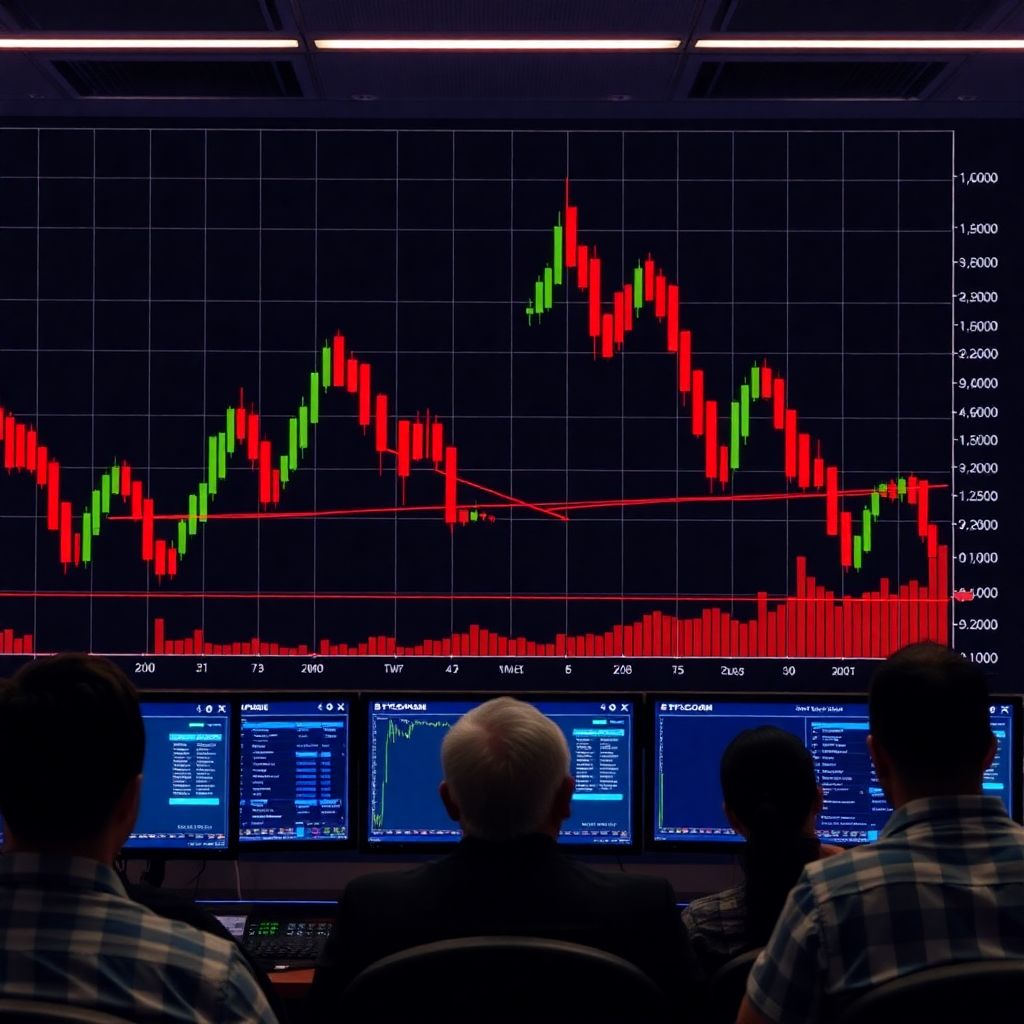
Bitcoin stalls at range high as sellers regain control, raising odds of a slide toward $60,000
Bitcoin is once again losing altitude after failing to break through its upper trading range, with price action rejecting sharply from resistance and restoring a bearish short‑term structure. The latest move underscores how fragile bullish momentum has become, and why the $60,000 area is now back in focus as a realistic downside target.
Rejection at value area high confirms range‑bound market
Over recent sessions, Bitcoin climbed toward the upper boundary of its established range, with key resistance clustered between roughly $69,000 and $72,000. This zone has acted as the “value area high,” where previous rallies have repeatedly stalled.
This latest push higher showed little follow‑through. Price barely probed into the resistance band before sellers stepped in aggressively. Such a shallow and short‑lived test typically signals that supply remains dominant and that buyers are unwilling or unable to commit enough capital to force a genuine breakout. Instead of a healthy consolidation near the highs, the market delivered a swift rejection – a classic warning that upside attempts are running out of steam.
Loss of Point of Control shifts equilibrium lower
The technical picture deteriorated further as Bitcoin slipped below the Point of Control (POC) of the current range – the price level that has hosted the highest traded volume. The POC often behaves as a fair‑value zone where buyers and sellers find temporary balance.
Closing candles below this level indicates the market is now accepting lower prices as the new equilibrium. That acceptance is an important signal: it shifts the short‑term structure from neutral to clearly bearish. When price falls away from the POC and fails to reclaim it quickly, it suggests that any prior accumulation is turning into distribution, with larger players using minor rallies to offload positions rather than build them.
Mid‑range breakdown opens the door to deeper rotation
Bitcoin is also struggling to hold the midpoint of the trading range. Multiple four‑hour closes beneath this mid‑range level confirm that bulls are losing control of what should be a key battleground. In range trading, the mid‑level often acts as a pivot: holding above it favors tests of the highs, while sustained trading below typically precedes moves back toward the lows.
Current behavior aligns with that textbook pattern. Failed attempts to reclaim the mid‑range are increasing the likelihood of a “full rotation” down toward the range floor, now sitting near $60,000. Each failed bounce adds to the impression that rallies are being sold rather than bought.
Bearish market structure: lower highs inside the range
From a structural standpoint, Bitcoin continues to print a series of lower highs within this sideways environment. That pattern is important: even though price is technically still inside a broader consolidation, the internal rhythm of the market is tilting downward.
Markets that repeatedly fail to break resistance have a tendency to seek liquidity in the opposite direction. If bulls cannot absorb supply near the range high, resting buy orders and stop‑losses below the range low become the next logical target. Without a decisive reclaim of the lost volume nodes – particularly the POC and the mid‑range – upward momentum remains capped and downside probes grow more probable.
$60,000 emerges as the critical support battleground
The next major level to watch is the range low around $60,000, a zone that combines horizontal support, psychological significance, and previous high‑volume activity. A move into this area would mark another complete traversal of the current consolidation, something Bitcoin has already done multiple times in recent months.
As long as the broader range remains intact, $60,000 can still function as a valid demand zone where buyers attempt to reassert control. However, technical structures rarely tolerate infinite re‑tests. Each successive visit to a support level tends to weaken it, especially if bounces grow shallower and volume fails to expand on the way up.
What a breakdown below $60,000 would mean
A convincing break beneath $60,000 would represent more than a routine dip; it would mark a meaningful shift in structure. Such a move would:
– Invalidate the current range as reliable support
– Confirm a series of lower highs and now lower lows on higher‑time‑frame charts
– Open the path to deeper downside targets, including prior consolidation zones and untested demand areas below the current range
In this scenario, selling pressure would likely accelerate as long‑held stop‑loss orders trigger and short‑term participants exit. That does not preclude a later recovery, but it would signal that the market has entered a new phase in which bulls have more work to do to restore confidence.
Volume and participation highlight lack of conviction
Volume dynamics back the cautious outlook. The latest rally attempt toward the range high was not accompanied by strong, expanding volume – a red flag for technicians looking for a sustainable breakout. Healthy breakouts tend to come with broad participation and increasingly aggressive buying; instead, Bitcoin’s climb looked more like a low‑energy drift into resistance.
Subsequent price action suggests defensive positioning rather than genuine accumulation. Larger players appear to be managing risk and trimming exposure into strength, creating overhead supply that smothers each attempt higher. Without a meaningful rise in participation and demand, the path of least resistance remains skewed toward lower levels of the range.
Macro backdrop: supportive narrative, fragile price
Interestingly, this short‑term bearish structure is unfolding despite a macro backdrop that still looks broadly constructive for Bitcoin. Institutional demand, growing interest in regulated products, and long‑term narratives around digital scarcity and portfolio diversification remain intact.
However, markets often correct even within larger bullish cycles. Consolidation ranges can last longer than most traders expect, and when sentiment becomes too one‑sided, shakeouts are common. The current structure fits that pattern: fundamentally supportive, yet technically vulnerable in the near term as price digests previous gains.
Key signals that would invalidate the bearish view
For the short‑term bearish bias to fade, bulls need to reclaim specific technical milestones rather than simply hold flat:
– Regain and hold the range midpoint with consistent closes above it
– Recover the Point of Control and establish it again as a support base rather than resistance
– Break the pattern of lower highs with a strong push that absorbs selling near $69,000-$72,000
– Show expanding volume and momentum on any upward move, confirming fresh demand
If these conditions start to align, the risk of a deep drop toward or below $60,000 would diminish, and the market could transition back into a more balanced or even bullish environment.
Trading implications: scenarios for bulls and bears
For bulls, the current environment demands discipline. Chasing price near resistance has repeatedly been punished, while the more rational strategy in a range has been to wait for entries closer to established support. Should Bitcoin reach the $60,000 area with signs of exhaustion in selling (wicks on candles, declining downside volume, momentum divergence), risk‑managed long setups could emerge for swing traders.
For bears, the structure currently favors patience as well. The cleanest opportunities often appear on rallies back into broken support zones – which can flip into resistance – rather than at the very lows. Short setups become more compelling if Bitcoin continues to reject the mid‑range and the POC on any bounce, reinforcing the idea that those levels have turned into supply.
Risk management in a volatile range
Regardless of bias, the most important factor in this type of environment is risk control. Ranging markets can whipsaw both sides, punishing late entries and overleveraged positions. Traders may consider:
– Reducing position size relative to strong trending periods
– Placing stops beyond key structural levels instead of tight, easily hunted zones
– Avoiding emotional decisions around range extremes, where fake breakouts are common
– Focusing on clearly defined setups, rather than trading every minor move
Preserving capital through the chop is often more valuable than trying to capture every rotation within the range.
Outlook: cautious until proven otherwise
As it stands, Bitcoin’s short‑term outlook leans bearish. Price is trading below both the range midpoint and the Point of Control, lower highs continue to form, and attempts to break higher have lacked conviction and volume. This constellation of signals keeps the probability skewed toward further downside, with $60,000 emerging as the key level where the next significant reaction is likely to develop.
Until bulls can reclaim lost territory and flip critical levels back into support, Bitcoin remains exposed to deeper exploration of its lower range – and, if $60,000 gives way, to a more substantial corrective phase.