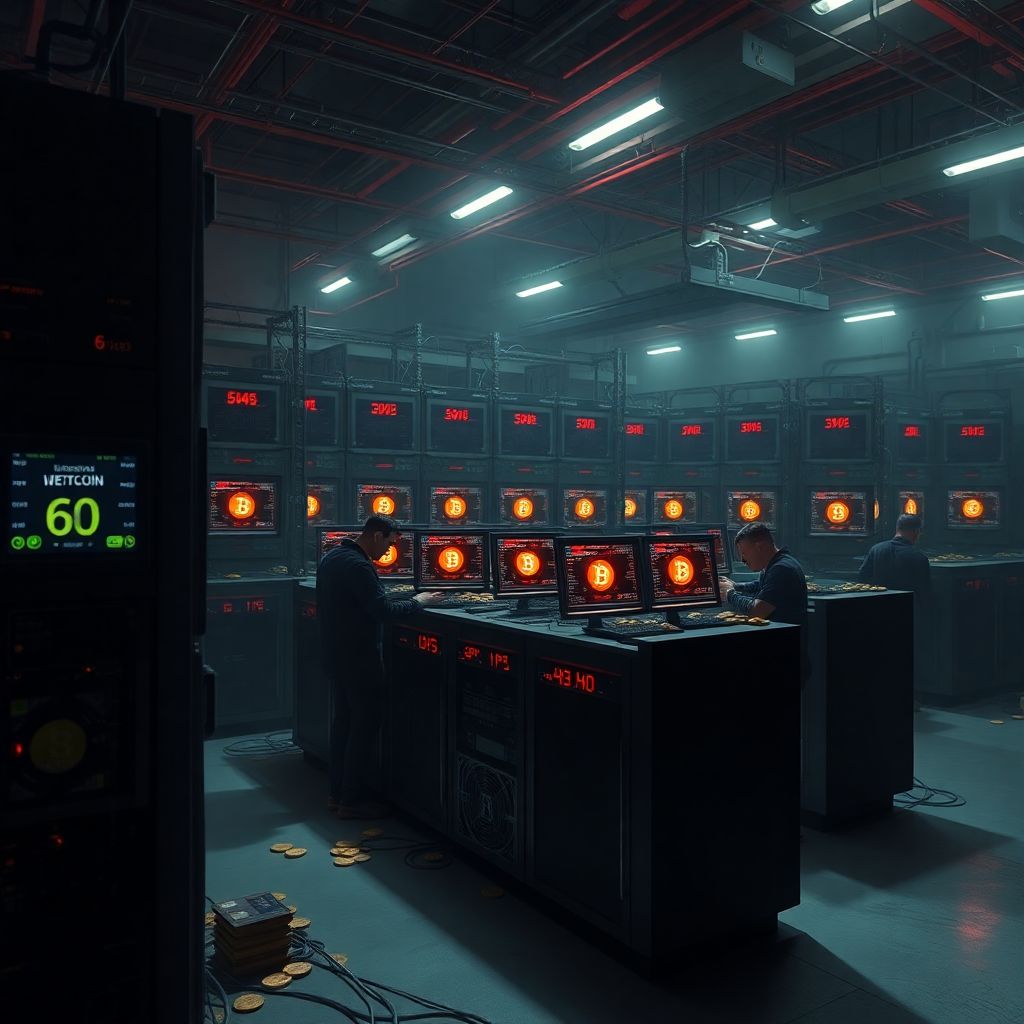
Bitcoin miners are selling: is capitulation here?
Publicly listed Bitcoin miners are unloading coins at an unprecedented pace, hashprice has fallen to fresh post‑halving lows, and older rigs are being powered down across the network. By most traditional definitions, that combination looks like classic miner capitulation.
What remains far less clear is whether this flush‑out is signaling a durable bottom, or whether it is only the opening act of a longer, more painful restructuring of the mining industry.
—
Why miners matter so much to Bitcoin’s cycle
Miners are often viewed as the market’s “strongest hands.” They invest heavily in hardware, power contracts, infrastructure, and personnel to produce Bitcoin. Historically, many of them have chosen to hold a portion of their output, treating mined BTC as a strategic treasury asset rather than just inventory to be sold.
When those same operators suddenly become aggressive sellers and start shutting down capacity, it usually means that the economics of production have broken down. That is precisely what has unfolded through the first half of 2026.
– Public miners sold more Bitcoin than in any previously recorded quarter.
– Hashprice has slid to lows not seen since the most recent halving.
– Network hashrate, after years of near‑relentless growth, has started to edge down as older, less efficient machines go offline.
Understanding why this is happening – and what it really means – is essential, because miners operate where several key forces intersect: Bitcoin’s price, electricity costs, network difficulty, debt obligations, and treasury strategy.
All of this is playing out against a backdrop of exhausted sentiment. Many traders and long‑term holders are already bruised by drawdowns, which makes every “capitulation” headline feel like either the final washout or another false dawn.
—
The record‑breaking wave of miner selling
The numbers from public mining companies are stark.
Across major listed players such as Marathon Digital (MARA), CleanSpark, Riot Platforms, Cango, Core Scientific, Bitdeer, and others, total Bitcoin sold in the first quarter of 2026 exceeded 32,000 BTC, based on company disclosures and industry estimates.
Key points:
– That 32,000 BTC figure set a new single‑quarter record for public miners.
– It surpassed the amount those same firms sold over the entire year of 2025.
– It also exceeded the roughly 20,000 BTC they collectively sold in Q2 2022, which had been remembered as a peak‑stress period during the bear market that followed the Terra‑Luna collapse.
This is not simply a case of miners immediately selling what they mine. In many cases, they are drawing down strategic reserves that were intentionally accumulated during earlier phases of the cycle.
Company‑level examples paint an even clearer picture
– Riot Platforms reported selling 3,778 BTC in the first quarter at an average price around 76,626 dollars, bringing in nearly 289.5 million dollars. Over the same period, it mined only 1,473 BTC. In other words, it sold more than twice its new production, dipping into previously held coins.
– Core Scientific liquidated roughly 1,900 BTC in January alone, worth about 175 million dollars at the time, as it focused on strengthening its balance sheet and navigating post‑restructuring obligations.
– Cango offloaded approximately 2,000 BTC in March for around 143 million dollars and used a meaningful portion of the proceeds to repay Bitcoin‑backed loans and reduce leverage.
In a single week, Marathon Digital, along with a couple of smaller listed miners, disclosed cumulative sales above 15,000 BTC, with Marathon representing the bulk of that volume. Importantly, much of this selling came not from newly mined coins but from treasury stacks that management had previously been reluctant to touch.
On‑chain and reporting‑based metrics that track “miner reserves” – the total BTC held by entities identified as miners – confirm this trend. Since late 2023, aggregate miner holdings have drifted down from above roughly 1.86 million coins to around 1.8 million by mid‑2026.
What started as periodic balance‑sheet optimization has turned into a persistent drawdown, intensifying as price pressure mounted.
—
The profit squeeze: hashprice at post‑halving lows
The immediate driver of this selling wave is a deep compression in mining profitability.
The central metric here is hashprice – the amount of revenue a miner earns per unit of computing power (for example, per petahash per day). Hashprice bundles together the effects of:
– Bitcoin’s market price
– Block subsidy (which halves roughly every four years)
– Transaction fees
– Network difficulty and hashrate
Since mid‑2025, hashprice has been on a steady downward trajectory. By the first half of 2026, it had fallen to new post‑halving lows, dipping into the high‑20‑dollar range per petahash per day on some industry dashboards – a decline of roughly two‑thirds from the local peak seen in October 2025.
Many miners still operating older or mid‑tier rigs have breakeven costs clustered around 35 dollars per petahash per day, or higher if they are stuck with expensive power or legacy hosting contracts. With realized hashprice sitting stubbornly below that line, a sizable slice of the industry has been operating at or below cash‑flow breakeven.
At periods earlier in the year, estimates suggested that as much as 20% of the network hashrate was coming from machines that were unprofitable or marginally profitable under prevailing conditions. In practice, this leads to a few rational responses:
– Turning off the most inefficient hardware.
– Redirecting some capacity to alternative revenue streams (for example, high‑performance computing for AI workloads).
– Selling BTC reserves to cover operating expenses, debt payments, and hardware upgrades.
The halving exacerbated this dynamic by cutting block rewards in half overnight, while fixed costs – power, maintenance, labor, and facilities – barely moved.
—
What miner capitulation actually means
“Capitulation” is one of the most misused words in crypto, so it is worth defining precisely in the context of miners.
Miner capitulation typically refers to a period when:
1. Revenue compresses sharply (falling hashprice).
2. Inefficient miners are forced to unplug rigs, leading to stagnation or decline in network hashrate.
3. Miners sell more Bitcoin than they produce, drawing down reserves to stay afloat or restructure.
4. Market sentiment around mining turns decisively negative, with fears of bankruptcies and fire‑sale liquidations.
Crucially, capitulation is not just about selling. Miners are always selling to some degree; it is how they pay for electricity. The defining feature is the combination of:
– Abnormally high selling relative to production and historical norms.
– A visible contraction in hashrate and network security horsepower from certain segments.
– Signals that operators are under financial duress rather than simply monetizing profit.
In the current cycle, all three elements are present to some extent. Profit margins have been crushed, public miners are tapping deep into their treasuries, and pockets of older hardware are going dark.
—
The bullish interpretation: capitulation as a bottom signal
Optimists point to history. In several prior cycles, clear miner capitulation events have coincided with, or slightly preceded, major Bitcoin bottoms.
The logic behind this bull case:
1. Forced sellers eventually run out of ammo.
When over‑levered or high‑cost miners have exhausted their BTC reserves and switched off unprofitable rigs, selling pressure from that group naturally declines.
2. Difficulty adjusts downward.
As inefficient miners unplug, network difficulty falls. This raises real‑world profitability for the remaining, more efficient operators, helping to stabilize the mining sector.
3. Survivors become stronger holders.
The miners who remain are generally those with low power costs, efficient hardware, disciplined balance‑sheet management, and better access to capital. These entities are more likely to be selective sellers and long‑term aligned.
4. Market narrative often flips from fear to resilience.
Narratives drive flows. Once investors start to believe “the weak hands are gone,” capital can re‑enter both spot BTC and mining equities, providing a tailwind to price.
From this perspective, the current wave of sales and shutdowns could be interpreted as a necessary cleansing: an industry purge that clears out the least competitive participants and eventually sets the stage for a more sustainable uptrend.
—
The bearish interpretation: a structural squeeze, not just a flush‑out
Skeptics counter that this time may be different, not because the laws of supply and demand have changed, but because the structure of the mining industry has evolved.
Several arguments underpin the bear case:
1. Higher fixed costs and institutionalization.
Today’s leading miners operate at industrial scale, with long‑term power contracts, substantial debt, and shareholder expectations. Unwinding or renegotiating these commitments is slower and more complex than in earlier cycles when smaller, more nimble operators dominated.
2. Intensifying global competition.
Mining has spread across multiple jurisdictions with ultra‑low power costs, state‑backed energy deals, and vertically integrated infrastructure. High‑cost miners in less favorable regions face structural disadvantages that cannot be solved simply by waiting for price to rise.
3. Persistent margin pressure from AI and data‑center demand.
The surge in demand for power‑hungry AI computing has driven up energy prices in some regions and increased competition for high‑quality data‑center space. Miners are often outbid by AI and cloud‑computing clients willing to pay more for the same electrons and square footage.
4. Public‑company constraints.
Listed miners must answer to public investors and regulators. Aggressive treasury‑holding strategies that were celebrated in earlier cycles are now judged against traditional metrics like return on capital and risk‑adjusted cash flows. This pressures management teams to adopt more predictable selling and hedging behaviors.
From this vantage point, the current capitulation is not simply a washout on the way to a “business‑as‑usual” recovery. Instead, it may represent an industry re‑rating, where only a narrow band of ultra‑efficient miners survive as pure Bitcoin producers, while others either pivot or gradually scale down.
—
The AI pivot: capitulation or reinvention?
A striking feature of the 2026 miner narrative is the growing overlap between Bitcoin mining and AI computing.
Some miners are repurposing or co‑locating their infrastructure to provide:
– High‑performance computing (HPC) for AI training and inference.
– GPU‑based workloads for machine‑learning companies.
– Mixed‑use data‑center services blending mining and cloud hosting.
This raises an important question: are we witnessing miner capitulation, or a strategic reinvention of the business model?
On the one hand, the AI pivot can look like capitulation: a tacit admission that pure‑play Bitcoin mining, under current economics, cannot deliver acceptable returns on the invested capital. When a miner converts part of its facility into an AI data center, it is effectively reallocating resources away from Bitcoin’s security budget.
On the other hand, diversification can be seen as an adaptive strategy:
– It provides alternative revenue streams that are less tied to Bitcoin’s price.
– It can stabilize cash flows, making it easier to service debt and finance new hardware.
– It may allow miners to keep some Bitcoin‑focused capacity alive through downturns that would otherwise force a complete shutdown.
Whether this trend strengthens or weakens Bitcoin over the long term depends on how far it goes. A moderate pivot might make leading miners more resilient, able to weather bear markets without dumping as much BTC. A full‑scale exodus into AI and HPC, however, would shrink the pool of dedicated mining capital – potentially leaving the network more exposed to future shocks.
—
The divergence that really matters
Beneath the short‑term noise, one divergence is becoming increasingly important: the gap between low‑cost, well‑capitalized miners and high‑cost, debt‑burdened operators.
Key characteristics of the survivors:
– Access to very cheap and reliable energy (hydro, stranded gas, surplus renewables, or long‑term fixed‑rate power deals).
– Modern, highly efficient ASIC fleets with aggressive upgrade cycles.
– Nimble treasury strategies that blend BTC holding with disciplined profit‑taking and occasional hedging.
– Lower leverage ratios and more flexible financing structures.
These entities are better positioned not only to survive capitulation events but to benefit from them. When competitors shut down or liquidate hardware, survivors can:
– Acquire rigs and facilities at distressed prices.
– Capture a larger share of the network hashrate once difficulty adjusts downward.
– Accumulate BTC at lower effective costs.
For investors trying to read the cycle, this divergence matters more than the headline hashrate number. A modest decline in total network hashrate might be less important than the fact that the remaining hashrate is increasingly concentrated in the hands of the most robust players.
—
What to watch next
Several indicators can help gauge whether this miner capitulation is nearing its end or still has room to run:
1. Hashprice stabilization or rebound
A sustained move higher in hashprice – driven by BTC price appreciation, rising fee revenue, or difficulty reductions – would ease the pressure on miners and reduce forced selling.
2. Difficulty and hashrate trends
– A sharp and prolonged drop in hashrate followed by stabilization can signal that most unprofitable rigs have already exited.
– Repeated small difficulty decreases may indicate a longer, more drawn‑out shakeout.
3. Miner treasury behavior
Watch whether miners continue selling more BTC than they produce. A shift back toward neutral or net accumulation (even if modest) would suggest the worst of the liquidity stress has passed.
4. Balance‑sheet announcements from public miners
Updates on debt reduction, refinancing, equity raises, or major capex cuts can tell you whether miners are still in triage mode or entering a rebuilding phase.
5. Sector rotation into or out of AI and HPC
Large commitments to AI infrastructure, especially if accompanied by reductions in Bitcoin‑specific capacity, would support the view that parts of the industry are structurally repositioning away from mining.
—
Frequently asked questions
Why are Bitcoin miners selling so much Bitcoin?
Miners are selling aggressively because their margins have been squeezed by a combination of:
– Lower hashprice (less revenue per unit of compute).
– The halving, which cut block rewards.
– Elevated operating costs, particularly power.
– Existing debt and financial commitments that cannot be deferred easily.
To keep facilities running, pay staff, service loans, buy new hardware, and in some cases pivot into higher‑margin businesses, they are drawing down BTC holdings accumulated in earlier, more profitable periods.
—
How much Bitcoin did miners sell in 2026?
Publicly traded miners alone sold more than 32,000 BTC in the first quarter of 2026, setting a new record for a single quarter. That figure exceeds their total combined sales for all of 2025 and is materially higher than the volumes sold during some of the worst stress events in prior bear markets.
If private and smaller‑scale miners were included, total industry‑wide selling would be significantly larger, though harder to quantify precisely.
—
What is miner capitulation?
Miner capitulation is a phase in the market cycle when:
– Mining profitability collapses.
– Inefficient miners shut down rigs.
– Operators sell more BTC than they mine, often dipping heavily into reserves.
– The sector experiences visible distress, from asset liquidations to restructuring.
It is essentially a purge of the weakest participants in the mining ecosystem, triggered by adverse economics.
—
Does miner capitulation mean the price has bottomed?
Not automatically – but historically, pronounced miner capitulation has often coincided with, or slightly preceded, major market bottoms.
The logic is that once the most stressed miners have liquidated their BTC and shut down, there are fewer forced sellers left. That does not guarantee an immediate price reversal, but it can remove a major overhang of supply.
However, each cycle is shaped by its own macro backdrop, regulatory environment, and industry structure. In the current cycle, the added complexity of AI competition, institutional balance‑sheet constraints, and higher fixed costs means that the “capitulation equals bottom” rule of thumb should be applied cautiously rather than blindly.
—
What is hashprice and why does it matter?
Hashprice measures how much revenue a miner earns for each unit of computing power deployed to the Bitcoin network, usually expressed as dollars per petahash per day.
It captures the combined effect of:
– Bitcoin’s price
– Block subsidy
– Transaction fees
– Network difficulty and total hashrate
Hashprice matters because it directly reflects miners’ ability to cover costs and generate profit. When hashprice falls:
– High‑cost miners struggle or become unprofitable.
– Treasury selling tends to increase.
– Some hardware becomes economically obsolete and is turned off.
Sustained low hashprice is one of the primary ingredients of miner capitulation.
—
Are miners capitulating or pivoting to AI?
Both dynamics are happening, often within the same companies.
Some miners are:
– Selling BTC at record levels.
– Shutting down legacy or inefficient hardware.
– Reducing pure Bitcoin exposure to survive the downturn.
At the same time, others are:
– Converting parts of their facilities into AI or general‑purpose computing centers.
– Signing contracts to host GPU clusters for machine‑learning workloads.
– Rebranding themselves as broader digital infrastructure or HPC companies.
Whether you label this as capitulation or reinvention depends on perspective. For the Bitcoin network, what matters is how much dedicated mining capacity remains and how committed those operators are to the long‑term security of the chain.
—
How does this capitulation compare to past cycles?
In previous downturns, miner capitulation often involved:
– Smaller, less professional operators.
– Lower absolute levels of capital at risk.
– More flexible exit and re‑entry paths.
In the current cycle:
– The absolute scale of investment in infrastructure, hardware, and power is much larger.
– Publicly listed companies with complex capital structures are heavily involved.
– Competition from alternative uses of power (especially AI) is much more intense.
This makes the 2026 capitulation both bigger in nominal terms and more structurally significant. It is not just about who survives this price level, but about what business models survive.
—
What signals would show that capitulation is ending?
Some of the clearest signs that miner capitulation is winding down would include:
– Hashprice bottoming and turning up for a sustained period, rather than brief spikes.
– Stabilization or gradual recovery in network hashrate after a period of decline.
– Public miners reporting neutral or positive BTC accumulation, instead of consistent net selling.
– Declines in distressed asset sales and bankruptcy headlines, along with more measured capex plans.
– Narrative shift from survival to growth, reflected in management commentary and investor interest.
When several of these indicators align, it is a strong hint that the most acute phase of the miner squeeze has passed, even if broader market conditions remain choppy.
—
Miner capitulation is painful to watch, especially for those directly invested in the sector. But it is also a key mechanism by which Bitcoin’s mining ecosystem periodically resets, redistributing hashpower from weaker to stronger hands. Whether 2026’s iteration marks a durable bottom or the beginning of a more fundamental reshaping of the industry will depend on how quickly hashprice recovers, how far the AI pivot goes, and how effectively surviving miners adapt to a more competitive, capital‑intensive reality.