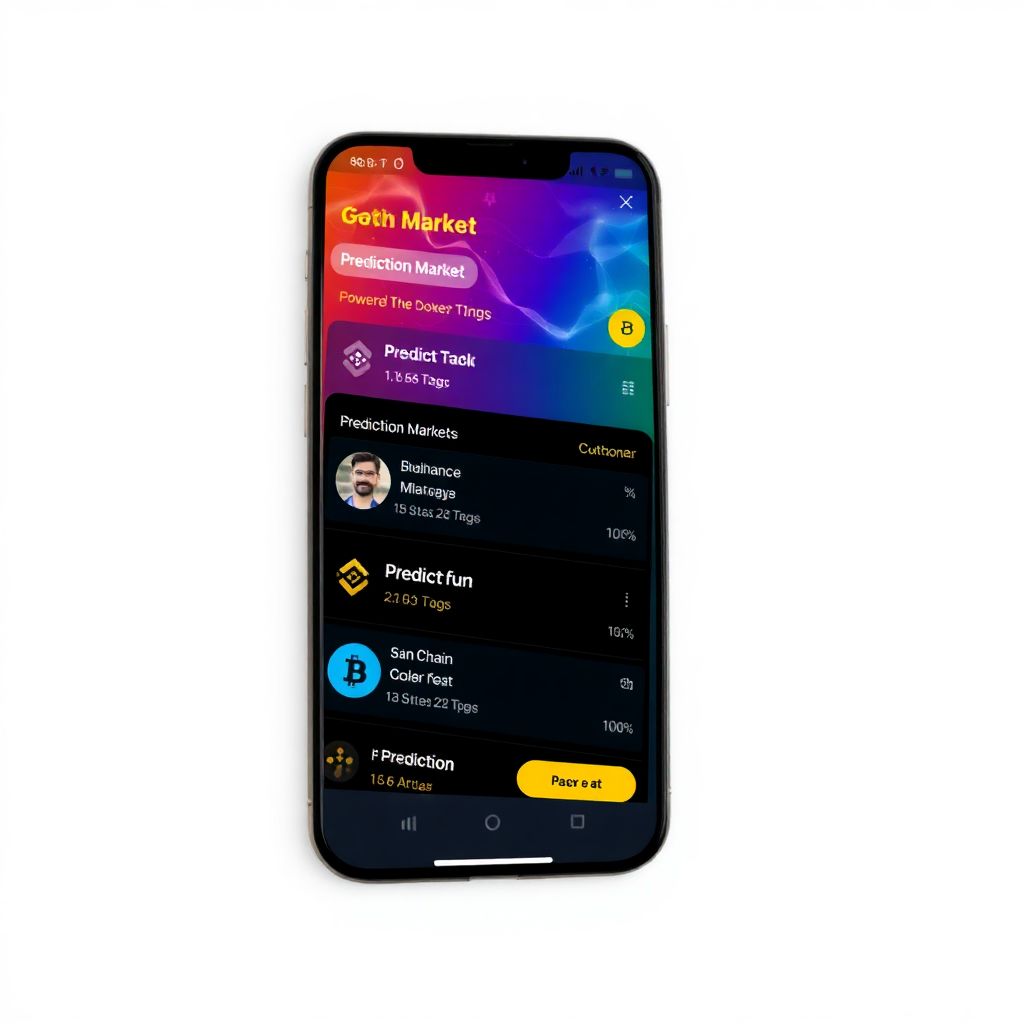
Binance Wallet brings on-chain prediction markets directly into its app through a new third‑party integration, giving users a way to interact with decentralized markets without leaving the familiar Binance environment.
The feature, now live after an earlier beta phase, is part of Binance Wallet’s broader push to lower the barrier to on-chain participation. Instead of requiring users to navigate external decentralized applications and interfaces, prediction market access is embedded within the existing wallet flow for eligible users.
Under the new setup, Binance Wallet connects users to markets operated by Predict.fun, described as the largest prediction market provider on BNB Smart Chain. Binance Wallet handles the user-facing experience – navigation, display, and transaction flow – while all trading, settlement, and contract logic run directly on-chain via Predict.fun’s smart contracts. Event creation, pricing mechanisms, and resolution rules remain fully controlled by Predict.fun.
Prediction markets are platforms where participants can trade on the likelihood of future events. These events span multiple categories, including sports, esports, macroeconomics, global politics, culture, and cryptocurrency developments. Contracts in such markets are typically quoted as probabilities: each outcome trades between roughly $0.01 and $0.99, with the price reflecting the crowd’s implied odds that a given scenario will occur. After the real‑world outcome is known, contracts are settled according to the predefined rules set by the market operator – in this case, Predict.fun.
By integrating these markets into Binance Wallet, Binance aims to channel its large user base toward on-chain activity that might otherwise remain niche or difficult to access. A smoother entry path can increase participation, deepen liquidity, and lead to more efficient pricing in prediction markets over time, as a greater number of traders contribute their views and capital.
The move also fits into Binance’s stated ambition to evolve its app into a kind of crypto “super app,” where users can handle centralized exchange functions, self‑custody, and a growing catalog of decentralized use cases in one place. Prediction markets become another module in this ecosystem, sitting alongside token swaps, yield features, and other DeFi tools available via Binance Wallet.
“With this integration, we’re making it simpler for users to access another on-chain utility using a familiar and secure in-app experience,” said Winson Liu, Global Lead of Binance Wallet. “It’s part of our wider effort to make Binance more useful in everyday life by cutting down friction and widening the spectrum of on-chain use cases users can tap into through Binance Wallet.”
Binance Wallet itself is a self‑custody wallet embedded in the main Binance application. It is designed as a gateway to decentralized finance and blockchain-based applications, allowing users to hold their own keys, manage a range of cryptocurrencies, conduct token swaps across multiple networks, interact with dApps, and seek yield opportunities across supported ecosystems. Unlike a traditional exchange account, a self‑custody setup gives users direct control over their assets – but also places full responsibility for security and transaction decisions in their hands.
The newly added prediction market access is structured so that Binance Wallet primarily serves as the front end, while the underlying risk, pricing, and settlement sit entirely on-chain. That separation is important from both a design and user-education standpoint: Binance Wallet does not run the prediction markets or determine their outcomes; it provides a streamlined door to a third‑party protocol that operates according to its own rules and smart contracts.
From a user-experience perspective, the integration is meant to feel like any other in-app feature. Eligible users can browse events, view odds, and place positions without switching to a browser or manually connecting an external Web3 wallet. This can be especially meaningful for users who are curious about DeFi but find traditional decentralized interfaces intimidating, cluttered, or technically complex.
At the same time, anyone engaging with prediction markets should recognize that these environments carry significant financial risk. Market prices move with new information, crowd sentiment, and liquidity flows; there is no guarantee of profit, and participants can lose their entire stake on any given event. Outcomes are also dependent on how events are defined and resolved, as specified by the protocol’s rule set, so understanding those terms is an essential part of responsible participation.
In theory, well‑functioning prediction markets can serve as information aggregators, turning dispersed opinions into tradable probabilities about future events. Supporters argue that these markets can generate real‑time signals around elections, sports results, macroeconomic indicators, or tech developments, sometimes reacting faster than traditional media narratives. Integrating such tools into a mainstream wallet could expose a much wider audience to these mechanisms and potentially deepen the data they provide.
For Binance Wallet users, the integration may also act as a bridge from passive holding to more active on-chain engagement. A user who initially opens a position on a sporting event, for example, might subsequently explore other DeFi products available within the wallet – liquidity pools, staking, or other dApps accessible through the same interface. In this sense, prediction markets function not only as a standalone feature but as an onboarding funnel into the broader Web3 landscape.
From a technical standpoint, routing prediction market activity through on-chain smart contracts preserves the core ethos of decentralized finance. Trades, positions, and settlements are recorded on the blockchain, and users interact with immutable code rather than a centralized book. This can provide transparency into how markets operate – order flows, price histories, and resolution outcomes can be inspected on-chain – although reading that data still requires some level of blockchain literacy.
Security remains a critical concern. While self‑custody wallets offer control, they also expose users to phishing attacks, malicious contracts, and operational mistakes such as sending funds to the wrong address. Integrations like this can mitigate some friction by reducing the need to jump between multiple interfaces, but they do not remove the underlying risks of interacting with smart contracts. Users still need to verify what they are signing, understand that every on‑chain transaction is irreversible, and maintain strict security over their seed phrases and devices.
Regulatory considerations also form part of the backdrop to any prediction market expansion. Different jurisdictions may treat prediction markets as speculative products, gaming, derivatives, or something in between, and access may vary based on location and local rules. The reference to “eligible users” underscores that availability is not necessarily global and can depend on compliance constraints.
Strategically, integrating third‑party protocols into a mainstream wallet signals how centralized and decentralized models are increasingly overlapping. Rather than expecting users to abandon familiar apps to explore DeFi, major platforms are weaving on-chain utilities into curated experiences. This hybrid approach may define the next phase of crypto adoption: centralized platforms providing strong UX and support, while value transfer and market logic migrate to decentralized infrastructure under the hood.
For developers and ecosystem builders, the move can be seen as a proof point that prediction markets have matured enough to be surfaced alongside more established DeFi primitives like swaps and lending. As liquidity and user numbers grow, protocols such as Predict.fun could potentially experiment with more complex event types, cross‑market hedging tools, or integrations with AI and data analytics to refine pricing and risk models.
For users, however, the core message remains straightforward: Binance Wallet now offers access to on-chain prediction markets inside the app, powered by a third‑party protocol on BNB Smart Chain. Participation is voluntary and inherently risky, and each individual must independently assess whether such markets fit their risk tolerance and objectives.
All information around this integration is intended for educational purposes only and should not be interpreted as investment, trading, or financial advice. Participants should carry out their own research, fully understand how on-chain prediction markets operate, and carefully evaluate the risks before interacting with any related products or smart contracts.