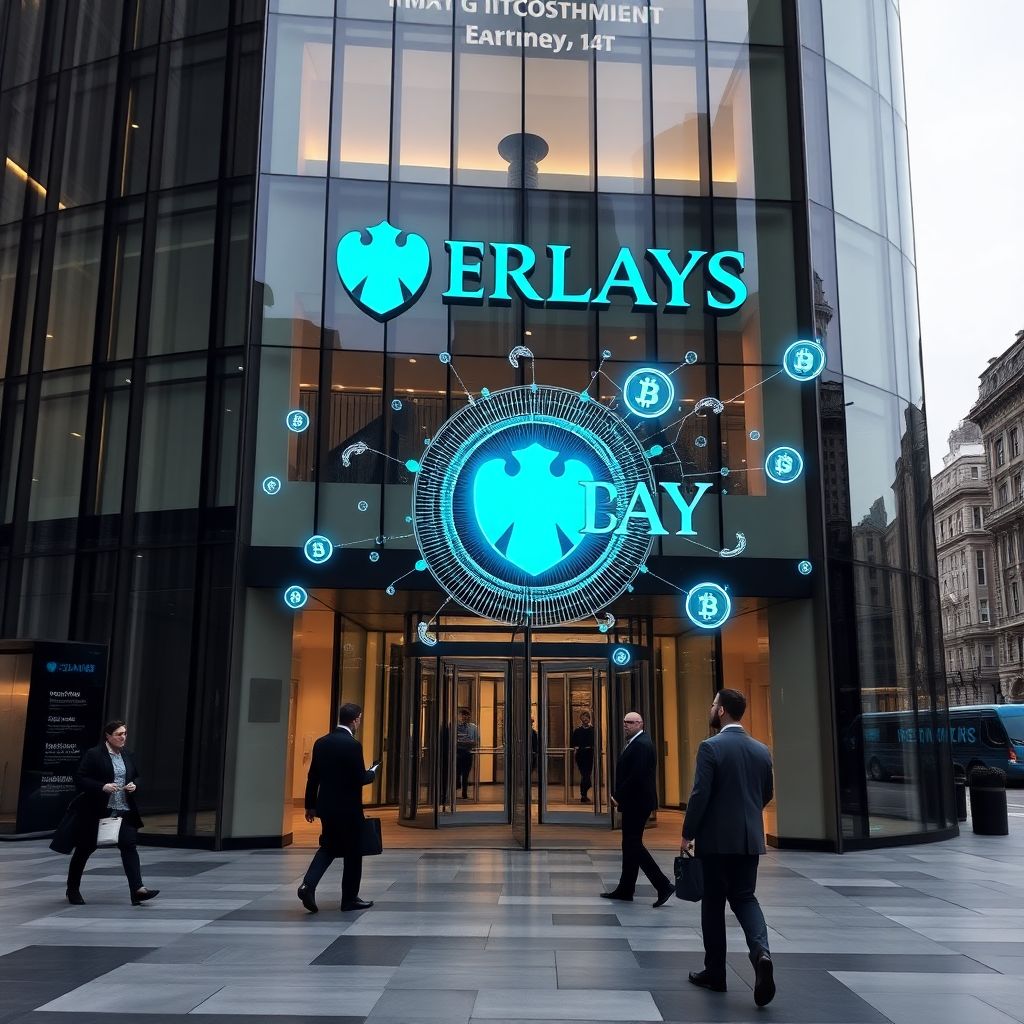
Banking powerhouse Barclays is weighing a significant expansion into crypto-enabled payments and deposits, according to a report citing people familiar with the bank’s plans. The London‑based institution, whose shares trade under the ticker BCS, is said to be actively collecting information from technology providers as it maps out a broader blockchain strategy.
Barclays quietly tests the crypto waters
Rather than launching consumer-facing products immediately, Barclays has reportedly issued requests for information to a range of “technology suppliers.” The goal is to understand what infrastructure would be required to support blockchain-based services inside a heavily regulated banking environment.
Among the options being examined are tokenized deposits and bank-issued stablecoins. Both would represent a move beyond simple experimentation and into the practical use of distributed ledger technology to move value, settle transactions, and potentially serve clients directly.
From cautious observer to active participant
Barclays has historically taken a relatively conservative stance toward public cryptocurrencies, but the bank has become more visibly engaged with digital assets over the past year.
The bank has invested in Ubyx, a startup focused on stablecoin settlement, signaling that it sees stable-value digital tokens as a potentially important part of future payment rails. Barclays was also listed last autumn among a group of global banks exploring the joint issuance of a stablecoin, indicating that collaboration rather than a go‑it‑alone approach may be the preferred route.
These moves suggest a strategic pivot: instead of merely observing the crypto market from the sidelines, Barclays is now positioning itself to help build the underlying plumbing for institutional-grade digital money.
Why tokenized deposits matter for banks
Tokenized deposits are essentially traditional bank deposits represented as digital tokens on a blockchain or similar ledger. Unlike independent cryptocurrencies, these tokens are fully backed by funds held within the bank’s balance sheet and are subject to existing banking regulation.
For a bank like Barclays, tokenized deposits offer several potential advantages:
– Faster and cheaper settlement compared to legacy payment systems
– Programmable money features, such as conditional or automated transfers
– Easier integration with emerging digital asset markets and tokenized securities
– The ability to operate in a blockchain environment while staying within regulatory frameworks
If Barclays proceeds, it could allow corporate clients-and eventually retail customers-to move tokenized balances across networks in near real time, while still enjoying the protections attached to traditional deposits.
Stablecoins in a regulated wrapper
Stablecoins are another component under review. Unlike tokenized deposits, which remain squarely within a single bank’s ledger, stablecoins can, in principle, circulate more freely across platforms and wallets.
A bank-issued stablecoin from Barclays would likely be tightly regulated, tied to fiat reserves, and designed primarily for institutional and commercial use-such as cross-border payments, on-chain settlement of securities, or treasury management. That would distinguish it from many existing stablecoins that grew out of the crypto-native ecosystem and have had to retrofit compliance.
For regulators and large corporates, a stablecoin backed by a systemically important bank may be more palatable than tokens issued by relatively young fintech firms or crypto exchanges.
Strategic timing amid evolving regulation
Barclays’ exploration comes as the U.K. refines its approach to digital assets and stablecoins. Policymakers have signaled an interest in supporting innovation while keeping systemic risk in check. For large lenders, this regulatory backdrop opens a window: move early enough to shape the market, but not so early that they run ahead of clear rules.
By starting with information-gathering and partnerships, Barclays can adapt quickly once the regulatory environment for tokenized deposits and stablecoins is precisely defined. This measured approach lets the bank test technology, build internal expertise, and assess demand without committing to a full-scale rollout prematurely.
Competitive pressure from peers and fintechs
Global rivals are already piloting similar concepts. Several major banks have tested their own tokenized cash instruments and blockchain settlement systems, while payment giants and fintech firms continue to encroach on territory once dominated by traditional lenders.
If Barclays delays too long, it risks ceding ground in areas like cross‑border payments, instant settlement, and digital asset custody. By contrast, being among the first U.K. high‑street banks to offer robust blockchain-based payment options could strengthen its appeal to corporates, fintech partners, and high-net-worth clients seeking regulated digital asset services.
Building the plumbing, not chasing hype
The emphasis on infrastructure rather than speculative trading is notable. Instead of pushing retail customers toward buying volatile cryptocurrencies, Barclays appears focused on how blockchain can modernize the core rails of finance-deposits, payments, and settlement.
This aligns with the view expressed by Ryan Hayward, Barclays’ Head of Digital Assets, who has stressed the importance of specialized technology in bridging the gap between traditional institutions and new forms of digital value. According to him, such technology will be central to building the connectivity and infrastructure that allow regulated firms to interact seamlessly in a tokenized economy.
What this could mean for customers and markets
If the bank ultimately rolls out blockchain-based products, several practical changes could follow:
– Faster cross-border transfers: Corporate clients might be able to move funds internationally in minutes rather than days.
– On-chain settlement for capital markets: Trades in tokenized bonds, funds, or other securities could settle nearly instantly using tokenized deposits or a Barclays-backed stablecoin.
– Integrated digital asset services: Over time, the bank could bundle custody, payments, and liquidity management for digital assets under one roof, giving clients a single, regulated counterparty.
For the wider crypto market, a deeper move by Barclays into tokenization and stablecoins would reinforce the trend of traditional finance co‑opting blockchain infrastructure, potentially narrowing the gap between “crypto” and mainstream banking.
Risks and unanswered questions
Despite the apparent momentum, Barclays has not publicly committed to launching any specific product, and several key questions remain:
– Will the bank focus on private, permissioned blockchains or tap into public networks?
– How will it manage compliance, especially around anti‑money laundering and sanctions, in a tokenized environment?
– Will any eventual offerings be limited to institutional clients, or will they trickle down to retail users?
The answers will shape how transformative this initiative ultimately becomes. A limited, institution-only rollout would still be significant for capital markets, while a broader offering could alter how everyday customers interact with digital money in the U.K.
A pivotal moment for bank-led digital money
Barclays’ exploration of crypto-enabled payments and tokenized deposits underscores a shift in how large banks view blockchain: less as a threat from the fringes and more as an infrastructure layer they can harness and help standardize.
If the bank moves from exploration to execution, it could accelerate the mainstreaming of tokenized money within regulated finance, raise competitive pressure on other institutions to follow suit, and further blur the line between “traditional” and “crypto-native” payments.