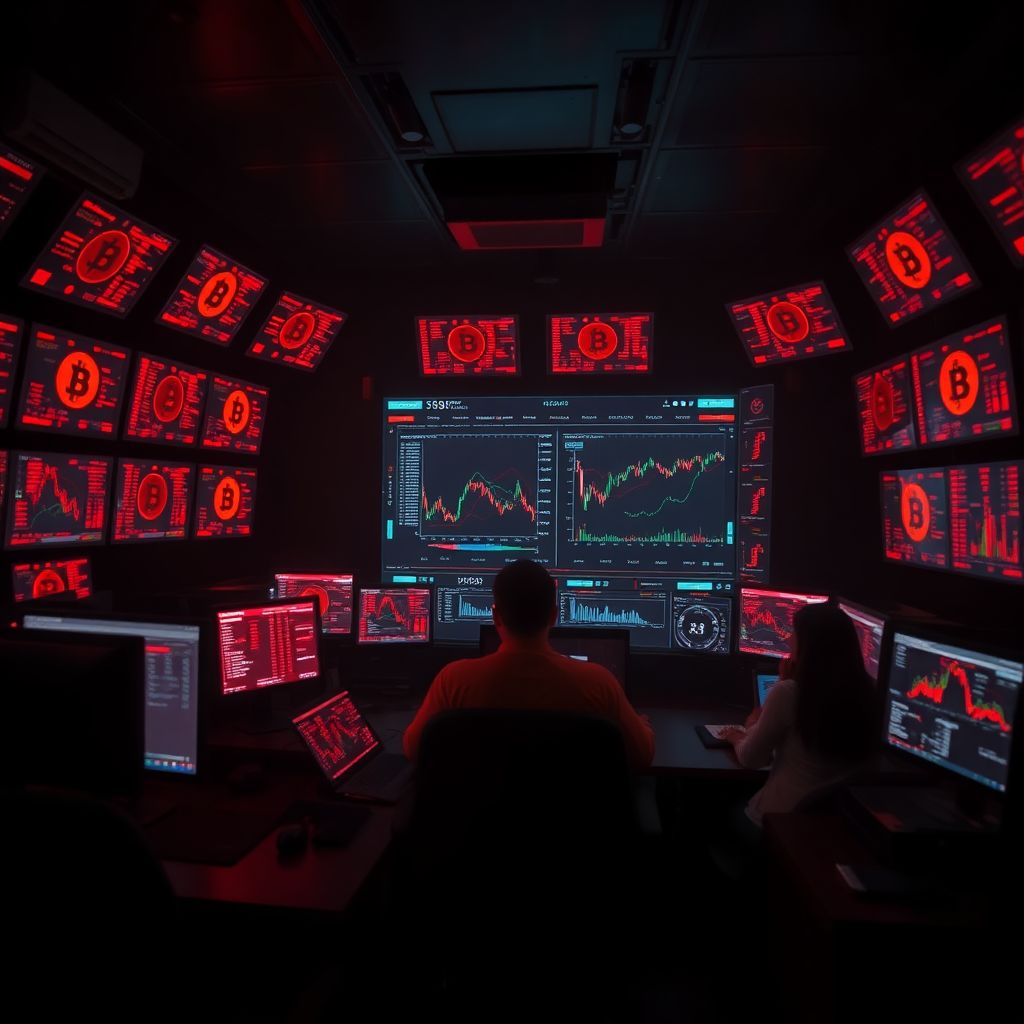
When markets fracture and prices free‑fall, the first thing that fails is not the matching engine – it is human attention.
Screens turn red, feeds explode with “urgent” updates, and even seasoned traders find themselves chasing the loudest narrative rather than the most relevant information. In those brief, violent windows of stress, the real battle is not only against volatility, but against cognitive overload.
That is precisely where AI is quietly becoming the “second screen” of modern crypto markets: a layer that compresses chaos into something a trader can actually think with.
—
When volatility spikes, attention becomes the true bottleneck
In calm conditions, traders can afford to scroll, compare, and reflect. During liquidation cascades, that luxury vanishes. Price action, breaking headlines, on‑chain anomalies, funding rate shifts, liquidation clusters, and social chatter all arrive simultaneously. The problem stops being “too little information” and becomes “too much, too fast.”
Behavioral research has repeatedly linked information overload to poorer decisions when attention is constrained. Under time pressure, people reach for shortcuts: herd behavior, social proof, familiar narratives. In markets, that translates into impulsive trades, chasing momentum, or freezing entirely.
Traders instinctively respond by searching for tools that can strip away noise and organize the deluge into a few interpretable signals. That is where AI has started to play a distinct role: not as a crystal ball, but as a filter and translator.
—
What usage spikes really say about trader intent
Since August 2025, one major exchange has reported that 2.35 million users interacted with its AI trading suite, generating 10.8 million total interactions. Around 93,000 users engaged daily on average, with a single‑day high near 157,000. Within that suite, conversational AI tools saw the heaviest use.
The raw numbers matter, but the pattern hidden underneath matters more: usage sharply spikes during stress events.
When volatility accelerates, traders flock to AI to answer a specific need: “Tell me what actually matters right now.” Short summaries, comparative context (“How is this crash different from the last one?”), quick breakdowns of funding shifts or liquidation clusters – these become more valuable than any prediction model.
Behind the everyday phrase “AI helps me trade” lies something very concrete. Under pressure, “help” typically means:
– Filtering out irrelevant noise
– Summarizing fast‑moving developments
– Highlighting what has changed versus what is just repetition
– Restoring a coherent picture of the market’s state
The AI is not pressing the buy or sell button. It is shaping the field of vision in the seconds before that decision.
—
In real markets, coherence beats prediction
Discussions about AI in trading often revolve around forecasting: can an algorithm predict the next candle, or identify arbitrage edges? But under real conditions of acute volatility, traders frequently value something more basic and more human: the ability to stay coherent.
Stress collapses attention to a narrow tunnel. Rumors rush to fill the gaps that raw data leaves. Social proof – the sense that “everyone” is acting in one direction – becomes louder than individual analysis. In that moment, the greatest risk is often not missing a signal, but losing the ability to reason clearly.
AI shows its most practical value here when it acts less like an oracle and more like an editor. It can:
– Distill what is actually known
– Flag what is still uncertain or unverified
– Anchor users on key variables rather than emotional narratives
– Present competing explanations side by side
That role matters because it draws a critical distinction between *support* and *substitution*:
– Support tools enhance comprehension and situational awareness, especially under stress.
– Substitution tools invite users to outsource judgment entirely – precisely when uncertainty is highest and blind delegation is most dangerous.
The healthiest use of AI in markets leans toward support. When traders see the tool as a thinking aid rather than an automatic pilot, the probability of catastrophic misjudgment tends to fall.
—
AI as stress infrastructure: clarity and restraint
As AI tools become embedded directly into trading interfaces, they start to function as part of the market’s “stress infrastructure.” They are not merely features; they are mechanisms for braking emotional reflexes.
Concrete examples include:
– Real‑time explanations of sharp moves: “This drop coincides with a wave of liquidations in over‑leveraged long positions, not necessarily a fundamental shift in network activity.”
– Context snapshots: “Current volatility is high but still below previous extremes seen during earlier market crashes.”
– Scenario framing: “Here are three plausible explanations for this move, and what data would confirm each.”
In practice, such features can:
– Reduce panic‑driven market orders at the worst possible levels
– Encourage traders to adjust position sizes or leverage more rationally
– Slow down cascade behavior that feeds on rumor and fear
That does not mean AI eliminates stress or risk. It does mean the trader has a better chance of interpreting events before reacting to them. At scale, those extra seconds of reflection can have systemic effects.
—
Why this matters for market structure, not just UX
It is tempting to see these tools as simple user‑experience upgrades. They are more than that. When a large share of participants relies on AI‑powered interpretation during volatile windows, the *collective quality* of those interpretations starts to influence how the market behaves under pressure.
If AI:
– Accurately highlights drivers of a move
– Clearly separates facts from speculation
– Shows risk, leverage, and concentration transparently
…then more participants may behave in ways that dampen extremes: trimming risk earlier, avoiding panic selling, or resisting rumor‑driven stampedes.
If, instead, AI:
– Reinforces sensational narratives
– Over‑simplifies complex dynamics into one‑line certainties
– Masks uncertainty behind confident language
…then it can exacerbate herding, accelerate cascades, and deepen liquidity vacuums during shocks.
This is why exchange quality can no longer be judged only by liquidity, latency, and fees. A broader definition now includes the platform’s capacity to keep users oriented when conditions turn violent. Orientation is increasingly a component of stability.
—
Crypto magnifies AI’s systemic impact
In traditional markets, trading halts, opening and closing auctions, and fixed schedules impose some natural breaks on reflexive behavior. Crypto strips many of those buffers away.
Crypto markets are:
– 24/7/365, with no forced downtime
– Highly reflexive, where sentiment and price feed each other in real time
– Structurally intertwined, with professional market makers and retail traders sharing the same venues and information streams
In this environment, AI‑driven strategies and AI‑assisted decision tools operate side by side. When many systems – both algorithmic and human‑in‑the‑loop – respond similarly to the same signals, the risk of correlated behavior rises.
That can mean:
– Faster propagation of selloffs triggered by similar model thresholds
– Simultaneous deleveraging when AI tools converge on the same risk cues
– Rapid clustering of positions around “consensus” interpretations generated by popular tools
The line between individual assistance and systemic influence becomes thin.
—
The next frontier: accountability and provenance in AI
As AI moves deeper into the crypto market’s plumbing, questions of governance become unavoidable. Two concepts rise to the forefront: accountability and provenance.
1. Accountability
– When an AI explanation or recommendation contributes to a bad outcome, who is responsible?
– How are models validated under stress conditions, not just under back‑tested or normal‑regime data?
– What safeguards prevent AI from confidently presenting speculation as fact?
2. Provenance
– From which data sources is the AI drawing its conclusions?
– Are those sources diverse, or concentrated in a few narratives or feeds?
– Can users see, at least in broad strokes, *why* the model emphasizes certain signals?
Without grounded answers, trust in AI as a second screen during crises will remain fragile. Traders do not need to see source code or full model weights, but they do need intelligible, high‑level clarity on:
– What inputs the system considers
– How it handles conflicting information
– How frequently it is audited and recalibrated
—
AI as the translation layer for speed
Crypto’s greatest feature and its greatest flaw is speed. Information, capital, and sentiment all move quickly, and that velocity can either create efficient price discovery or chaotic whiplash.
AI is increasingly becoming the translation layer between raw market speed and human cognitive limits. It:
– Converts dense, noisy data into legible narratives
– Surfaces structural information (liquidations, funding, depth) before traders act
– Helps humans maintain time‑consistent strategies in an environment engineered to fragment their focus
In this sense, AI is less about “out‑trading” the market, and more about “out‑thinking” one’s own worst impulses when the market is trying to tear decision‑making apart.
—
The risk of over‑delegation
There is, however, a real danger in this transition: the temptation to hand too much autonomy to AI during exactly the periods when clarity matters most.
Potential failure modes include:
– Overfitting to past crises: Models trained mainly on historical crashes may misinterpret novel stress events.
– False confidence: Polished, natural language outputs can mask underlying uncertainty, making traders overtrust incomplete analysis.
– Homogenization of views: If many participants use the same or similar AI tools, diversity of interpretation shrinks, raising the risk of one‑sided positioning.
Design choices can mitigate this. Tools that:
– Expose uncertainty (“There are multiple plausible explanations”)
– Offer alternative scenarios rather than a single “answer”
– Encourage manual confirmation for high‑impact actions
…are more likely to keep humans in a genuinely supervisory role rather than a ceremonial one.
—
Building healthier AI‑trader relationships
For AI to function as constructive stress infrastructure rather than an opaque driver of new risk, both traders and platforms need to adjust their expectations.
For traders, that means:
– Treating AI outputs as starting points, not endpoints
– Asking explicitly: “What is this tool *not* seeing or not optimizing for?”
– Using AI to manage cognitive load, not to abdicate responsibility
For platforms, it means:
– Prioritizing explainability and transparency over flashy, deterministic‑sounding outputs
– Testing tools in simulated crisis conditions before wide deployment
– Monitoring behavioral changes induced by AI features, not just usage metrics
Success is not defined by how many queries an AI tool handles, but by how it shapes user behavior in the worst 30 minutes of the quarter.
—
A new metric for market resilience
As AI usage climbs and concentrates around volatility spikes, its role in market structure will only grow. The critical question will be less “How powerful is the model?” and more:
– Does it help traders stay oriented when the market tries to disorient them?
– Does it reduce panic and herd reflexes or amplify them?
– Does it widen the range of informed responses or funnel everyone into the same trade?
When markets break, traders increasingly turn to AI, not to eliminate uncertainty, but to survive it with a clearer head. The markets that emerge strongest from the next generation of shocks may be those where AI is thoughtfully governed: visible enough to guide, humble enough to admit uncertainty, and transparent enough that human judgment still has room to breathe.