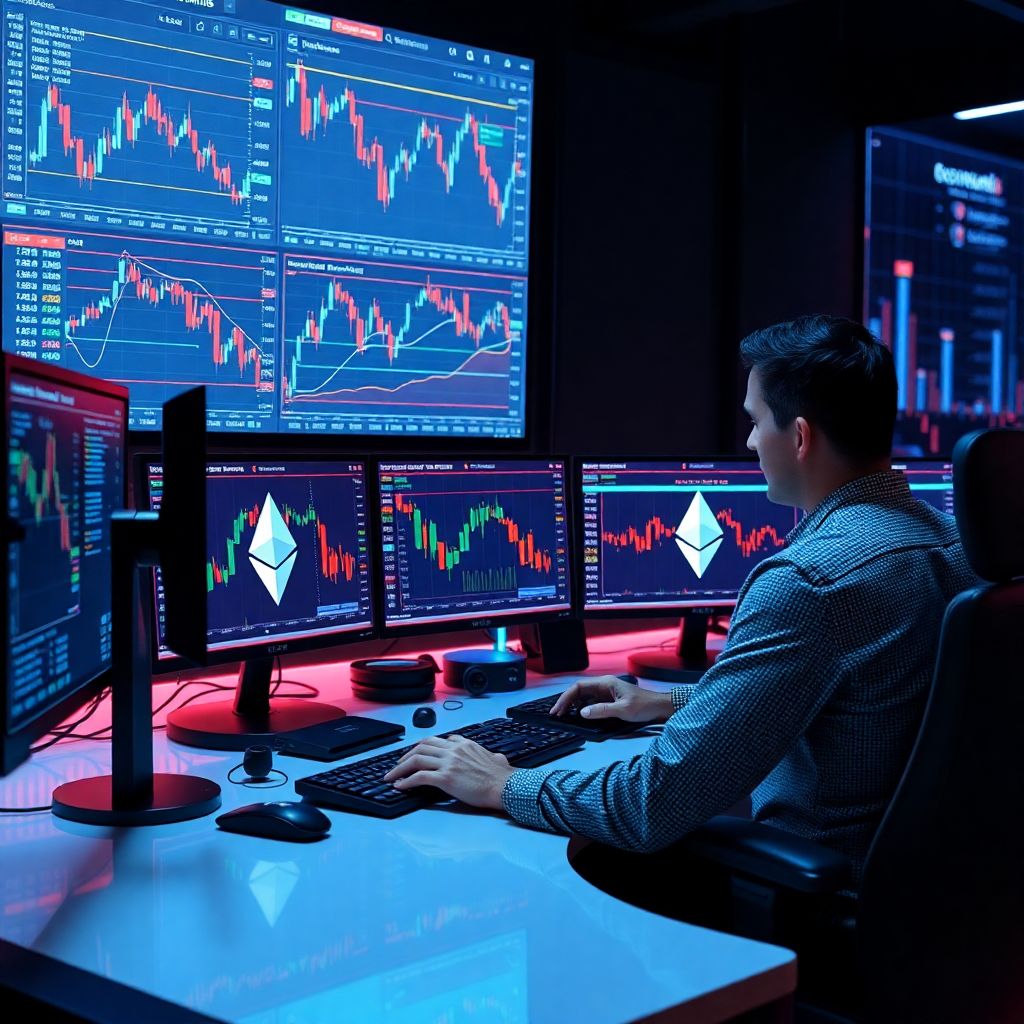
AccuQuant unveils an automated trading suite for Ethereum contracts that targets active swing traders, positioning its AI engine as a tool for capturing intraday volatility and, in one highlighted case, generating around 7,000 dollars in profit over a single day. Against the backdrop of a weakening Ethereum chart, the platform pitches automation as a way to trade more systematically and reduce the impact of emotions on decision‑making.
Ethereum’s recent downturn and why automation is gaining attention
Ethereum recently broke below a key support level, slipping under its daily moving average. Momentum indicators such as MACD have shifted back into bearish territory, while other technical signals remain subdued. Analysts warn that, if any rebound fails to push the price back above the recent high near 2,200, the market could extend into a fifth‑wave style retracement, introducing further downside risk.
In such conditions, discretionary traders who rely solely on manual chart watching can easily be swayed by fear, greed, or fatigue. Short‑lived intraday swings are difficult to catch in real time, and missing a few decisive candles often means missing the entire move. This environment is precisely where automated trading systems like AccuQuant attempt to step in, scanning the market continuously and executing predefined strategies at machine speed.
What is AI‑driven automated crypto trading?
AI automated trading in cryptocurrencies uses algorithms and data‑driven models to analyze market conditions, detect patterns, and execute trades without the need for constant human input. Instead of a trader manually reading charts, watching order books, and placing orders, an AI engine processes streams of data around the clock and follows a strategy designed in advance.
Key characteristics of this approach include:
– Continuous 24/7 monitoring of price action and indicators
– Automatic detection of long (buy) and short (sell/hedge) opportunities
– Instant execution of entries and exits according to the strategy’s rules
– No direct impact from human emotions such as panic or overconfidence
In practice, the system aims to break down the market’s volatility into a series of small, manageable moves, turning frequent but modest price fluctuations into a cumulative performance over time.
How users typically get started with fully automated AI trading
AccuQuant presents the onboarding process in a simplified, step‑by‑step format designed to lower the barrier to entry:
1. Register and receive a welcome bonus
New users are offered a 20‑dollar sign‑up reward, together with a daily 0.50‑dollar login incentive. These bonuses are positioned as a way to experiment with automation without committing large amounts of capital at the outset.
2. Select a strategy and activate automation
After funding an account, users choose from a menu of pre‑built trading strategies tailored to different risk appetites and market conditions. Once a strategy is selected, the AI system begins operating automatically, analyzing market data and placing orders on behalf of the user.
3. Monitor performance, withdraw, or reinvest
Profits, if generated, can either be withdrawn or kept on the platform to compound over time. The interface is designed to show positions, profit and loss, and overall account status in a straightforward dashboard format.
This structure is aimed at both newcomers, who may lack technical analysis skills, and experienced traders looking to offload repetitive intraday tasks to an automated agent.
Strategy performance example: reaching 7,000 dollars in one day
One AccuQuant case study involves a user who activated an automated Bitcoin strategy on a highly volatile trading day. The AI did not rely on a single major win. Instead, it executed numerous trades throughout the session, each designed to exploit minor price swings.
Over the course of that day, repeated small gains accumulated into a reported profit of approximately 7,000 dollars. The emphasis, according to the platform, is on:
– Frequent but controlled entries and exits
– Strict adherence to algorithmic rules
– Reducing the influence of emotional trading impulses
This example is used to demonstrate the potential of systematic swing trading under extreme volatility. However, such performance is not guaranteed and depends heavily on market conditions, risk parameters, and capital size. Automated systems can also generate losses when markets behave unpredictably or when models fail to adapt.
Core advantages AccuQuant claims to offer
AccuQuant frames its product around a collection of user‑focused benefits:
– No‑cost trial incentives
The 20‑dollar welcome bonus and daily login reward serve as an entry route for users who want to test automated trading with minimal initial funds.
– 24/7 operation and time savings
The AI system tracks the market continuously, freeing users from staying up at night or constantly checking charts. This is particularly relevant in crypto, where markets never close and major price moves can occur at any hour.
– User‑friendly interface
The platform promotes an intuitive layout and simplified controls, making it accessible both to beginners and professional traders who want a streamlined execution layer.
– Transparent, fee‑conscious structure
AccuQuant states that there are no extra transaction or management fees beyond those clearly displayed within the platform, aiming to make real returns easier to track and understand.
– Flexible deposit and withdrawal options
The system supports deposits and withdrawals in a range of well‑known digital assets, including BTC, ETH, DOGE, SOL, XRP, USDC, LTC, and USDT on both TRC20 and ERC20 networks, covering the needs of users who hold different types of crypto assets.
– Affiliate rewards
Users can take part in an affiliate program that offers up to 3 percent plus 1.5 percent in referral rewards, providing an additional income stream independent of trading results.
Together, these elements are marketed as a comprehensive package aimed at lowering friction for anyone interested in algorithmic crypto exposure.
How AI strategies attempt to manage risk in volatile markets
A central promise of automated trading is not only profit generation but also more disciplined risk management. In theory, an AI‑driven strategy can:
– Set predefined stop‑loss and take‑profit levels for every trade
– Limit position size in accordance with account equity and volatility
– Avoid revenge trading or impulsive doubling‑down after losses
– Diversify trades across time frames or correlated instruments
By encoding these rules into software, the system applies them consistently, something that many human traders struggle to do under pressure. During violent sell‑offs or sudden rallies, the model executes its instructions without hesitation, potentially reducing large drawdowns that stem from emotional decision‑making.
However, algorithmic risk management is only as good as the underlying logic and parameters. Poorly designed strategies, excessive leverage, or unsupervised changes to settings can lead to significant losses, even if decisions are executed “emotionlessly.”
Who might consider using an automated trading platform
Automated systems like AccuQuant are often aimed at several types of users:
– Newcomers to trading who want exposure to market movements but feel overwhelmed by chart reading, indicators, and order management.
– Busy investors who do not have time to monitor markets yet want to participate in intraday or swing trades.
– Experienced traders seeking to complement their manual trading with systematic strategies, using AI to capture smaller moves while they focus on broader market analysis.
– Yield‑seekers who are already comfortable with crypto risk but want to explore additional, more active approaches beyond simple holding or staking.
For each group, expectations and risk tolerance will differ. Automated trading should be seen as a tool rather than a guarantee of returns, and capital allocation should reflect the possibility of both gains and losses.
Practical considerations before enabling full automation
Before activating a fully automated strategy, users may want to think carefully about several practical points:
– Capital allocation
Decide in advance how much to allocate to automation and avoid committing funds you cannot afford to lose. Many traders choose to start small and scale up only after understanding how the strategy behaves.
– Strategy selection and time horizon
Different AI models may be optimized for high‑frequency intraday trading, medium‑term swing trading, or hedging. Clarifying your time horizon and risk profile helps in choosing an appropriate approach.
– Monitoring and oversight
While the system runs independently, periodic checks can be important. Reviewing trade history, drawdowns, and performance metrics allows users to verify that the strategy still matches their expectations and market conditions.
– Security and operational risk
As with any platform holding digital assets, users should assess security measures such as two‑factor authentication, withdrawal protections, and internal control processes that reduce the risk of unauthorized access or operational errors.
By approaching automation with a structured plan rather than a purely profit‑driven mindset, users are better positioned to integrate tools like AccuQuant into a broader investment or trading framework.
Automation as a way to participate in volatility, not predict it
The core philosophy behind AccuQuant’s offering is that in cryptocurrencies, volatility itself is the resource. Instead of trying to forecast long‑term price direction with precision, the platform focuses on systematically engaging with frequent, shorter‑term moves.
From this perspective:
– Sharp intraday swings become a series of opportunities rather than random noise.
– Algorithmic rules attempt to standardize how entries and exits are chosen.
– Emotional reactions to sudden spikes or crashes are deliberately removed from the decision chain.
This shift from prediction to structured participation is what AccuQuant presents as its main value proposition for Ethereum contracts and other supported markets.
Balancing potential rewards with realistic expectations
While examples such as a 7,000‑dollar profitable day can be compelling, they represent specific scenarios in highly volatile environments and should not be treated as a baseline outcome. Markets can move in ways that invalidate models, liquidity can thin out, and black‑swans can trigger simultaneous losses across multiple strategies.
Anyone considering automated Ethereum contract trading through AccuQuant or similar platforms should bear in mind:
– Returns can vary widely from day to day and month to month.
– Past performance of any strategy is not a reliable indicator of future results.
– Leveraged or derivative products can amplify both gains and losses.
– Diversification and prudent risk controls remain essential, even with AI.
Viewed with these caveats, automation can be a powerful addition to a trader’s toolkit, particularly in fast‑moving markets where human reaction times and emotions often become liabilities.
Conclusion
With Ethereum under pressure and broader crypto markets prone to sudden reversals, AccuQuant positions its fully automated contract trading system as a way to convert volatility into structured opportunity. By combining 24/7 AI monitoring, predefined strategies, user incentives, and a simple interface, the platform aims to make algorithmic intraday and swing trading accessible to a broad audience.
However, automated trading does not eliminate risk. It changes how decisions are made and executed, but it cannot guarantee profits. Users considering these tools should perform their own analysis, understand the strategies involved, and only allocate capital that fits their risk profile.
Disclosure: The information presented here is for educational and informational purposes only and does not constitute financial, investment, or trading advice. Cryptocurrency trading, including automated and leveraged strategies, carries a high level of risk and may not be suitable for all investors. Users should conduct their own research and, if necessary, consult a qualified professional before making any financial decisions.