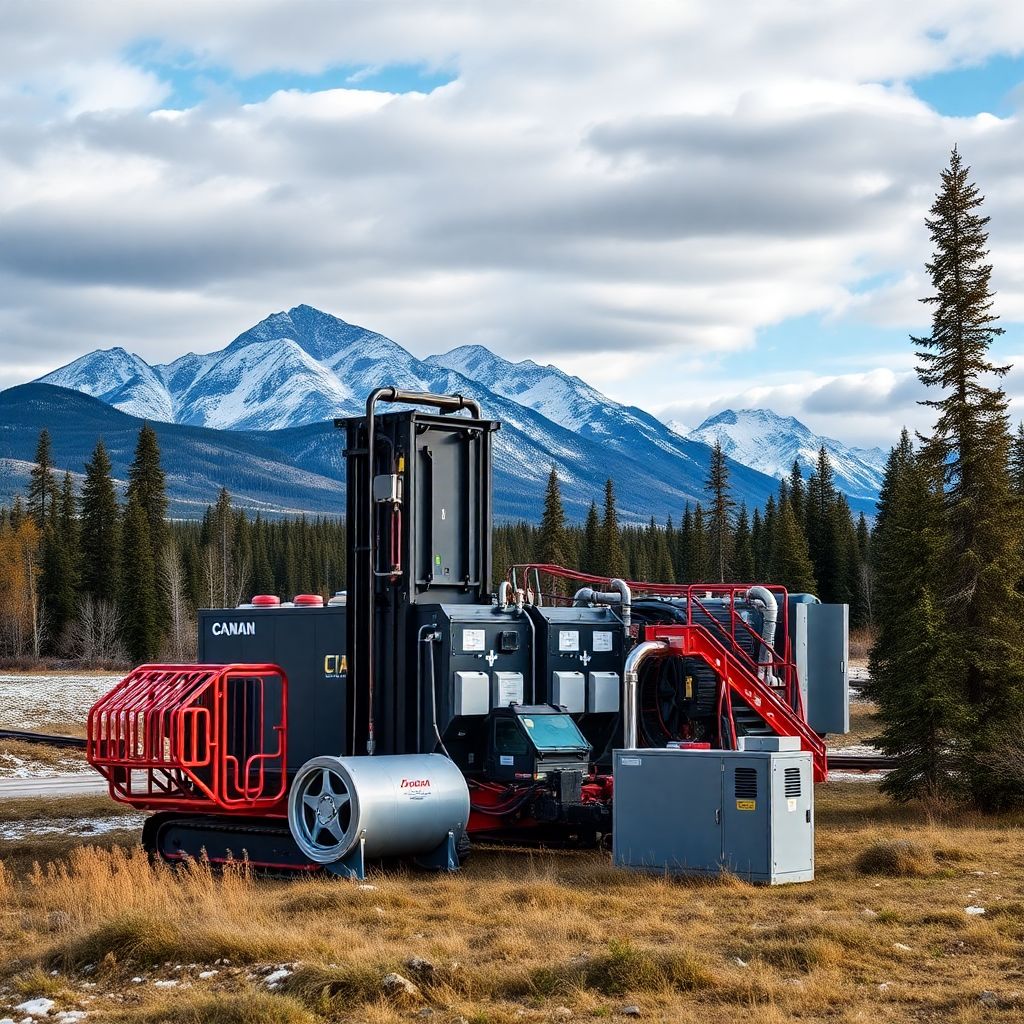
Canaan Inc. (NASDAQ: CAN), a leading manufacturer of Bitcoin mining hardware, saw its stock surge by more than 40%—closing at $1.52—after the company revealed a groundbreaking pilot initiative in Alberta, Canada. The project, developed in partnership with Calgary-based Aurora AZ Energy, aims to convert distributed natural gas resources into a stable and cost-effective power source tailored for high-density computing, including cryptocurrency mining.
This innovative approach addresses a long-standing challenge in the energy sector: how to utilize stranded or underutilized natural gas found in remote or small-scale extraction sites. Instead of allowing this gas to go to waste or investing in costly infrastructure to transport it to centralized power plants, Canaan and Aurora AZ Energy intend to convert it on-site into electricity. This electricity can then be used to power data centers or mining facilities, which often require a consistent and robust energy supply.
The term “distributed natural gas resources” refers to gas reserves that are not connected to major pipeline networks and are typically considered economically unviable to exploit. By deploying modular power generation units at these remote sites, the gas can be harnessed for local use, offering a sustainable and often cheaper alternative to grid electricity. This model not only provides a new energy solution for compute-intensive applications but also helps reduce greenhouse gas emissions by preventing flaring or venting of unused gas.
The market responded swiftly and positively to the announcement, with Canaan’s stock trading at twice its average volume on the day of the news. This surge reflects investor confidence in the potential of the gas-to-compute model to open up new revenue streams for Canaan, especially in an era where energy costs and environmental concerns are increasingly shaping the future of blockchain infrastructure.
The Alberta pilot is expected to serve as a proof of concept for scaling similar initiatives across North America and beyond. If successful, it could mark a significant shift in how energy is sourced and utilized for data-driven industries, particularly in regions where traditional energy grids are either unreliable or expensive to access.
Canaan’s pivot toward energy innovation comes at a time when the global cryptocurrency mining sector is under pressure to find greener and more efficient energy sources. Regulatory scrutiny around energy consumption and carbon emissions has intensified, especially in countries with high energy prices or ambitious climate targets. By tapping into distributed gas resources, Canaan may position itself as a forward-thinking leader in sustainable mining practices.
Beyond mining, the implications of this project could resonate across other sectors that depend on high-performance computing. Industries such as artificial intelligence, machine learning, and scientific research all require massive computational power, and the ability to power such operations off-grid using otherwise wasted energy could be transformative.
For Aurora AZ Energy, the collaboration with Canaan offers an opportunity to expand its presence in the energy-tech sector, showcasing how traditional fossil fuel assets can be reimagined in an era of digital transformation. Their involvement also highlights Alberta’s growing role as a hub for energy innovation, blending Canada’s rich natural resources with cutting-edge technological applications.
In the broader context of the energy transition, projects like this underscore the importance of hybrid solutions—mixing conventional fuel sources with modern applications—to bridge the gap between today’s infrastructure and tomorrow’s sustainability goals. Rather than abandoning fossil fuels outright, the initiative illustrates how they can be repurposed more responsibly.
Looking ahead, investors and industry analysts will be closely watching the pilot’s performance metrics, including cost per kilowatt-hour, uptime reliability, emissions output, and scalability potential. If the model proves economically viable and environmentally efficient, it could attract further investment and policy support.
In addition, Canaan’s move might inspire similar strategies among other mining hardware or infrastructure companies, potentially spurring a wave of innovation centered around alternative energy sources. As the competition for efficient, affordable power intensifies, those who successfully pioneer such hybrid solutions could gain a decisive edge in the evolving digital economy.
Canaan’s market momentum suggests that investors are betting not just on the success of the Alberta project, but on a broader strategic shift that aligns technological growth with energy sustainability. This approach could become a blueprint for how industrial computing adapts to a future defined by both performance demands and environmental responsibility.