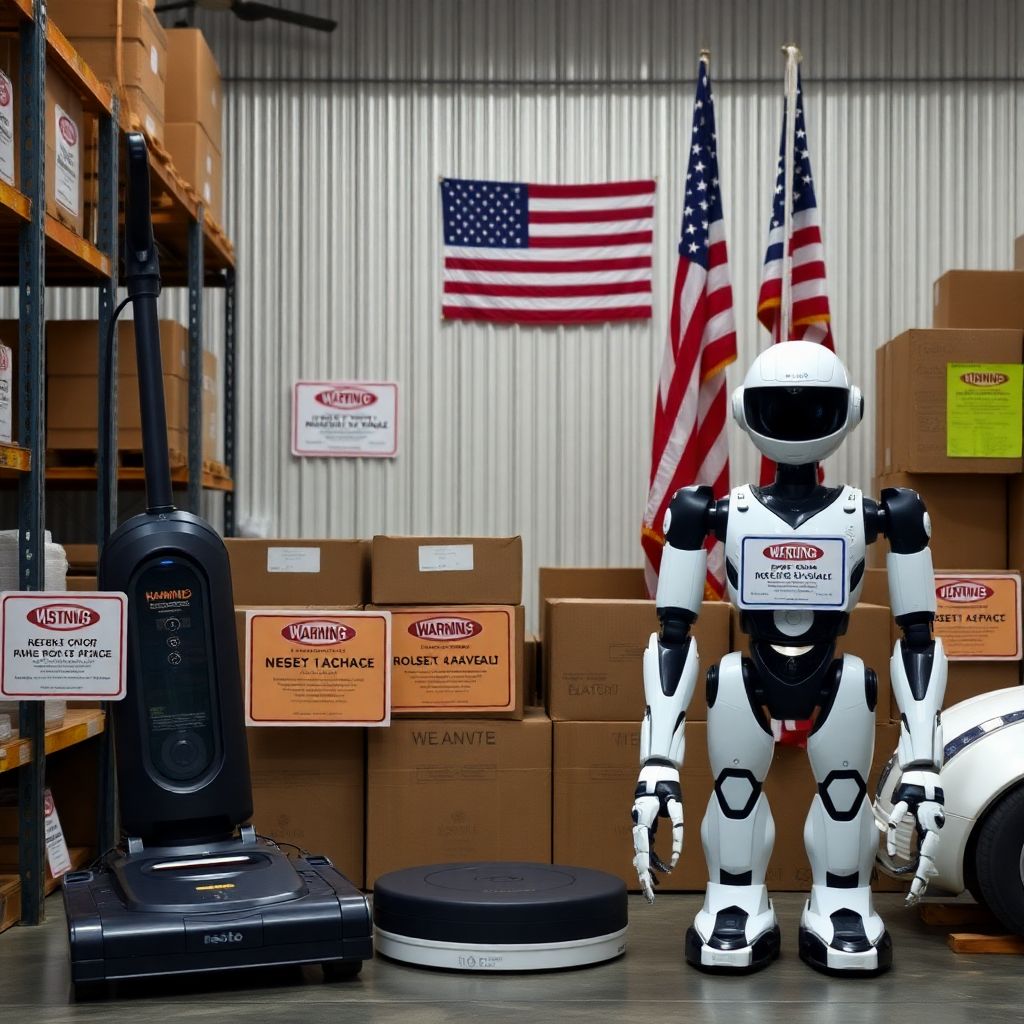
US Moves to Block Foreign-Made Robots-Including Robot Vacuums
The United States has taken a dramatic new step in its tech security policy, targeting a category few homeowners ever imagined would be swept into a national security debate: household robots and other connected devices.
Earlier this week, the Federal Communications Commission (FCC) announced that a broad class of “advanced robotic devices” and certain connected power inverters manufactured abroad will no longer be eligible for approval to operate in the country. Although the policy is aimed most directly at China, it applies to foreign-made products in general-and it doesn’t stop at flashy humanoid machines. Even robot vacuum cleaners, such as popular Roomba-style devices, are caught in the dragnet.
What Exactly Is Being Banned?
The FCC has added several categories of devices to what is known as its “Covered List.” This list identifies communications and connected equipment that U.S. authorities believe pose an “unacceptable risk” to national security. Once a product or manufacturer is placed on the list, new devices from that company generally cannot receive FCC authorization, a prerequisite for legally marketing and operating wireless products in the United States.
The newly covered categories include:
– Advanced robotic devices, specifically:
– Humanoid robots
– Quadruped robots (dog-like robots, for example)
– Connected power inverters (devices that convert and manage electrical power while connected to networks)
– Internet-connected household robots, including robot vacuum cleaners
This decision came after an interagency review convened by the White House, which brought together multiple U.S. national security and intelligence bodies. Their conclusion: these products could open up significant cybersecurity and supply chain vulnerabilities that might affect critical infrastructure and sensitive information.
Why Are Robots Suddenly a National Security Issue?
Modern robots, even consumer-grade ones, are no longer simple, isolated machines. They are:
– Packed with cameras, microphones, and advanced sensors
– Constantly connected to the internet via Wi-Fi or cellular networks
– Often tied to cloud services that store maps of homes, offices, or industrial sites
– Updated remotely with new software, sometimes directly from overseas servers
For national security agencies, that combination looks less like a household convenience and more like a potential surveillance platform. A connected robot vacuum, for example, can build a detailed floor plan of a home or office, track movement patterns, and in some cases capture images and audio, all of which may be stored or processed on servers outside the U.S.
Similarly, connected power inverters used in solar systems, energy storage, or industrial installations can sit at the junction between digital networks and the electrical grid. If those systems can be controlled or exploited remotely, they become a potential entry point for sabotage or espionage targeting critical infrastructure.
Focus on China-but Wider Implications
While the FCC’s rule does not single out one country by name in its technical language, the policy direction is clearly aligned with a broader U.S. campaign to reduce dependence on Chinese-made communications and networked equipment. Over the past several years, Washington has restricted or banned a range of Chinese telecom hardware, surveillance cameras, and networking gear.
Advanced robots and smart inverters are now being framed as the next frontier in that same struggle: complex, internet-connected systems that could provide foreign governments or companies with unauthorized insight into U.S. homes, businesses, military facilities, and energy systems.
However, because the rule applies to “foreign-made” devices meeting certain risk criteria, it may end up affecting manufacturers and supply chains beyond China, especially in countries where data governance rules or corporate ties are viewed as problematic by U.S. authorities.
What the Ban Actually Does-and Doesn’t Do
The move to add these devices to the Covered List has several practical consequences:
– No new FCC approvals
Future models of covered foreign-made advanced robots and connected power inverters will not be granted FCC authorization. Without this, companies cannot legally sell or operate new wireless models in the U.S. market.
– Existing devices are not automatically recalled
The policy primarily affects future approvals. Robots and devices that are already certified and sold are not, by default, being forcibly removed from homes or businesses. However, they may face restrictions on future software or hardware upgrades if those require new authorizations.
– Impact on new product launches
Foreign manufacturers planning to introduce next-generation humanoid robots, industrial robotic platforms, or smart power equipment will likely have to redesign products, adjust supply chains, relocate manufacturing, or partner with U.S.-approved entities if they want to remain in the market.
– Signal to investors and developers
Being placed on the Covered List is also a reputational signal. It tells regulators, investors, and large corporate buyers that these products are officially considered high-risk from a national security standpoint.
Are Roombas and Other Robot Vacuums Really at Risk?
Robot vacuums are specifically included in the scope of concern because they combine several sensitive capabilities:
– Detailed mapping of indoor spaces – Many models create precise digital maps of rooms, furniture, and obstacles.
– Cameras and microphones – Higher-end devices can capture images or video to avoid objects, recognize rooms, or support remote monitoring.
– Always-on connectivity – They connect to home Wi-Fi for app control, voice assistant integration, and cloud-based processing.
From a cybersecurity lens, that makes them mobile, networked sensor platforms roaming through bedrooms, offices, and potentially secure areas. If their data flows through overseas servers, or if their firmware can be updated remotely by entities under foreign jurisdiction, U.S. agencies see a path for espionage or data exfiltration.
While not every brand or model is automatically banned, foreign-made robotic vacuums that fall under the advanced, connected category and depend on foreign-managed cloud infrastructure are squarely within the scope of the FCC’s new restrictions for future approvals.
How Consumers Might Be Affected
For now, most consumers won’t see an immediate change: their existing devices will continue to function. However, longer-term effects are likely:
– Reduced choice in imported models – Some brands may be unable to bring their newest robots or smart inverters to the U.S. market if they cannot secure FCC authorization.
– Shift toward “trusted” suppliers – Retail shelves may tilt more heavily toward U.S.-made or U.S.-approved devices, especially in categories flagged as sensitive.
– Potential price pressure – If competition from certain foreign manufacturers declines, prices in some segments could creep upward, at least in the short term.
– More local processing – To comply with U.S. expectations, companies may prioritize on-device AI and local storage instead of routing data through foreign clouds.
For buyers concerned about privacy and security, the policy may accelerate a trend that was already underway: prioritizing devices with transparent data practices, local data storage, clear update policies, and verifiable cybersecurity standards.
Impact on Manufacturers and Supply Chains
Foreign robotics and power electronics companies now face a strategic decision:
– Reshore or diversify production – Moving manufacturing or final assembly to facilities in countries deemed lower risk by U.S. authorities could become a prerequisite for continued access to the American market.
– Separate global and U.S. product lines – Firms might create U.S.-specific models with different firmware, cloud providers, or hardware components to satisfy regulators.
– Invest in compliance and auditing – Demonstrating secure-by-design principles, independent code audits, and strict data localization can become selling points rather than afterthoughts.
At the same time, U.S. and allied manufacturers gain an opening to capture market share in advanced robotics and grid-related equipment. Domestic startups and established industrial players alike may find new demand for “secure, trusted” robots and power systems explicitly designed to meet U.S. security criteria.
How This Fits into the Bigger Tech-Policy Picture
The FCC’s move is part of a broader, rapidly evolving landscape in which:
– Networked devices are treated as strategic assets – Anything that connects to the internet and collects data-whether a smartphone, a security camera, or a cleaning robot-is now seen as part of the national infrastructure.
– Cyber-physical systems are under scrutiny – Devices that can both sense and affect the physical world, such as industrial robots or grid-connected inverters, are treated as critical risk factors in cyber defense planning.
– Supply chain resilience is a national priority – The pandemic, geopolitical tensions, and high-profile hacks have convinced policymakers that reliance on a narrow set of foreign suppliers creates systemic vulnerabilities.
Robots and power electronics, once seen as neutral tools, are now firmly embedded in these strategic debates.
What to Expect Next
Several developments are likely to follow in the wake of this decision:
– More categories could be added – As technology advances, other classes of smart devices-particularly those with cameras, microphones, or access to industrial systems-could face similar scrutiny.
– Stricter standards for data handling – Regulators may refine technical guidelines on where data can be stored, how it’s encrypted, and who can access it, especially for devices used near critical infrastructure or government facilities.
– International responses – Other countries may adopt similar restrictions or retaliatory measures, further fragmenting the global market for robotics and connected devices.
For now, manufacturers, importers, and large buyers should treat the FCC’s decision as both a warning and a roadmap: connected hardware that touches sensitive data or critical systems will be evaluated through a national security lens, not just a consumer electronics lens.
What Users and Businesses Can Do
Individuals and organizations that rely on robotic devices and smart power electronics can take steps to get ahead of future restrictions:
– Audit existing devices – Understand what data your robots and connected inverters collect, where it goes, and who controls it.
– Favor transparent vendors – Choose manufacturers that publish clear, detailed policies on data use, software updates, and security practices.
– Segment critical networks – Keep devices that control or monitor sensitive areas on segregated networks with strict access controls.
– Plan for lifecycle changes – Be prepared for the possibility that certain foreign-made devices may not be supported or upgradable in the long term if regulations tighten further.
As robotics and AI continue to spread from factories and research labs into living rooms, offices, and power systems, the line between convenience gadget and critical infrastructure will only blur further. The U.S. decision to block future foreign-made advanced robots and connected power inverters from FCC approval illustrates how quickly that shift is unfolding-and signals that the next phase of the global technology race will be fought as much over security and trust as over features and price.