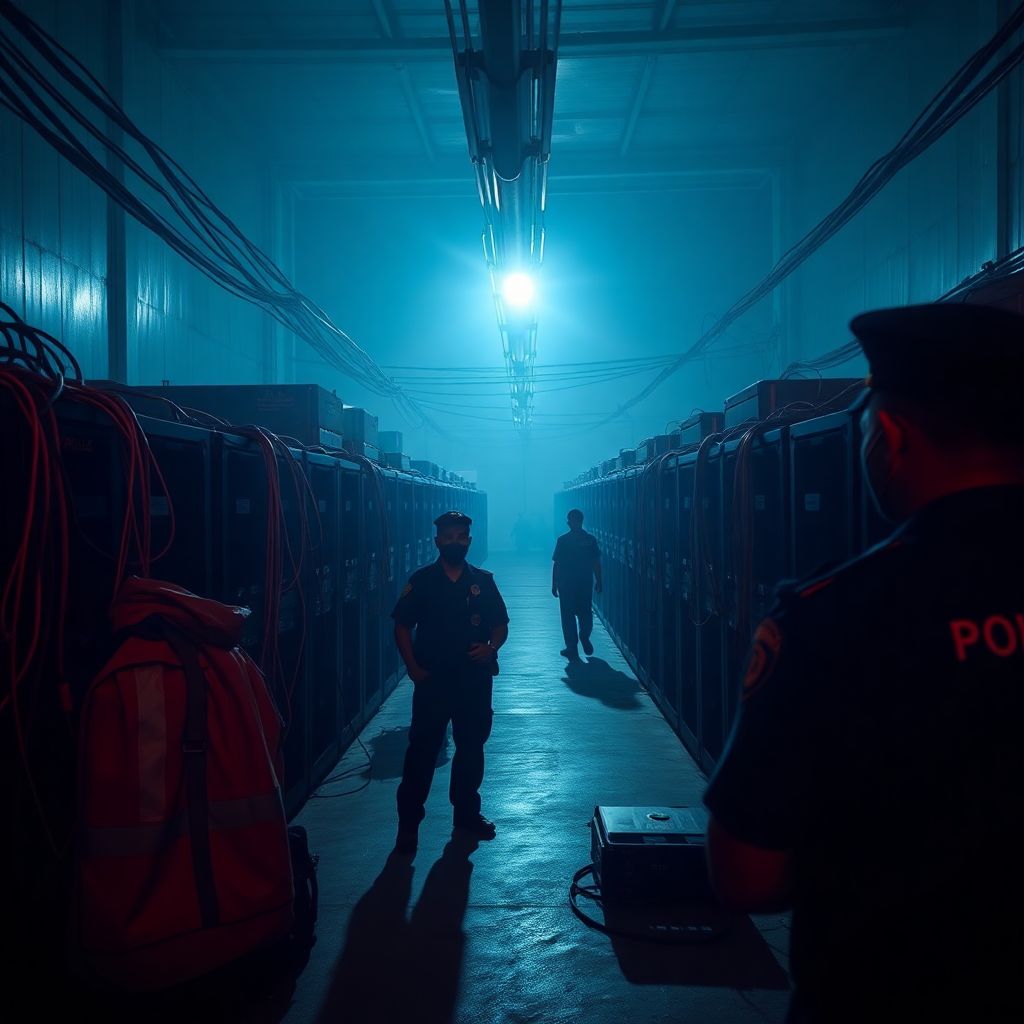
Malaysia has intensified its crackdown on illicit cryptocurrency activity, arresting two men and dismantling an illegal Bitcoin mining operation that was allegedly powered by stolen electricity. During coordinated raids, police seized 73 mining rigs along with supporting equipment, underscoring the authorities’ growing focus on energy theft tied to crypto mining.
The operation, conducted under an enforcement initiative known as Op Elektrik, targeted three separate properties in Tronoh on Tuesday night. Batu Gajah district police chief Assistant Commissioner Md Noor Aehawan Mohammad said officers from the district Criminal Investigation Department worked in tandem with specialists from national power utility Tenaga Nasional Berhad’s technical unit to uncover the scheme.
Raids began at around 9:02 p.m. and continued into the night. Investigators say each of the three premises had been converted into Bitcoin mining sites. Two of the properties were abandoned houses, while the third was an unoccupied residence that had been fitted out with mining equipment rather than used as a home.
Technical inspections by Tenaga Nasional Berhad confirmed that the mining setups at two of the houses were connected via illegal power lines that bypassed official meters. Instead of drawing electricity through legitimate, billable connections, the suspects are believed to have tapped directly into the power grid to avoid paying for the substantial energy required to run the machines around the clock.
Police detained two local men, aged 40 and 52, to assist in the investigation. Both have been remanded for three days, from Wednesday to Friday, as authorities work to build a fuller picture of the operation, including how long it had been active and whether others may have been involved.
Alongside the 73 Bitcoin mining rigs, officers confiscated various accessories and electronic components thought to be integral to the illegal mining network. The hardware will be examined to determine the scale of the operation, the potential revenue generated, and whether the equipment was linked to wider mining pools or exchanges.
The case is being investigated under Section 427 of Malaysia’s Penal Code, which deals with mischief, including acts resulting in damage or loss such as electricity theft. Authorities are also invoking Section 37(1) of the Electricity Supply Act 1990, which covers tampering with electrical installations, unauthorized connections, and other interference with the national power system.
Police have urged the public to remain vigilant and to report any unusual power usage patterns, suspicious wiring, or constant machine noise coming from residential or commercial premises that might indicate illegal mining activity. Residents are encouraged to contact the Batu Gajah district police operations room or their nearest police station if they suspect electricity theft or unauthorized cryptocurrency mining.
This latest action is part of a broader national strategy targeting unlicensed mining facilities that tap into the electrical grid without paying for what is often an enormous level of consumption. Over the past year, Malaysian authorities have carried out several similar crackdowns across multiple states, reflecting mounting concern over both financial losses and safety risks.
In May, police in Terengganu disrupted another suspected Bitcoin mining network as part of an enforcement campaign known as Op Letrik. Raids on properties in the Hulu Terengganu and Marang districts led to the seizure of 45 illegal mining machines from two locations: a residential home in Bukit Perpat and a commercial building in Wakaf Tapai.
At that time, Terengganu police chief Datuk Mohd Khairi Khairuddin said investigators believed the premises had been deliberately altered to bypass electricity meters. The modifications reportedly resulted in estimated monthly losses of around 36,000 Malaysian ringgit for the national utility, with mining-related hardware at the sites valued at approximately 225,000 ringgit. No arrests were announced in connection with that particular operation, but authorities opened an investigation under Sections 379 and 427 of the Penal Code, along with Section 37 of the Electricity Supply Act 1990.
Another case in February exposed different risks associated with illegal mining when firefighters were called to a house in Kuala Lumpur following reports of an explosion and smoke. Emergency responders discovered a fire caused by altered electrical wiring. Subsequent checks revealed a cluster of Bitcoin mining rigs installed inside the property and connected to unauthorized power lines. That incident triggered a separate inquiry into both energy theft and potential safety violations.
Malaysia’s national electricity provider has repeatedly warned that cryptocurrency mining operations which steal power impose a heavy financial burden on the grid. In 2024, Tenaga Nasional Berhad reported that illegal Bitcoin mining alone had caused more than 440 million ringgit in losses due to unmetered electricity consumption. The utility estimated that, between 2018 and 2023, energy theft tied to unauthorized crypto mining resulted in total losses of about 755 million ringgit, highlighting the scale of the problem.
Beyond financial damage, authorities stress that illegal connections pose serious safety hazards. Unapproved wiring, overloaded circuits, and non-compliant installations significantly increase the risk of electrical fires, explosions, and power outages. In densely populated neighborhoods, one clandestine mining setup can endanger surrounding homes and businesses, not just the property where the rigs are installed.
Bitcoin mining is inherently energy-intensive because it relies on specialized computers performing complex calculations to secure the network and process transactions. In regions with relatively affordable electricity, mining can be legitimately profitable. However, when electricity prices are higher or when regulations tighten, some operators resort to bypassing meters to cut costs, shifting their largest expense onto power providers and law-abiding consumers.
Malaysian enforcement efforts are therefore not aimed at all cryptocurrency activity, but specifically at operations that abuse the electrical infrastructure. Legal mining, conducted under proper licenses and with metered electricity, is treated as a business activity. The focus of police and regulators is on unlicensed farms, meter tampering, and direct taps into the grid that undermine both the energy market and public safety.
Authorities are also increasingly using data and technology to detect suspicious consumption patterns. Abnormally high electricity use at properties registered as residential, unusual night-time peaks, or sudden spikes in demand can all trigger closer inspection. Cooperation between law enforcement and the electricity provider’s technical teams, such as TNB’s SEAL unit, has become a central element of these investigations.
From a policy perspective, Malaysia’s stance mirrors a broader international trend. Several governments have moved to regulate or restrict crypto mining where unauthorized or excessive electricity use threatens grid stability. In countries such as Iran, repeated operations have been mounted to seize unregistered mining rigs drawing power from subsidized energy. Venezuela has taken an even tougher line by imposing a formal ban on crypto mining to safeguard its already strained power system from additional demand.
For miners operating legally or considering entering the sector, the Malaysian cases underscore the importance of compliance. That includes securing the proper business licenses, registering with local authorities where required, using certified electricians to install equipment, and ensuring that all electricity is drawn through metered, billable connections. Failure to meet these standards can lead not only to confiscation of equipment, but also to criminal charges and potential imprisonment.
The growing number of enforcement actions suggests that the era of operating clandestine mining farms with minimal risk is coming to an end in Malaysia. As electricity theft figures climb and public awareness of the issue increases, coordination between police, regulators, and the national utility is likely to intensify. For local communities, that may mean more inspections and a stronger emphasis on reporting suspicious setups before they escalate into financial losses or dangerous incidents.
In the latest Batu Gajah case, investigators will now focus on tracing how long the operation had been active, calculating the volume of stolen electricity, and determining whether the suspects had links to larger networks or overseas partners. The outcome is expected to feed into ongoing discussions about stricter penalties, tighter monitoring, and perhaps new regulatory measures for high-energy-use industries, including cryptocurrency mining.
Ultimately, Malaysian authorities are signaling that while digital assets and blockchain technology may continue to evolve and develop, they must do so within the boundaries of existing laws-particularly those designed to protect critical infrastructure like the national power grid. The arrests in Tronoh and the seizure of 73 rigs serve as a reminder that any attempt to mine Bitcoin at the expense of public resources is likely to be met with firm legal consequences.