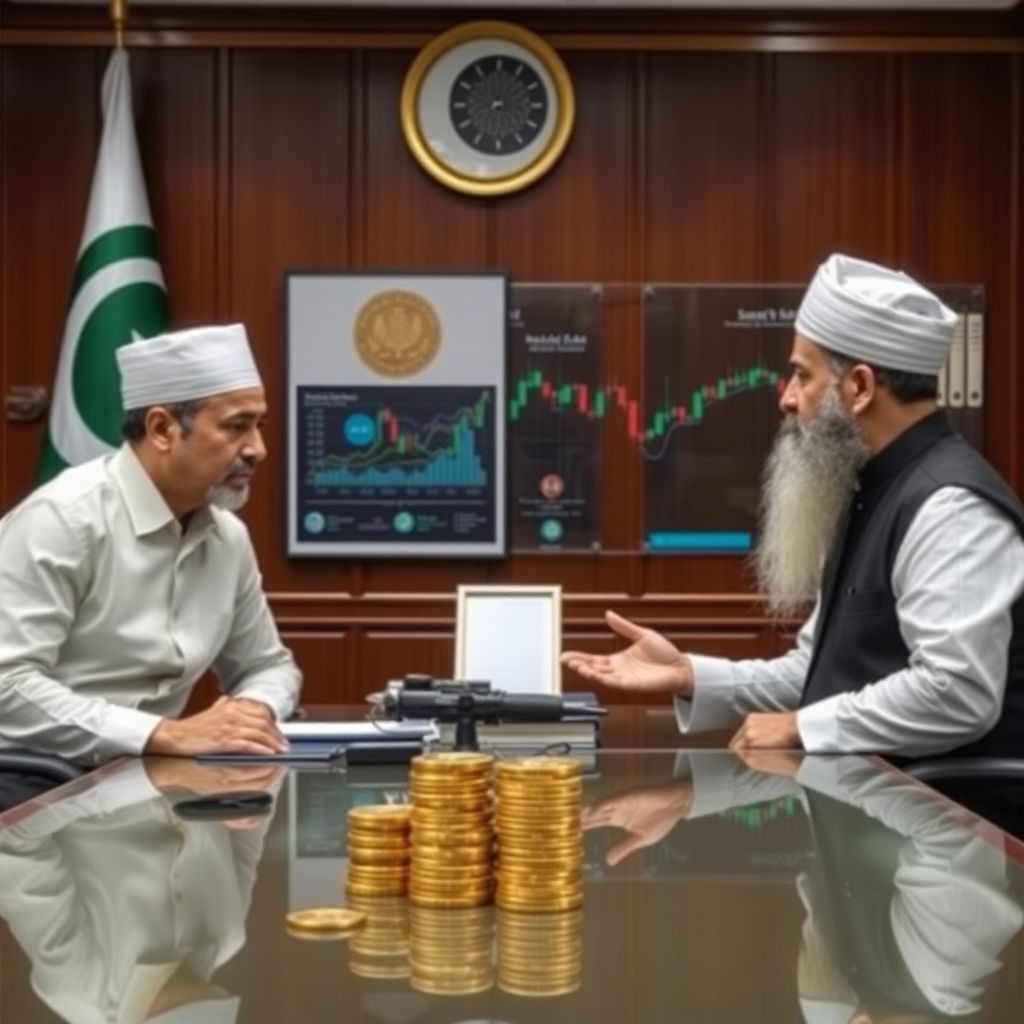
Pakistan’s top virtual asset regulator is pushing for a nuanced, ongoing conversation on cryptocurrency under Islamic law after a prominent scholar rejected payments made with USDT and other digital assets.
The chairman of the Pakistan Virtual Assets Regulatory Authority (PVARA), Bilal bin Saqib, issued the call following a July 11 meeting with respected Islamic jurist Mufti Taqi Usmani. Saqib emphasized that, despite differing views on specific technologies, both regulators and religious scholars share a common objective: shielding the country’s citizens from fraud, exploitation, and financial loss.
In his statement, Saqib stressed that “digital assets” is an umbrella term covering several distinct innovations. Blockchain networks, stablecoins, tokenized real-world assets, and other crypto-related tools each function differently, serve different purposes, and carry different risk profiles. Because of that, he argued, they should not be treated as a single, homogenous product under Shariah. Instead, he called for “careful technical assessment” of each category, combined with rigorous Islamic legal analysis, rather than a sweeping, one-size-fits-all religious ruling.
Saqib urged deeper collaboration between three groups: Islamic scholars, financial regulators, and industry experts. In his view, constructive dialogue among these stakeholders is the only way to arrive at a regulatory and religious framework that both protects the public and allows safe, lawful innovation to proceed.
The meeting took place against the backdrop of a recent fatwa issued by the Darul Ifta of Jamia Darul Uloom Karachi. The ruling, dated June 10, 2026 and signed by Mufti Taqi Usmani along with five other scholars, declared that transactions involving cryptocurrency, including stablecoin payments such as USDT, were impermissible according to their interpretation of Islamic law.
According to coverage by Pakistani media, the scholars concluded that existing research does not yet support classifying cryptocurrencies as recognized “mal” – legally acknowledged property or wealth under Shariah. The ruling described crypto as “merely the recording of fictitious numbers in an account,” suggesting that, in its current state, it lacks the tangible or legally grounded characteristics that would justify its use as money or tradable property within an Islamic framework.
Notably, Saqib did not publicly dismiss or contradict that assessment. Rather than directly challenging the fatwa, he responded by calling for disaggregation: Bitcoin, stablecoins such as USDT, and tokenized claims on real-world assets might each deserve separate consideration. In his view, placing all of them in a single religious category risks overlooking potentially important differences, such as asset backing, legal enforceability, and price stability.
This legal and theological exchange is unfolding as Pakistan continues to construct a formal regulatory architecture for digital assets. The Virtual Assets Act 2026 established PVARA as the authority in charge of licensing and supervising virtual asset service providers in the country. Under this framework, exchanges, custodians, brokers, issuers of tokenized instruments, and other businesses working with virtual assets are required to obtain licenses and operate under defined standards.
PVARA has already opened a public consultation process to shape these rules, taking input from market participants and other stakeholders on how platforms should handle custody, trading, disclosure, and consumer protection. While that process is primarily technical and legal, the recent religious ruling introduces a parallel dimension: even a fully licensed product may face questions about its permissibility for observant Muslims.
On the banking side, a key shift arrived on April 15, when the State Bank of Pakistan formally allowed banks to open accounts for firms licensed by PVARA. This marked a major change from the past, during which crypto-related businesses had struggled to secure stable banking relationships. Under the new circular, banks must verify a company’s PVARA licence, conduct thorough due diligence, monitor account activity, and maintain strict segregation between customer funds and the company’s own capital.
The central bank also drew a clear line on proprietary exposure: banks are prohibited from using their balance sheet – whether their own capital or customer deposits – to trade or hold virtual assets. This effectively limits banks to providing traditional financial services to licensed firms, rather than speculating on crypto markets themselves.
A previous policy analysis described this shift as the end of an eight-year stretch in which regulated crypto companies were effectively locked out of the formal banking sector. However, the new openness does not mean a relaxation of safeguards. Banks must continue complying with foreign exchange regulations, anti-money laundering requirements, and counterterrorism financing rules. Any suspicious behavior detected in accounts serving virtual asset firms must be reported to Pakistan’s Financial Monitoring Unit.
In parallel, Pakistan’s government has been exploring more specialized use cases for blockchain-based instruments, especially in the form of stablecoins and tokenized assets. In December 2025, authorities signed a nonbinding understanding with Binance to study the tokenization of up to 2 billion dollars’ worth of state-owned assets. Public reporting linked this initiative to the possible digital representation of government bonds, Treasury bills, and commodity reserves – instruments that are already part of conventional finance but could be made more liquid and programmable through tokenization.
Another initiative, announced in January 2026, centered on evaluating the use of a dollar-pegged stablecoin, USD1, for cross-border transactions. That project, involving Pakistan’s finance ministry and central bank, aimed to explore whether a regulated stablecoin could lower costs and speed up remittances and trade payments. Both the tokenization plan and the USD1 cross-border payments study remain subject to comprehensive regulatory review, technical vetting, and formal government approval before any live implementation.
The recent religious ruling adds a new layer of complexity to these policy ambitions. Any move to tokenize sovereign assets or adopt stablecoins for international transfers now must be weighed not only against prudential, technological, and legal criteria, but also against evolving Shariah interpretations. For a country where Islamic banking and finance already hold a significant share of the financial system, religious legitimacy is more than a symbolic concern – it can directly affect adoption, investor confidence, and political support.
So far, PVARA has not announced any revisions to its licensing framework in response to the Darul Uloom Karachi fatwa. The authority continues to operate under the Virtual Assets Act 2026 and the State Bank’s circulars, while drafting detailed operational rules for market participants. Saqib’s public comments suggest the regulator intends to keep the conversation open, rather than rush into restrictive changes driven by one early religious opinion.
Licensed virtual asset firms, meanwhile, remain bound by existing regulations: they must comply with PVARA’s oversight, adhere to central bank rules, and implement robust compliance systems. The religious ruling does not automatically alter their legal status, but it could influence how customers, banks, and other partners perceive and interact with them, especially if additional scholars endorse similar positions.
For Pakistan, the situation exposes a broader challenge: how to align a rapidly evolving, borderless technology with a legal and ethical framework rooted in centuries-old principles. Islamic finance has previously adapted to complex instruments such as sukuk, Islamic derivatives, and modern banking practices by reinterpreting concepts like risk-sharing, ownership, and speculation. Crypto and tokenization now pose a fresh test of that adaptive capacity.
One possible direction for future dialogue is the clear differentiation between speculative, highly volatile tokens and asset-backed or utility-based digital instruments. Scholars may, for instance, take a harder stance on pure price speculation while taking a more nuanced view of tokenized claims on real assets or stablecoins fully backed by reserves and subject to state oversight. That is precisely the type of categorization Saqib is encouraging when he calls for technical and Shariah reviews on a category-by-category basis.
Another practical issue is consumer protection. Even if certain forms of crypto were deemed permissible in principle, Pakistan would still need to demonstrate that ordinary users are adequately shielded from scams, market manipulation, and extreme volatility. Stronger disclosure rules, caps on leverage, restrictions on high-risk products, and clear segregation of client funds could all play a role in making any approved products more compatible with the Islamic finance emphasis on fairness and avoidance of harm.
Cross-border remittances offer another focal point for the debate. Millions of Pakistanis work abroad and send money home, often paying high fees through traditional channels. Proponents argue that regulated stablecoin-based rails could deliver cheaper, faster transfers, reducing economic pressure on households. Scholars, in turn, may ask whether these benefits can be achieved without excessive uncertainty, speculation, or unjust enrichment – core concerns in Islamic jurisprudence related to gharar and maysir.
Tokenization of state assets raises its own set of Shariah questions. While government bonds and commodities are already recognized financial instruments, putting them on-chain might change how they are traded and used as collateral. Scholars would likely examine whether new trading patterns create prohibited forms of interest, undue uncertainty, or purely speculative markets disconnected from real economic activity. Regulators, for their part, would need to design safeguards so tokenization enhances transparency and liquidity rather than fueling unchecked speculation.
The evolving conversation in Pakistan may also influence how other Muslim-majority countries approach crypto. Some jurisdictions have already issued permissive or restrictive rulings, but few have developed a detailed taxonomy that distinguishes between different types of digital assets in a systematic way. Pakistan’s process – combining regulatory experimentation with structured Shariah dialogue – could eventually serve as a reference model, especially if it leads to clear, widely accepted criteria for what is allowed and what is not.
For now, the situation remains fluid. PVARA is continuing its work on licensing, supervision, and technical standards. Religious scholars are refining their views as they gain more exposure to the underlying technology and its real-world use cases. Market participants must navigate both sets of frameworks, balancing legal compliance with reputational and ethical considerations in a society where religious legitimacy carries significant weight.
The key question going forward is whether Pakistan can find a middle path that permits tightly regulated, Shariah-compliant digital finance while curbing the excesses and risks that have defined much of the global crypto boom. Saqib’s call for deeper, structured dialogue signals that the answer will not come from regulators or scholars alone, but from a sustained collaboration that respects both technical realities and religious principles.
In the coming years, the outcome of this debate will likely shape not just the fate of USDT and similar stablecoins in Pakistan, but the broader contours of how Islamic finance engages with blockchain, tokenization, and the next generation of financial infrastructure.