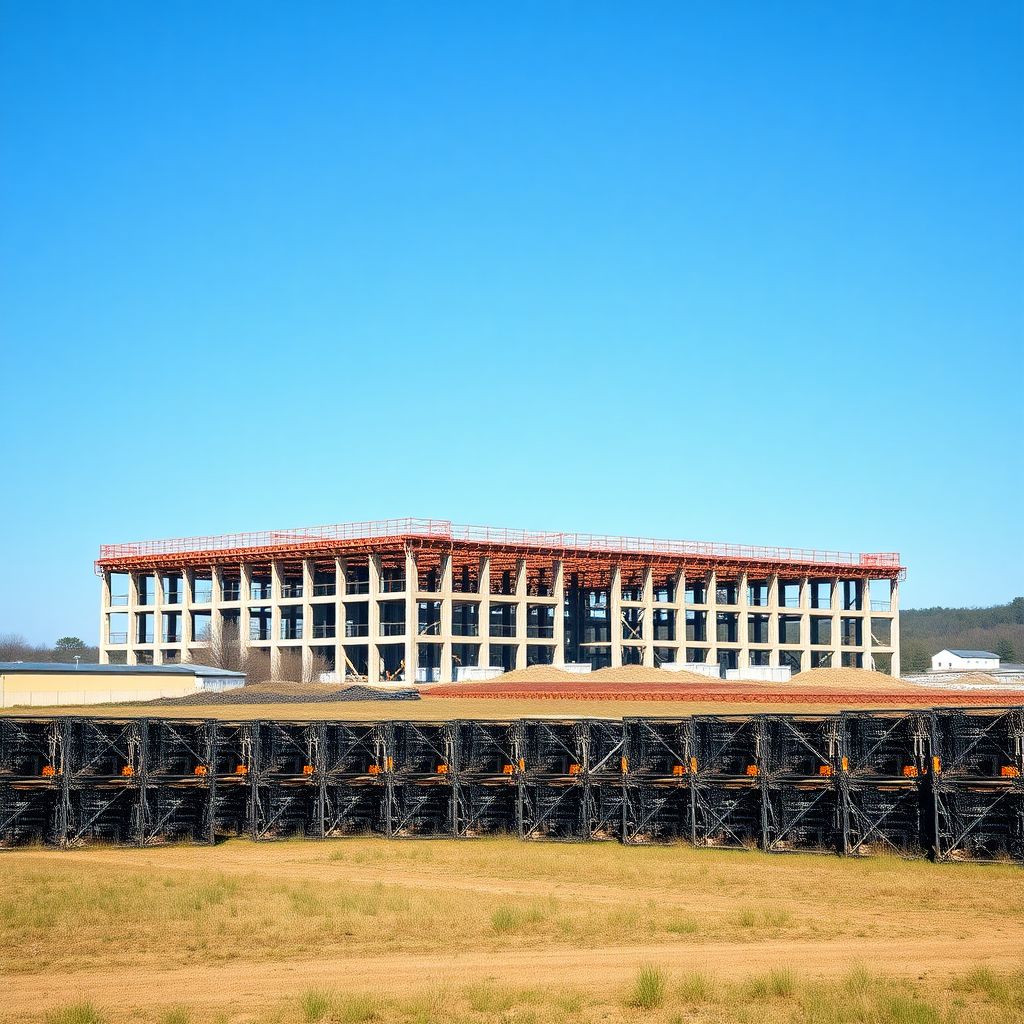
TeraWulf is preparing one of its most ambitious financing efforts to date, aiming to raise about $3.5 billion in debt to build a massive artificial intelligence data center campus in Kentucky that will be leased to Anthropic. The project, structured under a 20‑year agreement, is expected to generate roughly $19 billion in contracted revenue over its initial term, marking a decisive shift in TeraWulf’s business model from pure Bitcoin mining toward AI-focused digital infrastructure.
According to reports, the company is exploring a mix of leveraged loans and high‑yield bonds to assemble the funding package. Morgan Stanley is anticipated to lead the deal, which could formally come to market later in 2026, though neither the bank nor TeraWulf has released detailed terms, interest rates, or a final timetable. The scale and structure of the transaction suggest TeraWulf is ready to tap deeper, more complex credit markets than it has in the past.
Chief Financial Officer Patrick Fleury has indicated that TeraWulf may enter the leveraged loan market for the first time as part of this capital raise. Leveraged loans are typically reserved for borrowers with substantial existing debt or credit ratings below investment grade. These loans usually carry floating interest rates, meaning TeraWulf’s borrowing costs could climb if benchmark rates rise over the life of the loan.
Alongside the loan component, TeraWulf is expected to issue high‑yield, or “junk,” bonds to complete the financing stack for its Justified Data campus in Hawesville, Kentucky. This hybrid structure-combining leveraged loans and high‑yield notes-is common for large, capital‑intensive projects that must balance flexibility, maturity profiles, and investor appetite. Nonetheless, all details remain conditional on broader market conditions, and the company has left room to adjust the structure if credit markets tighten.
The financing effort follows TeraWulf’s previously announced 20‑year lease with Anthropic, one of the leading AI companies. Under that agreement, TeraWulf will design, build, and operate a dedicated AI infrastructure campus capable of supporting about 401 megawatts of critical computing capacity. Initial operations are expected to begin in the second half of 2027, with full deployment targeted for early 2028, making the project a multi‑year, phased build‑out.
TeraWulf projects that the Anthropic lease will produce approximately $19 billion in contracted revenue over the initial 20‑year term. That figure reflects long‑duration, recurring payments rather than an upfront lump sum. The contract is also expected to be supported by an investment‑grade credit profile on the tenant side, which should strengthen the perceived stability of cash flows and help TeraWulf justify its heavy upfront capital spending.
The market initially responded positively to the deal. TeraWulf’s shares moved higher after the company disclosed the Anthropic agreement, as investors saw the contract as a way to secure long‑term, predictable income from AI infrastructure hosting. For a business once heavily exposed to swings in Bitcoin prices and mining difficulty, locking in multi‑decade revenue streams is an attractive shift.
Still, the headline $19 billion figure can be misleading if viewed as immediate value creation. That revenue is spread over two decades and must be offset by the costs of constructing and operating the Kentucky campus, as well as servicing the sizable debt load. Interest expenses, maintenance, energy costs, and future upgrades will all reduce the portion of that contracted revenue that ultimately flows through to TeraWulf’s bottom line.
The company has already demonstrated a willingness to rely on large debt offerings to fund its transition into high‑performance computing (HPC). In October 2025, a TeraWulf subsidiary issued $3.2 billion in senior secured notes at a 7.75% annual interest rate, with maturity in 2030. Those proceeds were used to finance part of the expansion of its Lake Mariner data center in New York, a key asset in its broader infrastructure portfolio.
Beyond those notes, TeraWulf has tapped convertible debt and other credit facilities to expand its footprint. The planned $3.5 billion Kentucky package would significantly add to its total leverage, underscoring both the scale of its AI ambitions and the financial risk inherent in building cutting‑edge data centers ahead of realized cash flows. The strategy assumes that stable, long‑term contracts like the Anthropic lease can justify the heavier balance sheet.
TeraWulf’s pivot is part of a wider migration by Bitcoin miners into AI and HPC services. Many miners already control access to critical inputs such as power, land, cooling, and grid interconnections-exactly the ingredients needed for large‑scale data centers. By repurposing or expanding these assets, they aim to serve cloud providers, AI labs, and enterprise clients that require enormous computing capacity.
Historically, TeraWulf derived the bulk of its income from Bitcoin mining operations. Now the company describes itself as an energy infrastructure operator focused on AI and high‑performance computing clients. Its first‑quarter 2026 results showed that more than half of its revenue already came from HPC hosting, highlighting how rapidly its business mix has changed in just a few years.
The company argues that contracted leases with counterparties like Anthropic reduce its exposure to the volatility of digital asset markets. Instead of relying solely on block rewards and transaction fees, TeraWulf can capture steady, utility‑style cash flows by selling power and space to AI customers. This model more closely resembles traditional data center and infrastructure operators, which investors often value on predictable earnings.
However, this shift introduces a different set of challenges. Building an AI campus of nearly 401 megawatts requires massive upfront capital outlays long before full revenue is realized. TeraWulf must complete substantial portions of the Kentucky site and grid connections before Anthropic can deploy its own servers and begin paying in line with the lease’s ramp‑up schedule.
The company has also faced scrutiny over the total construction budget, the transparency of its cost estimates, insider stock sales, and whether its capital structure is sustainable. Some observers question whether the combination of rising interest rates, high construction inflation, and rapid AI hardware cycles might compress margins over time. Fleury has countered that TeraWulf’s role is deliberately limited to providing power and physical infrastructure, while customers like Anthropic remain responsible for servers, processors, and ongoing technology upgrades.
This separation of responsibilities is central to TeraWulf’s risk management narrative. By avoiding ownership of rapidly depreciating AI hardware, the company seeks to shield itself from the pace of chip innovation and the need for constant refresh cycles. Instead, TeraWulf aims to monetize long‑lived assets such as land, power infrastructure, substations, and cooling systems-elements that do not become obsolete as quickly as GPUs or specialized AI accelerators.
From Anthropic’s perspective, the Kentucky project offers a dedicated environment designed specifically for large‑scale AI workloads. Purpose‑built campuses allow AI operators to secure energy‑efficient, high‑density deployments in locations where power can be sourced at competitive rates. As demand for AI inference and training grows, such bespoke facilities are increasingly seen as a strategic necessity rather than a luxury.
The choice of Kentucky is also notable. Regions with relatively affordable electricity, access to transmission lines, and supportive local authorities are emerging as hubs for next‑generation data centers. For TeraWulf, siting the Justified Data campus in Hawesville suggests a focus on both operational costs and long‑term expansion potential, as well as potential synergies with existing infrastructure and energy supply arrangements.
At the same time, the reliance on debt markets exposes TeraWulf to macroeconomic uncertainty. If credit spreads widen or investor appetite for leveraged loans and high‑yield bonds weakens, the cost of capital could rise or the company might be forced to adjust the project timeline. Given the multi‑year build, TeraWulf must navigate financing windows carefully while keeping the Anthropic timeline on track.
Investors evaluating TeraWulf’s strategy will likely weigh the stability of the Anthropic lease against the risks of high leverage and execution complexity. Key questions include whether the company can deliver the campus on schedule, manage construction and energy costs, refinance maturing debt on reasonable terms, and maintain attractive margins over a 20‑year period marked by rapid changes in AI computing needs.
For the broader crypto and digital infrastructure sector, TeraWulf’s move serves as a case study in how Bitcoin miners are attempting to reinvent themselves. If the Kentucky campus and similar projects prove successful, more miners could accelerate their transitions into AI‑oriented infrastructure providers, leveraging their knowledge of power markets and industrial operations to capture a share of the AI boom.
Ultimately, TeraWulf’s $3.5 billion debt plan underscores both the opportunity and the risk embedded in building AI‑ready infrastructure at scale. The 20‑year, $19 billion Anthropic lease gives the company a clear revenue roadmap, but realizing that potential will depend on careful financial engineering, disciplined project execution, and the continued willingness of capital markets to fund the company’s transformation.