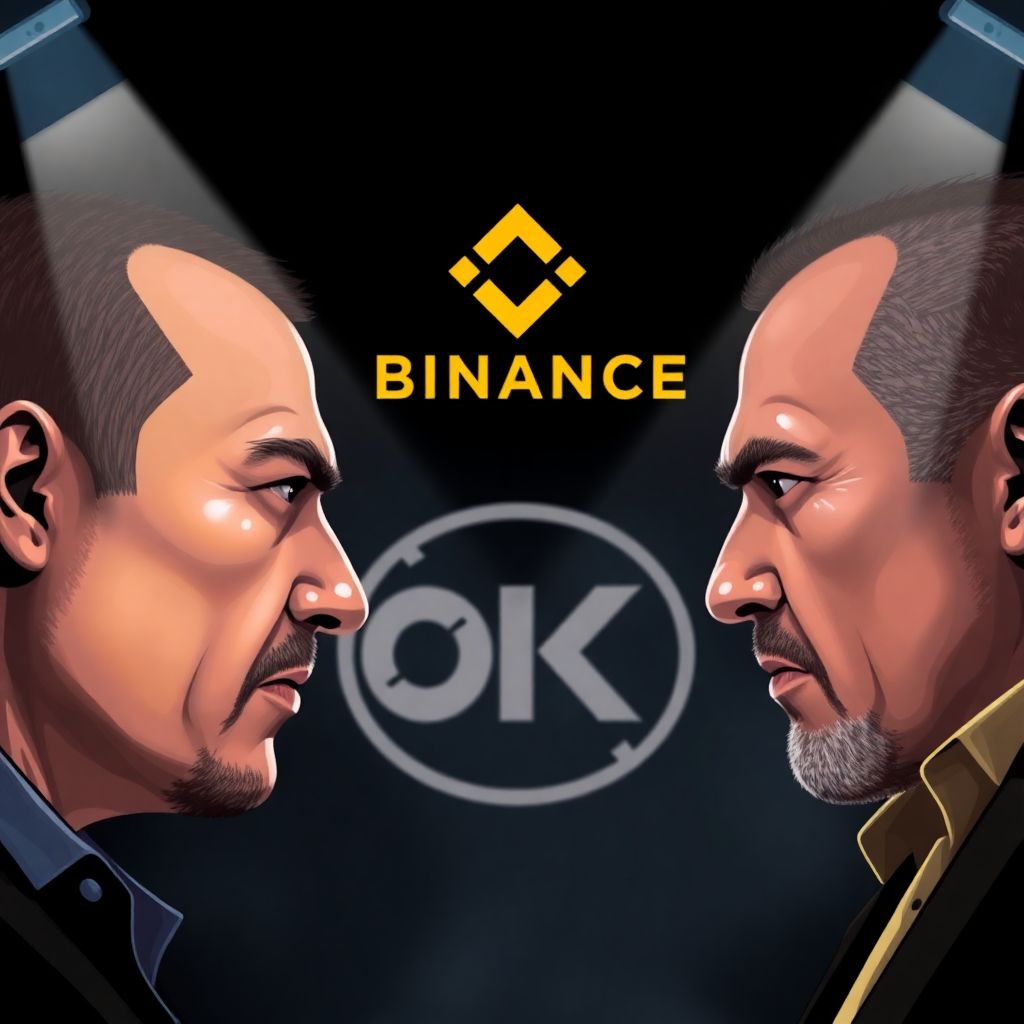
Rivalry Reignites: $1 Billion Showdown Between Binance And OKX Founders
A long-standing tension at the very top of the crypto industry has flared up again, and this time it is less about exchanges and more about the people who built them. Binance founder Changpeng Zhao (CZ) and OKX founder Star Xu (Mingxing Xu) are once again locked in a public war of words, trading accusations about integrity, past business dealings, and even personal life details.
The latest escalation was triggered by the release of Zhao’s autobiography, *Freedom of Money*. Soon after the book began circulating, Xu took to the social media platform X with a barrage of pointed posts, accusing CZ of including “purely false information” and misrepresenting events involving key figures in the industry. Xu framed the book not as a personal memoir but as a vehicle for spreading misleading narratives about himself and others.
One of the central flashpoints in Xu’s criticism is a story in the autobiography that references Huobi founder Li Lin. According to Zhao’s account, Li Lin allegedly told him in 2025 that he had been arrested, supposedly following a whistleblower report tied to Xu. The implication is that Xu may have played a role in Li Lin’s legal troubles through behind-the-scenes reporting to authorities.
Xu has firmly rejected that version of events. He denies ever having filed any such report or contacting authorities about Li Lin at all. In his posts, he stressed that while it is not unusual for people in the crypto sector to submit complaints or reports, such actions rarely, if ever, translate directly into arrests. He argued that Zhao’s telling of the story distorts causality and unfairly casts him as a shadowy instigator.
This renewed conflict has also revived a much older and unresolved dispute from the early days of the industry, dating back to 2014-2015. At that time, Zhao served as a senior executive at OKCoin, a Chinese exchange that would later evolve into OKX. The historic dispute centers on a commercial agreement involving early Bitcoin investor Roger Ver, known for his high-profile advocacy of crypto in its formative years.
According to Xu, the friction emerged when OKCoin discovered what it believed to be doctored contract documents. He claims the company accused Zhao of creating an altered version of a contract that introduced a six‑month termination clause that was not part of the original deal. This alleged modification, Xu says, went to the heart of the business relationship and sparked questions about whether the documents had been falsified.
Zhao has long denied any wrongdoing in that episode. In both past statements and his autobiography, he has suggested that any so‑called “evidence” presented against him could itself have been manipulated. He portrays himself as the target of a smear campaign built on altered documents and incomplete context, rather than a perpetrator of forgery.
Xu counters that narrative by insisting he has material that backs up his side. Recently, he resurfaced what he described as a notarized video, which he claims proves the existence of contract forgery. He said this video, along with other documentation, has been publicly available on the internet for roughly 12 years, implying that the evidence has long been accessible to anyone interested enough to look.
In his latest comments, Xu did not mince words. He labeled Zhao “a habitual liar” and argued that people do not fundamentally change their nature, suggesting that the behaviors he accuses CZ of in the past continue to this day. His posts form a pattern of framing Zhao not just as mistaken, but as someone who systematically distorts reality.
While Xu has gone into detail revisiting old disputes and specific allegations, Zhao chose a different tone in his initial reply. In a separate post on X, CZ dismissed the accusations as false and exaggerated. He stated that he usually does not respond to such claims, but this time ended his message by saying, “You can apologize now,” signaling a refusal to accept any of Xu’s characterizations.
Zhao then shifted the argument into more personal and legal territory. Without engaging line by line with Xu’s technical claims, he announced that he would refrain from posting legal documents publicly, citing respect for his ex‑wife and the privacy of his family. This reference to his marital status set the stage for a bold challenge that has since captured attention across the crypto landscape.
CZ publicly offered a bet of monumental scale. He said he would be “happy to bet $1 billion USD (or any number you choose)” that he is, in fact, legally divorced-and has been for a long time, “way before today.” The wager was framed as a way to resolve disputes over his personal circumstances through formal verification, rather than through speculative online accusations.
To make the stakes clear, Zhao suggested that lawyers could easily validate the divorce agreement, describing the process as “dead simple.” He added that the offer was not time‑limited in principle, stating the bet would remain open “whenever you feel ready.” Yet he also imposed an informal deadline, saying that if Xu failed to accept within 24 hours, observers would be able to infer who had been misleading the public.
This billion‑dollar challenge has injected an almost theatrical element into an already dramatic feud. While it ostensibly relates to the factual question of CZ’s marital status, the underlying issue is credibility. Zhao is effectively wagering an enormous sum to reinforce the message that he stands by his version of events and is willing to put real money behind his claims.
Beyond the personalities involved, the confrontation highlights how much of the crypto sector’s history is still shaped by informal relationships, private agreements, and limited public documentation. Early‑stage contracts, handshake deals, and unrecorded conversations from 2013-2015 now resurface in disputes where there is no neutral referee and where narrative control becomes a powerful weapon.
For market participants, these public clashes between high‑profile founders carry potential implications. On one hand, crypto has long been fueled by strong personal brands and charismatic leaders, so conflicts of this sort tend to attract attention and engagement. On the other hand, persistent accusations of forgery, lying, or collusion can erode trust in platforms, especially among newcomers who are still deciding which exchanges and ecosystems to rely on.
The saga also raises important questions about corporate governance in crypto. Traditional finance firms operate under strict disclosure rules, well‑defined legal frameworks, and regulatory oversight that help adjudicate disputes. In contrast, many leading crypto entities grew out of start‑up environments where founders made rapid decisions, sometimes with minimal paperwork, and where later disagreements are hard to conclusively resolve. The CZ-Xu confrontation is a vivid reminder of how those early informal structures can haunt the sector years later.
From a legal standpoint, both men are in complex positions. Zhao is already navigating regulatory and legal challenges in multiple jurisdictions, making any public statement a potential point of scrutiny. Xu, as the face of another major exchange, must also consider how his public commentary might be interpreted by regulators and institutional partners, especially when it touches on sensitive topics like whistleblowing, arrests, or alleged document tampering.
Investors and users observing this feud may draw different conclusions. Some will view it as a personal vendetta with limited practical consequences; others may see it as a window into how key industry players handle conflict, transparency, and accountability. In a market still fighting for mainstream legitimacy, how leaders conduct themselves in the public eye is no longer a trivial detail-it can influence institutional confidence and user adoption.
There is also a reputational risk for the broader crypto ecosystem. Stories about billion‑dollar bets, accusations of habitual lying, and disputed accounts of arrests can reinforce external perceptions that the industry is chaotic and personality‑driven. At the same time, the very fact that these disputes are aired publicly rather than behind closed doors gives outsiders an unusually raw view into power dynamics that, in other sectors, would likely remain hidden.
For everyday crypto users, the practical takeaway is not only to follow the drama but to strengthen due diligence practices. That means looking beyond founder personas and focusing on concrete factors: security track records, regulatory status, transparency reports, proof‑of‑reserves mechanisms, and the robustness of internal controls. Personal conflicts between executives may be noisy, but the underlying resilience of platforms depends on systems, not individual egos.
As the CZ-Xu rivalry reignites, it illustrates a broader transition underway in crypto: from an era defined by a few dominant, highly visible founders to a more institutionalized phase where governance, compliance, and verifiable data matter more than personal narratives. Whether this particular feud fades or escalates further, it will likely be remembered as one of the defining personal clashes of crypto’s formative decade-and as a case study in how unresolved disputes from the sector’s early years continue to echo through its present.