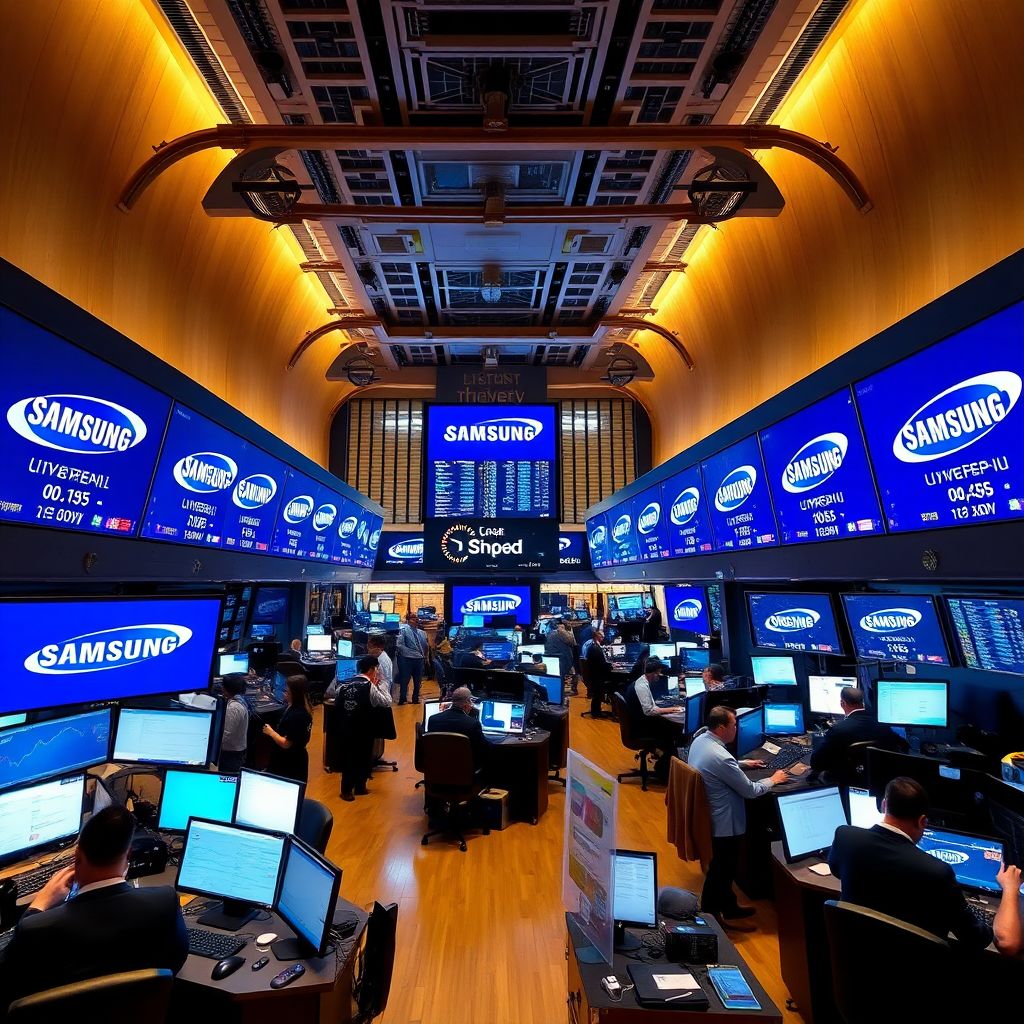
Samsung stock climbed on Tuesday after the electronics giant signaled that the AI chip boom is translating into unprecedented earnings. Investors piled in after the company projected a record first-quarter operating profit powered by surging demand for advanced memory used in artificial intelligence systems.
Shares rose as much as 4.8% during intraday trading before paring gains to close up 1.76%, reflecting both excitement over the blockbuster guidance and caution about growing geopolitical risks that could disrupt supply chains.
According to preliminary figures, Samsung expects an operating profit of about 57.2 trillion won (roughly $37.8 billion) for the first quarter. That would represent more than an eightfold increase compared with the same period a year earlier, underscoring how sharply the company’s fortunes have reversed after a prolonged downturn in the memory market.
If the guidance is confirmed when full results are released later this month, it would set a new quarterly profit record for Samsung. The projected figure is nearly three times higher than the company’s previous peak and far ahead of the 42.3 trillion won analysts were anticipating, showing how conservative market forecasts had been relative to the speed of the AI-driven upswing.
Revenue is also expected to hit new territory. Samsung is forecasting sales of around 133 trillion won for the quarter, a year-on-year increase of nearly 70%. That would mark the first time in its history that the company’s quarterly revenue surpasses the 100 trillion won mark, a psychological and strategic milestone that puts it more firmly in the same league as the largest global technology platforms by scale.
MS Hwang, a research analyst at Counterpoint Research, noted that the magnitude of Samsung’s updated guidance now positions it alongside the world’s biggest tech players in terms of quarterly revenue and profit, highlighting how central advanced semiconductors have become to the broader technology ecosystem.
The primary engine behind this surge is high-bandwidth memory (HBM), a specialized type of DRAM designed to handle the immense data throughput required by AI accelerators from companies such as NVIDIA and AMD. As cloud providers and enterprises race to build out AI infrastructure, demand for these chips has exploded, transforming what was once a cyclical commodity business into a strategic pillar of the AI economy.
Over the past year, the rush to deploy larger AI models and more powerful inference systems has dramatically increased memory intensity in data centers. Training state-of-the-art models and then serving them at scale requires stacks of high-performance HBM integrated alongside GPUs and custom accelerators. This shift has tightened supply and pushed memory prices sharply higher, particularly in segments tied to AI and hyperscale computing.
Industry forecasts now suggest that pricing for data center-related memory products will continue to rise over the coming quarters. For Samsung, this means that its earnings are increasingly leveraged to AI infrastructure spending, with memory chips forming the backbone of its profit growth. The company’s trajectory illustrates how the AI boom is no longer just about processors and software but also about the memory architecture that feeds those chips.
HBM in particular has been at the center of a supply squeeze. Demand has outstripped expectations, creating shortages that ripple across the broader memory market. As customers prioritize AI deployments, they are willing to pay a premium for guaranteed supply and leading-edge performance. Hwang estimates that prices for mainstream memory products, not just HBM, could jump by more than 50% in the second quarter, and expects tight conditions to persist as capacity expansions take time to come online.
This environment has strategic implications for competitive dynamics within the memory industry. Samsung, long considered a leader in DRAM, found itself trailing domestic rival SK Hynix in the earliest waves of HBM for AI workloads. SK Hynix moved faster to supply the most advanced generations of HBM to key customers, capturing a strong position in the high-end AI memory stack.
Samsung is now aggressively working to regain that leadership. It is ramping production of next-generation HBM products, investing heavily in process technology, and pushing to secure qualification in the supply chains of major AI chipmakers. Recovering share in HBM is not just a matter of prestige; it directly impacts access to long-term contracts with the most important customers in the AI value chain.
The importance of this business is evident in the company’s internal structure. Samsung’s Device Solutions division, which includes its memory operations, generated 39% of total revenue and 57% of operating profit in 2025. That profit concentration underscores how critical memory remains to the group’s financial health, even as it continues to sell smartphones, displays, consumer electronics, and other products at massive scale.
At the same time, the company’s guidance is tempered by recognition of growing external risks. Rising tensions in the Middle East are beginning to affect semiconductor logistics, particularly for niche but essential materials. Shipments of helium, a critical input used in various semiconductor manufacturing processes and equipment cooling, have already seen delays.
The conflict dynamics involving the U.S., Israel, and Iran have raised concerns that broader disruptions could affect access to key gases and chemicals required for chip fabrication. Any sustained interruption in these supplies would create operational challenges not just for Samsung, but also for other major memory producers like SK Hynix, potentially exacerbating volatility in both production and pricing.
Hwang cautioned that the duration of the conflict will be crucial. If tensions subside quickly, the impact on profits is likely to be limited. However, a drawn-out crisis lasting several months or longer could have severe consequences for the semiconductor sector, compounding existing bottlenecks at a time when AI-related demand is already stretching the system.
For investors, the current moment encapsulates both the promise and vulnerability of the AI chip cycle. On one hand, AI demand is pushing memory markets into a super-cycle, lifting prices, capacity utilization, and margins to levels that were difficult to imagine just a few years ago during the last downturn. On the other hand, the concentration of production in a handful of regions, alongside geopolitical uncertainties, increases the risk profile of these gains.
Strategically, Samsung is likely to use this profit windfall to double down on capital expenditure. Expanding advanced memory capacity, accelerating R&D into new HBM generations, and investing in cutting-edge manufacturing nodes will be crucial if the company wants to stay competitive as AI systems grow more complex and memory-intensive. The firm also has incentives to diversify its supplier base for critical materials to mitigate geopolitical risk.
Another emerging question is how sustainable the current growth trajectory will be. While AI infrastructure demand looks robust for the next several years, much depends on the pace of deployment by cloud hyperscalers, the economics of AI services, and potential improvements in model efficiency. If AI developers find ways to significantly reduce memory footprints or compute requirements per task, it could moderate the intensity of demand for HBM and related products over the longer term.
In the nearer term, however, the bottleneck is more physical than theoretical. Data centers worldwide are racing to secure enough GPUs and associated memory to train and deploy competitive AI models. This urgency is prompting long-term supply agreements, larger prepayments, and closer technical collaboration between chipmakers, memory vendors, and cloud providers. For Samsung, being at the center of these relationships could translate into more predictable revenue streams, even in a historically cyclical business.
There is also a broader macro angle. As AI becomes a foundational technology across industries-from finance and healthcare to manufacturing and entertainment-the hardware underpinning those capabilities becomes strategically significant for national economies. Governments are increasingly attentive to where advanced semiconductor production is located and how resilient those supply chains are. Samsung’s performance therefore has implications beyond corporate earnings, intersecting with industrial policy and national security debates in multiple countries.
From a market perspective, the latest guidance will likely intensify focus on valuation and expectations. With profits and sales leaping ahead of consensus, analysts will need to adjust models to reflect not only stronger near-term pricing but also a structurally higher earnings base if AI-related demand proves durable. At the same time, any sign of easing memory prices, project delays in AI data center buildouts, or escalation of geopolitical disruptions could trigger sharp reassessments.
Ultimately, Samsung’s record-setting quarter highlights how the AI revolution is reshaping the semiconductor landscape. Memory, long treated as a cyclical commodity, has become a strategic asset in the race to build AI infrastructure. Whether the company can sustain its momentum-while navigating fierce competition and mounting geopolitical shocks-will be one of the key technology stories to watch in the coming years.
Комментарии