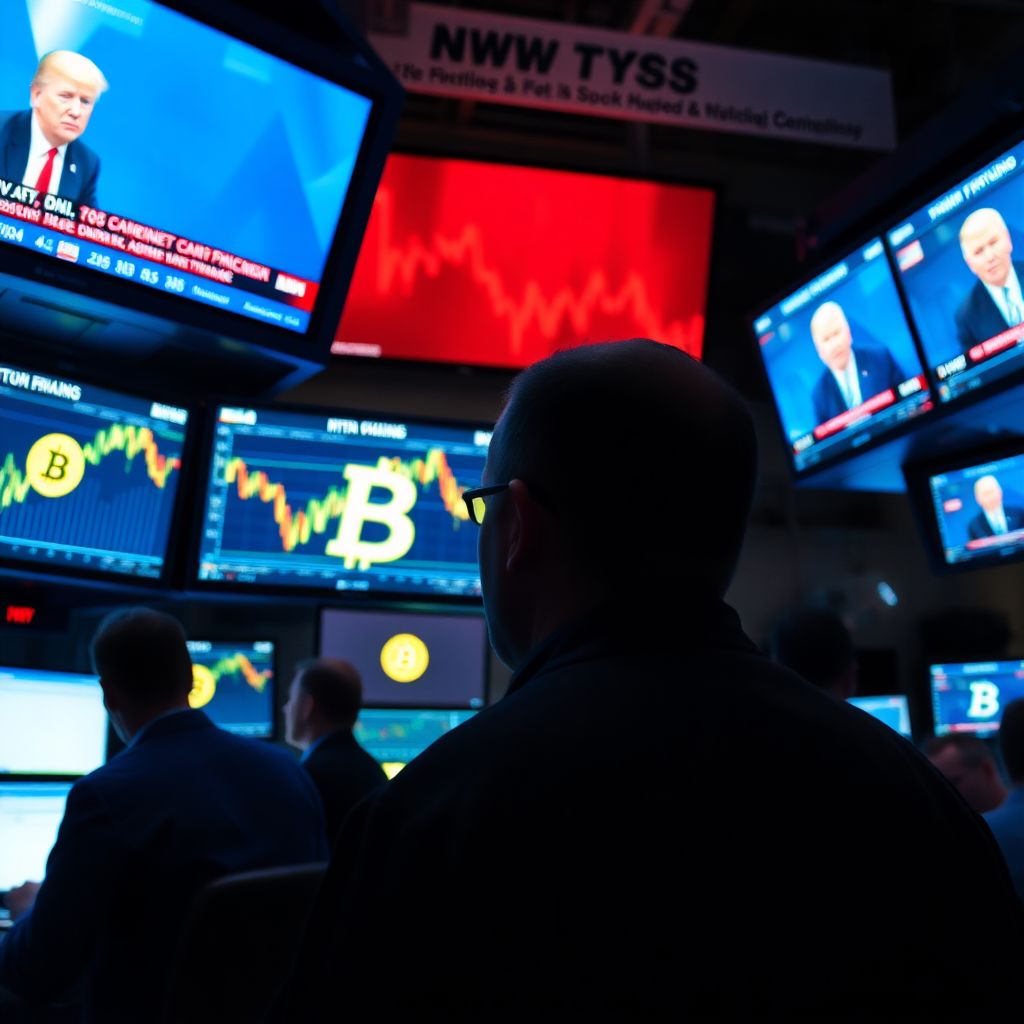
Is Bitcoin gearing up for a breakout as tensions between Donald Trump and Iran escalate? The market is sending mixed but increasingly interesting signals.
At the time of writing, Bitcoin (BTC) hovered close to 66,749 dollars. Price action over the past day was slightly negative, while the seven‑day performance showed a modest gain of 0.81%. Daily trading volume stood at around 19.67 billion dollars, underscoring a market that is active but far from euphoric.
Beneath the surface, the broader crypto landscape remained unusually subdued. Major digital assets moved within tight ranges, and overall market participation looked weak. Altcoins in particular suffered from soft turnover and thinner order books, reinforcing the sense that liquidity is sitting on the sidelines and waiting for a catalyst.
Several analysts highlighted how compressed the market has become. Crypto trader Michaël van de Poppe noted that volatility on Bitcoin’s four-hour chart has dropped to its lowest reading since the last major breakdown. In technical terms, the market appears to be deep inside a volatility squeeze – a phase when price coils in a narrow band before expanding sharply in one direction or another.
According to van de Poppe, this low‑volatility regime is unlikely to persist much longer, based on how similar setups have resolved in the past. He pointed out that altcoins mirror Bitcoin’s pattern: weak price swings, declining volume, and shallow liquidity across many pairs. To him, this environment often precedes a “liquidity sweep,” when price briefly dips or spikes to flush out leveraged positions, followed by a fast rebound rather than a prolonged sell‑off.
Despite rising geopolitical risks, van de Poppe does not foresee a significantly deeper downward leg. Instead, he anticipates a possible shakeout that could quickly be retraced, potentially as soon as the coming week. In his view, the technical structure of the market is more important right now than the constant stream of political headlines.
Another widely followed commentator, EGRAG CRYPTO, took a longer‑term perspective, focusing on the historical structure of Bitcoin market cycles. He drew attention to a recurring pattern in which previous cycle bottoms gravitated toward the 1.618 Fibonacci extension level before forming a durable base. This region, according to his analysis, has often coincided with peak fear in the market and the beginning of serious accumulation by longer‑horizon investors.
EGRAG characterized this 1.618 zone as less of a magical number and more of a recurring behavioral marker: a place where capitulation and opportunity tend to overlap. He emphasized that his outlook is driven by chart structure rather than the latest political developments, arguing that traders should prioritize on‑chain metrics, price action, and numerical models over emotionally charged narratives.
While technical analysts focused on charts, traders could not ignore new comments attributed to Donald Trump concerning Iran and the Strait of Hormuz. Fresh posts from the macro-focused Kobeissi Letter highlighted statements linking potential US actions and tensions in one of the world’s most critical oil shipping lanes. The account also reported that Trump planned to appear alongside US military officials at a press conference scheduled for 1 PM Eastern Time on Monday.
Those developments injected an extra layer of caution across risk markets, including crypto. The Strait of Hormuz is a key chokepoint for global energy supplies, and any perceived threat to its stability tends to reverberate through oil, equities, and alternative assets. For Bitcoin traders, this raised the question: Will escalating geopolitical tensions act as a catalyst for a breakout, or will they simply deepen uncertainty and keep liquidity on the sidelines?
Historically, Bitcoin’s reaction to geopolitical crises has been inconsistent. In some episodes, such as regional conflicts or sudden sanctions, BTC has briefly behaved like a hedge, catching a bid as investors looked for assets outside the traditional financial system. At other times, particularly during acute risk‑off phases, Bitcoin has traded more like a high‑beta tech stock, dropping in tandem with equities as traders rushed to raise cash.
The current setup is complicated by Bitcoin’s maturation as an asset class. Institutional participation and derivatives usage have grown dramatically, making positioning and liquidity far more important drivers than simple “safe‑haven” narratives. A tightly wound volatility squeeze in the context of rising geopolitical stress can therefore produce outsized moves in either direction, depending on how leveraged players are aligned.
One key factor to watch is how derivatives markets are positioned around the current price range. When volatility is compressed and options implied volatility is low, a surprise headline or sudden shift in narrative can trigger forced liquidations, especially if many traders are leaning in the same direction. This is what analysts refer to as a “squeeze”: price rapidly moves against crowded positions, hunting stop‑losses and margin calls before establishing a new range.
In the spot market, thin liquidity can amplify that effect. With order books less dense than usual, relatively modest buy or sell flows can push price further than expected. This dynamic has become visible in the altcoin sector, where smaller capitalizations and reduced participation have made sharp intraday swings more common, even within an otherwise flat broader market.
For long‑term investors, such periods often present both risk and opportunity. On the one hand, fragile liquidity and heightened political tension can translate into sudden and uncomfortable drawdowns. On the other, history shows that some of Bitcoin’s most attractive entry points have emerged from zones of fear and exhaustion – precisely the kind of areas that long‑term Fibonacci and cycle analyses attempt to identify.
It is also important to recognize that macro and regulatory backdrops are shifting in parallel with geopolitics. Recent moves toward clearer oversight from agencies such as the SEC and CFTC have begun to redefine how large participants can access the market. While stricter rules can appear restrictive in the short run, they also create a more predictable framework that enables institutional capital to approach Bitcoin with greater confidence.
At the same time, the crypto ecosystem continues to wrestle with its own internal vulnerabilities. Events like the 285‑million‑dollar exploit of Drift Protocol underscored how social engineering and security lapses remain a significant threat to decentralized finance platforms, particularly on networks like Solana that have seen rapid growth. These episodes do not directly dictate Bitcoin’s price, but they shape overall sentiment around digital assets and influence how risk is priced.
Parallel to that, innovation around prediction markets and new forms of on‑chain liquidity is quietly expanding. Projects aiming to bring derivatives, forecasting tools, and AI‑driven liquidity provision directly onto blockchain rails hint at a future where macro bets – including wagers on war, elections, and policy decisions – could be increasingly integrated into crypto market structure. As those products mature, geopolitical tension could translate more quickly and transparently into on‑chain positioning.
Security concerns are not limited to smart contracts. Broader technological shifts, such as advances in quantum computing and the development of fully homomorphic encryption, are reshaping how developers think about the long‑term resilience of cryptographic systems. While Bitcoin’s core design remains robust for now, debates around post‑quantum security and data privacy are becoming more central to the narrative and may influence how deeply governments and institutions are willing to integrate with public blockchains.
Against this background, narratives around war, empire, and financial sovereignty are resurfacing in public discourse. Commentators and academics alike are exploring how Bitcoin fits into a world where currency policy, military strategy, and digital infrastructure are increasingly intertwined. Some argue that Bitcoin represents a kind of neutral monetary rail in an era of fragmented geopolitics; others see it as just another speculative asset whose fate is bound to central bank liquidity and global risk appetite.
Regional policy experiments highlight these tensions. In some jurisdictions, like Dubai, efforts to build crypto‑friendly hubs collide directly with the realities of regional conflicts and sanctions, including those involving Iran. Elsewhere, policymakers debate whether capital flight, health emergencies, or domestic regulations – rather than foreign bans – are the real drivers behind corporate migration and shifting financial centers. All of this forms the macro backdrop in which Bitcoin’s next big move will occur.
So is Bitcoin on the verge of a breakout as Trump‑Iran tensions rise? From a structural standpoint, multiple ingredients for a large move are present: compressed volatility, thin liquidity, modest but positive recent returns, and a framework of geopolitical uncertainty that could act as a spark. Technical analysts are watching for the end of the volatility squeeze and tracking key Fibonacci zones that historically marked points of maximum fear and strong accumulation.
Yet the direction of that breakout is not predetermined. If tensions escalate sharply and traditional markets enter a deep risk‑off phase, Bitcoin could initially suffer alongside equities as traders de‑risk across the board. Conversely, if the situation escalates in rhetoric but not in systemic economic damage, or if markets interpret any announcements as contained, Bitcoin could catch a bid from investors looking for uncorrelated exposure and from short‑sellers caught on the wrong side of the squeeze.
For traders, the current environment calls for precise risk management rather than blind bets on geopolitical outcomes. Monitoring liquidity, open interest, funding rates, and spot‑derivatives flows can offer better clues than headlines alone. For long‑term holders, the critical question is whether current price levels and fear indicators align with historically attractive accumulation zones, independent of this week’s political theater.
Ultimately, the market appears to be coiling for a decisive move. Whether Bitcoin breaks out upward as a perceived hedge amid Trump‑Iran tensions, or downward in a broader flight to safety, will depend less on a single speech or press conference and more on how leveraged positioning, liquidity, and long‑term conviction collide in the days ahead.