Free Bitcoin Returns? Jack Dorsey’s Block Revives the Classic Faucet Model
Block is preparing to bring back one of Bitcoin’s oldest traditions: the faucet. On April 6, the company plans to relaunch a Bitcoin giveaway via a new website, btc.day, echoing the early days of the network when small amounts of BTC were handed out for free to help newcomers get started.
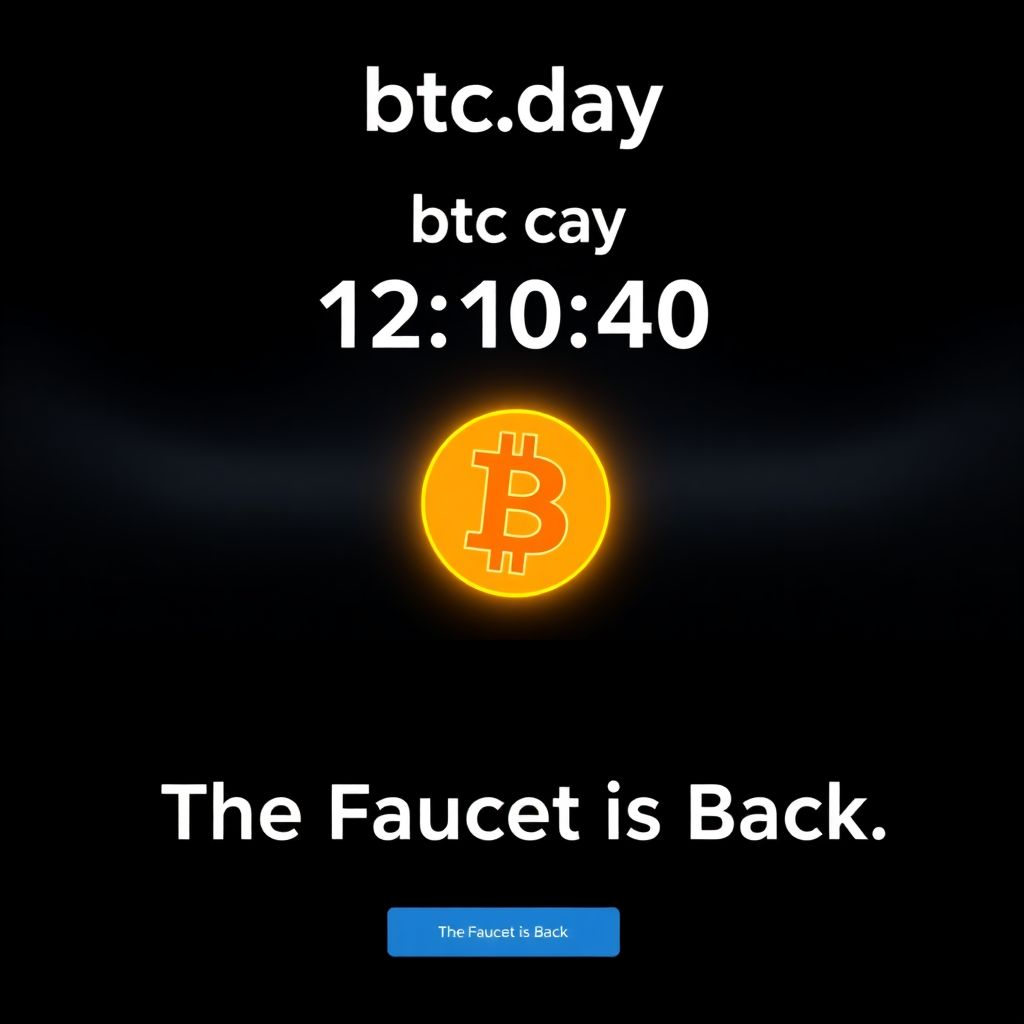
The btc.day landing page is already live, featuring a countdown clock, an orange faucet icon, and the tagline “The Faucet is Back” alongside the words “Buy, Secure, Spend.” For now, that is all users can see. There are no sign-up forms, no visible tasks, and no published instructions for how the Bitcoin will be distributed once the countdown ends.
Jack Dorsey announced the initiative in an update focused on Block’s broader Bitcoin strategy, framing the faucet as part of a push to expand access and deepen public understanding of the asset. Block confirmed that btc.day will host the new faucet but has deliberately held back key details such as eligibility criteria, distribution rules, and the total amount of BTC involved.
A Throwback to Bitcoin’s Earliest Days
The faucet idea is not new. It traces back to 2010, when software developer Gavin Andresen launched one of the first Bitcoin faucets to boost awareness of the then-obscure digital currency. At that time, users who solved a simple captcha and submitted a wallet address received five BTC for free.
In 2010, Bitcoin had almost no mainstream recognition and was largely an experiment among developers and early adopters. Faucets played a practical educational role: they gave people a way to test wallets, learn how transactions worked, and see coins move on-chain without risking their own money. Over time, that early faucet became a legendary part of Bitcoin history, often cited as an example of just how different the ecosystem looked when the currency was worth almost nothing.
By reviving the faucet format, Block is explicitly tying a modern campaign to one of the most iconic distribution methods from Bitcoin’s first years. The move suggests a desire to reconnect with Bitcoin’s original ethos of openness and experimentation, but translated into today’s far more mature market.
What We Still Don’t Know About btc.day
Despite the fanfare around the announcement, much remains unclear. Block has not said whether the faucet will:
– Require users to complete captchas or similar human-verification tools
– Involve wallet checks or any on-chain conditions
– Ask for KYC or identity verification
– Be open worldwide or restricted to certain regions, age groups, or customer segments
The btc.day interface currently shows no indication that users must complete tasks, watch ads, or engage with specific products. That could change once the countdown ends, but for now the experience is intentionally minimal, echoing the simplicity of Andresen’s original faucet, which relied only on a captcha and a wallet address.
Block has also not disclosed the size of the Bitcoin allocation reserved for the faucet. As of its accumulation record dating back to October 2020, the company held 8,883 BTC, but neither Dorsey nor Block has said whether any portion of that stash will be used for the giveaway, or whether the BTC will come from a separate budget.
A Very Different Market From 2010
While the faucet model is familiar, the environment it returns to could hardly be more different. In 2010, Bitcoin was a niche experiment with a handful of users and almost no economic activity. Today, there are millions of wallets, institutional holders, listed companies with BTC on their balance sheets, and a dense infrastructure of exchanges, custodians, and payment services.
That shift fundamentally changes what a faucet can achieve. Back then, five BTC was simultaneously trivial from a market perspective and almost meaningless in fiat terms. Now, even modest distributions could attract significant attention and speculative interest, especially if claimed at scale by a large global user base.
Some observers see the faucet revival as a way to keep Bitcoin approachable at a time when high prices and complex infrastructure might intimidate beginners. Giving away small amounts of BTC can make the asset feel tangible again, turning abstract headlines about market caps and ETFs into a direct interaction with the network itself.
Education, Onboarding, and Brand Strategy
Beyond nostalgia, the faucet fits neatly into Block’s positioning as a Bitcoin-first company. The initiative can serve multiple overlapping goals:
– Education: By guiding new users through wallet setup, security basics, and transaction mechanics, a faucet can function as a live tutorial, not just a giveaway.
– Onboarding: The campaign can introduce people to Block’s broader ecosystem of Bitcoin-focused products, from payments to custody tools.
– Reputation and alignment: Recreating a classic Bitcoin distribution method signals alignment with long-time Bitcoin supporters and reinforces Block’s image as committed to the asset’s long-term growth, not just its short-term price.
If Block chooses to integrate educational modules into btc.day – such as step-by-step guides, risk explanations, and basic security lessons – the faucet could double as an entry point into more responsible crypto usage rather than a one-off marketing stunt.
Potential Structures and Constraints
Without official rules, observers can only speculate about how the faucet will function in practice. Several models are possible:
– Simple one-time claim: Each user can claim a fixed, small amount of BTC once, after minimal verification.
– Tiered distribution: Users might unlock larger or repeated claims by completing educational content or demonstrating certain on-chain actions.
– Region-limited rollout: Due to regulatory constraints, the faucet might initially be available only in selected jurisdictions, expanding over time.
– Time-based releases: BTC could be distributed in stages, with periodic claim windows to prevent rapid draining of the entire allocation.
Block will also have to balance ease of access with fraud prevention. Captchas, device checks, and limits per user or per wallet are classic tools to deter bots and mass farming. Too much friction, however, could undermine the accessibility that makes faucets attractive in the first place.
Regulatory and Compliance Considerations
Compared with 2010, giveaways of digital assets now operate under far closer regulatory scrutiny. Depending on how the faucet is structured, Block may need to navigate rules around:
– Anti-money-laundering and know-your-customer procedures
– Marketing and promotional disclosures
– Tax reporting obligations for both the company and recipients in some jurisdictions
These constraints might explain why Block is withholding details until closer to launch. Designing a faucet that feels open and simple while remaining compliant across multiple markets is a complex task – especially for a publicly listed company with a large Bitcoin treasury.
Why This Matters for Bitcoin’s Narrative
The return of a faucet under a high-profile figure like Jack Dorsey carries symbolic weight. It highlights several ongoing trends in the Bitcoin story:
– A renewed focus on broad access, not just institutional adoption
– Recognition that first-hand experience – even with tiny amounts – is one of the most effective ways to demystify Bitcoin
– An attempt to bridge early cypherpunk culture with present-day corporate participation
At a time when much of the conversation revolves around price levels, ETFs, and macro correlations, a faucet re-centers the user. It reminds the market that Bitcoin’s value proposition is grounded in self-custody, peer-to-peer transfers, and individual experimentation.
What Prospective Users Should Expect
Until Block publishes the full rules, the most practical step for interested users is straightforward: monitor btc.day as the April 6 countdown approaches and be prepared with a secure, non-custodial Bitcoin wallet if the faucet requires one.
Users should also set realistic expectations. Historically, modern faucets distribute very small sums per person, intended more as a learning tool than as a source of profit. The key benefit is often educational: experiencing how to receive, hold, and potentially spend Bitcoin safely.
At the same time, the design of this particular faucet will reveal how a major corporate player interprets Bitcoin’s grassroots heritage in 2026. Whether btc.day ends up as a simple nostalgia-driven drop or the foundation of an ongoing educational and onboarding program, its launch will offer a clear signal of how Block envisions its role in Bitcoin’s next chapter.
For now, the market is waiting on three crucial pieces of information from Block: how much Bitcoin will be allocated, who will be allowed to participate, and what, if anything, users will need to do to claim their share once the faucet is turned back on.