Art on Tezos is rapidly outgrowing its reputation as a niche crypto experiment. At TezDev 2026 in Cannes it appeared less like a speculative subculture and more like a working prototype of how digital culture, art infrastructure, and global creative economies might function in the coming decade.
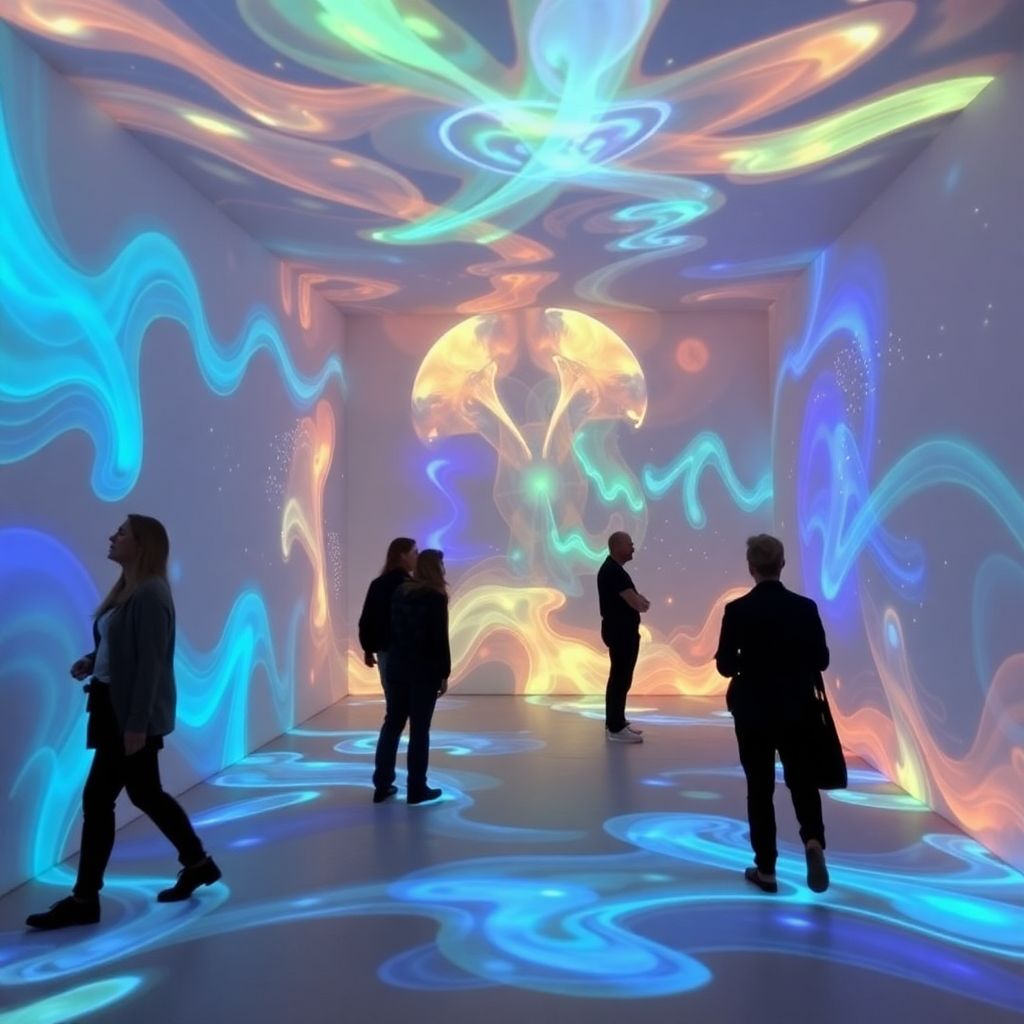
Under the banner “Art on Tezos: The Future of Digital Creativity,” the event at Hôtel Martinez on March 30 was staged as an immersive environment rather than a traditional conference panel. Instead of rows of chairs facing a screen, visitors entered a room enveloped in projection‑mapped artworks: generative compositions flowed across the walls, responsive visuals shifted with the movement of the audience, and the space pulsed like a living gallery. Conversations between artists, curators, and ecosystem builders unfolded literally inside the artwork, underscoring a core message: on‑chain art is no longer just about static NFTs; it is becoming a responsive, infrastructural layer of culture.
Curator and art advisor Brian Beccafico framed Tezos’ significance in terms of who gets to participate. Drawing on his experience with digital marketplaces, he emphasized that Tezos dramatically broadens the geography of the art world. On the network, he regularly encounters artists from regions historically sidelined by traditional institutions: countries across Africa, Southeast Asia, and South America, where physical access to galleries and major auction houses is limited or non‑existent. In a global system where the majority of auction value still concentrates in a handful of cities, this redistributive effect is not just symbolic; it is economic.
Low transaction costs and open‑source tools translate into viable income streams. Beccafico pointed out that for artists in lower‑income economies, selling digital pieces for seemingly modest amounts can be life‑changing. A price that looks small from the perspective of New York or London may equate to a sustainable monthly income elsewhere. On Tezos, this is not a theoretical promise but an observable pattern: artists who never had access to the primary or secondary market now earn consistently from their work, build collectors, and fund further experimentation without needing to relocate or secure representation in elite galleries.
Aleksandra Art, Head of Arts at Trilitech, situated this shift within a longer history of media and legitimacy. She recalled that photography itself was once dismissed as a mechanical trick rather than a serious art form. Only after decades of exhibitions, criticism, and collecting practices did it become central to museums and major collections. A similar trajectory is now visible for digital and on‑chain art, with each technological wave – from early computer graphics to social media and now blockchain – forcing institutions to rethink what counts as “art” and who gets to make it.
The advent of platforms built around images, she noted, created a new category of “Instagram artists” who reached global audiences without any formal gallery backing. Blockchains and digital marketplaces extend this logic further by hard‑wiring provenance, ownership, and distribution into the medium itself. Instead of relying on a small network of intermediaries, artists tap into decentralized systems that connect creators, curators, technologists, and collectors into self‑organizing communities. These networks are not just promotional channels; they become the actual infrastructure through which art circulates, is valued, and is archived.
For Aleksandra, the most radical break is not financial but spatial. Digital works on Tezos are not bound to white‑cube galleries or fixed wall dimensions. They can inhabit vertical and horizontal screens, browser windows, augmented reality overlays, or site‑specific projections mapped onto architecture. A piece can be experienced simultaneously in a museum, on a home display, and on a phone, with each viewer encountering essentially the same work at the same time. This “screen‑native” condition untethers art from location, making the gallery less a physical address and more a protocol for shared experience.
Beccafico also underscored the political implications of this technological shift. He recalled shows where artists from conflict zones used crypto not as a trendy payment method but as a survival tool. In some cases, blockchain‑based assets helped them escape violence, bypass capital controls, or move resources across borders when banking systems were collapsing. In such contexts, the older cypherpunk ideals of censorship resistance and financial autonomy are not nostalgic slogans; they are immediate questions of safety and agency.
This dimension bleeds back into aesthetics. Many artists from Iraq, Turkey, Kurdistan, and across Latin America use on‑chain work to bear witness to war, displacement, and state violence while simultaneously leveraging crypto rails to sustain themselves. Rather than being relegated to the periphery, these voices increasingly anchor the conversation about where both the crypto ecosystem and the art world are headed. In Beccafico’s view, they represent not the margins but the horizon line – the place where new forms of artistic and economic practice are first visible.
Alongside Aleksandra and Beccafico, the session brought together figures like Vinciane Jones (Art Partner Manager at Trilitech) and artists Patrick Tresset and Georg Eckmayr. Their discussion traced a genealogy from early algorithmic drawing and plotter art through networked installations and today’s AI‑assisted systems. Tezos, they argued, acts as a backbone for these practices: a ledger that doesn’t just record ownership but captures process, iterations, and interactions as part of the artwork itself.
This technical layer dovetails with developments elsewhere in the TezDev 2026 program. Protocol improvements such as Tezos X and faster Etherlink confirmations are often framed as upgrades for finance or DeFi, but here their cultural implications were foregrounded. Reduced latency and greater throughput make it feasible to build real‑time, interactive works – pieces that respond to live data, audience behavior, or game environments while still writing key events and states on‑chain. The result is a new genre of art that is both performative and collectible, both live and permanently verifiable.
Trilitech signaled that what happened in Cannes is not an isolated spectacle but part of a broader institutional strategy. The team highlighted plans for an upcoming Tezos‑powered exhibition at HEK (Haus der Elektronischen Künste) in Basel, curated by Dr. Alfredo Cramerotti and Auronda Scalera. Both curators are known for bridging contemporary art, emergent technologies, and critical media practices. Their involvement indicates that on‑chain art is moving further into the museum ecosystem, not as a novelty add‑on but as a serious node within the history of digital and conceptual art.
This institutional embrace has several consequences. First, it gives collectors and museums a framework for conservation: questions about how to preserve smart‑contract based works, maintain interactive systems, or display generative projects over decades are now being tackled in dialogue with established conservation practices. Second, it pushes curators to consider how artists from emerging markets and historically excluded communities fit into the canon of digital art, rather than being siloed into separate “NFT” categories. Third, it challenges audiences to approach blockchain not only as a financial technology but as a medium – a material with its own constraints, aesthetics, and politics.
The comparison with photography’s slow ascent into museum collections is instructive. Where the photographic medium took roughly a century to transit from “mere mechanical reproduction” to “museum cornerstone,” Tezos artists are compressing that arc into a fraction of the time. Over just a few years, the ecosystem has evolved from early collectible tokens into a dense field of generative, interactive, and socially engaged practices. Blockchains here function not only as marketplaces but as infrastructure for new kinds of authorship, collaboration, and distribution.
From a market perspective, this shift is redefining what collectors look for. Instead of focusing solely on rarity or speculative price action, a growing segment of Tezos collectors pays attention to artistic lineage, conceptual rigor, and technical innovation. They follow specific artists over time, observe how codebases evolve, and treat on‑chain works as part of a broader practice. This resembles traditional collecting – tracking an artist’s career – but it is augmented by transparent provenance, programmable royalties, and community‑driven curatorial signals encoded in the chain itself.
For artists, Tezos lowers the barrier to experimenting with sophisticated formats. Smart contracts allow for dynamic pricing, evolving editions, or works that change state in response to real‑world events. Generative projects can reveal new outputs over time, while interactive pieces can reward collectors or communities for participation. Because transaction costs are relatively low, creators can iterate rapidly, test ideas in public, and involve their audience in the life cycle of the work without prohibitive overhead.
The educational impact is equally significant. At festivals like TezDev, participants do not just passively watch talks; they gain direct exposure to minting, collecting, and interacting with on‑chain art. Curators, developers, and artists share workflows and code, accelerating the diffusion of knowledge. Students and young practitioners witness a model where art, technology, and global economics intersect, and they see clear pathways to enter the ecosystem regardless of their geographic origin or institutional affiliation.
Meanwhile, the physical‑digital interplay is becoming more sophisticated. The Cannes event demonstrated how large‑scale projection, spatial sound, and responsive installations can translate on‑chain logic into sensory experience. Rather than displaying small screens on plinths, organizers treated the entire venue as a canvas, with blockchain‑registered works unfolding across floors and walls. This approach hints at future hybrid exhibitions where museums, public spaces, and urban infrastructure become interfaces for live, verifiable digital art.
Looking ahead, the path from Cannes to Basel sketches an emerging institutional future for Art on Tezos. Festival showcases, museum exhibitions, academic research, and grassroots marketplaces are starting to connect into a cohesive ecosystem. In that ecosystem, artists from underrepresented regions stand alongside established digital pioneers; political urgency coexists with formal experimentation; and blockchain technology shifts from background infrastructure to an explicit, debated component of artistic practice.
If the Cannes event is any indication, Tezos‑based art is no longer content to exist at the periphery of culture. It is actively testing how digital creativity can operate at scale: more inclusive in who creates and collects, more flexible in how and where works are experienced, and more transparent in how value and authorship are defined. In doing so, it turns places like Cannes – once primarily synonymous with cinema and red carpets – into live laboratories for the next phase of digital culture.