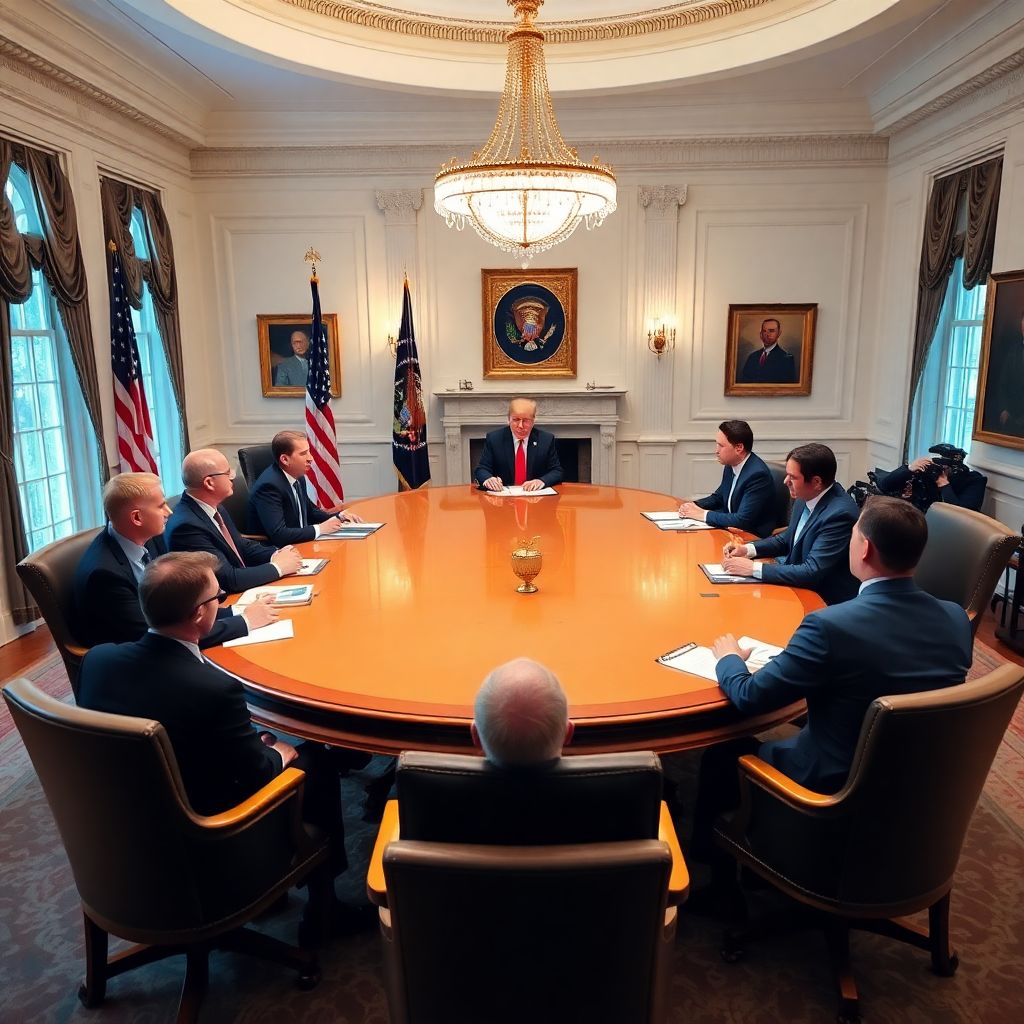
Trump’s revamped science advisory council has become an unexpected convergence point for artificial intelligence pioneers and crypto heavyweights, underscoring just how central these technologies have become to U.S. economic and security strategy.
On Wednesday, President Trump named the first 13 members of his President’s Council of Advisors on Science and Technology (PCAST). While the body is traditionally stacked with academic scientists, engineers, and industrial researchers, this iteration leans heavily into frontier tech: AI researchers, crypto entrepreneurs, digital asset investors, and infrastructure builders reportedly make up a significant share of the early picks.
Rather than treating digital assets as a fringe interest, the new lineup effectively places crypto and AI alongside more conventional areas like biotechnology, energy, and aerospace. The message is clear: in this administration’s view, blockchains, machine learning, and quantum computing are no longer side projects-they’re core pillars of national science and technology policy.
A council that looks like a startup cap table
The early composition of the council resembles a roster you’d expect to see on the advisory board of a deep-tech startup fund, not a government committee. It includes:
– Founders or executives from AI companies focused on large language models, autonomous systems, and data infrastructure.
– Crypto and Web3 leaders with experience in stablecoins, layer-1 and layer-2 networks, and institutional adoption of digital assets.
– Venture investors known for backing AI, crypto, and other “general-purpose” technologies that cut across many sectors of the economy.
What makes this notable is not just who is in the room, but what they represent: a worldview that treats code, compute, and cryptographic networks as strategic assets on par with oil reserves or semiconductor fabs. It also hints at a policy agenda that may prioritize onshoring AI infrastructure, creating friendlier rules for digital asset innovation, and using market incentives to drive scientific breakthroughs.
Crypto finally gets a formal seat at the policy table
For years, crypto policy in the U.S. has largely been driven by regulators, courts, and ad-hoc legislative efforts, often with limited technical input from practitioners. By giving digital asset leaders an official role in a science and technology advisory body, the administration is signaling that crypto is no longer just a compliance problem to be managed, but a strategic tool to be leveraged.
In practice, this could influence areas such as:
– Stablecoin frameworks: Advice on how dollar-pegged tokens should be supervised without suffocating innovation.
– Market structure and custody: Guidance on how to safely integrate digital assets into banks, brokers, and traditional market rails.
– Digital identity and payments: Exploration of crypto rails for cross-border payments, remittances, and programmable money.
– National competitiveness: Recommendations on keeping blockchain talent, capital, and infrastructure inside U.S. borders.
Whether this leads to looser regulation, tighter guardrails, or simply clearer rules will depend on how much weight the administration gives to the council’s recommendations-and how much pushback comes from more skeptical agencies.
AI policy: racing to stay ahead of the curve
The strong AI presence on the council reflects a parallel concern: the global arms race around advanced machine learning. With frontier models shaping everything from cyber defense to industrial automation, the White House appears to be betting that it needs direct lines into the top minds (and companies) driving this wave.
Expect the council to weigh in on questions like:
– How to balance open-source AI with national security risks.
– What kind of liability or safety standards should apply to powerful models.
– How to ensure access to compute and data for smaller players, not just tech giants.
– How AI can be used to accelerate scientific discovery in areas like drug development, materials science, and climate modeling.
The intersection with crypto is not trivial either: AI workloads increasingly depend on decentralized compute, token-incentivized data markets, and on-chain coordination mechanisms. A council that understands both sides of that equation may push for policies that treat AI and crypto as mutually reinforcing, rather than siloed domains.
Google draws a line in the sand on quantum: 2029
The broader technology backdrop is equally aggressive. Google has reportedly set itself a deadline of 2029 for a major quantum computing milestone, which would bring practical, large-scale quantum systems closer to reality.
If that timetable holds, it has direct implications for both AI and crypto:
– For AI: Quantum machines could accelerate certain optimization and simulation tasks, potentially reshaping how we train and deploy complex models.
– For crypto: Quantum capabilities raise long-term questions about the security of existing cryptographic schemes, pushing governments and protocols toward “post-quantum” defenses.
A science council preoccupied with AI and blockchains will almost certainly be forced to grapple with a future in which quantum computing can both empower and destabilize digital systems.
Circle’s bad day looks more like a market overreaction
Away from Washington, digital asset markets have been working through their own drama. Stablecoin issuer Circle recently endured what looked like its worst day in recent memory, with sharp moves in its stock and broader speculation about its long-term prospects.
Analysts now increasingly frame that episode as an overreaction rather than a fundamental breakdown. After the dust settled, key data points-on-chain volumes, redemption activity, and reserves-did not show systemic stress in the company’s flagship dollar-pegged token. The market appears to have briefly treated headline risk as existential risk, only to reverse as hard data filtered in.
For policymakers and investors alike, the incident is a reminder that:
– Stablecoin issuers can be extremely sensitive to sentiment, even when their collateral position is sound.
– Clear, transparent reserve reporting can dramatically shorten the life of fear-driven selloffs.
– A better regulatory framework might reduce the frequency and severity of these episodes.
With stablecoins increasingly central to global crypto liquidity, how regulators and advisory bodies interpret such events could shape rules on disclosures, audits, and reserve management.
Whop brings DeFi into mainstream tooling with Aave integration
In the builder ecosystem, platform provider Whop has embedded lending protocol Aave directly into its product suite. This move effectively puts DeFi yield and borrowing tools in front of users who might never visit a standalone decentralized finance dashboard.
The integration suggests three broader trends:
– DeFi is becoming “invisible infrastructure”: End users won’t necessarily know-or care-that Aave is under the hood, as long as the experience is smooth and yields are competitive.
– Regulatory pressure is pushing toward compliant wrappers: Platforms like Whop can add KYC, reporting, and additional safeguards on top of open protocols.
– Composability remains DeFi’s killer feature: Protocols that make it easy for third parties to plug in-via APIs and SDKs-are best positioned to capture mainstream usage.
Advisory councils focused on science and technology will need to understand how these protocol-level building blocks can be used not just for speculation, but for real-world credit, commerce, and infrastructure finance.
Bitcoin ETFs: edging back toward breakeven
On the institutional front, U.S.-listed Bitcoin ETFs are reportedly close to being back to even for investors who piled in during the early waves of approval and hype. After a volatile stretch that saw sharp inflows, drawdowns, and renewed buying, the average cost basis for many ETF holders is now not far from current market prices.
This near-breakeven point matters for several reasons:
– It reduces the pressure for forced selling from discouraged late entrants.
– It can reopen the door to new inflows as risk managers perceive the downside as more limited.
– It strengthens the narrative that Bitcoin is establishing itself as a semi-mature macro asset with structured access products, not just an offshore trading token.
If the administration’s science council wants to treat digital assets as part of a broader capital markets and innovation strategy, ETF flows and ownership structures are key data points-not least because they determine who actually bears the risk of crypto volatility: retail traders, institutions, or the broader financial system.
NFTs: less hype, more utility
The NFT segment continues to transform. While speculative JPEG trading has cooled, attention is shifting toward:
– In-game items with real ownership and secondary markets.
– Tokenized access passes for events, communities, and content.
– On-chain credentials and identity primitives that could plug into both Web2 and Web3 apps.
From a policy lens, NFTs sit at the intersection of intellectual property, consumer protection, and digital commerce. If the new science council takes a holistic view of emerging tech, it will need to wrestle with questions like how to treat tokenized media, what counts as a security, and how to handle cross-border enforcement in a world of digital collectibles.
—
Why this council composition actually matters
Beyond the headlines, packing a national science advisory body with AI and crypto leaders has several deep implications:
1. Regulation may become more technically literate
For years, rules have often lagged behind the realities of how protocols and models work. Having people who actually design these systems at the table doesn’t guarantee good policy, but it reduces the risk of rules that are simply unworkable in practice.
2. Industrial policy could prioritize digital infrastructure
The council is likely to push for investments in data centers, chip manufacturing, secure cloud infrastructure, and educational pipelines for AI and cryptography talent. That could reshape grant priorities, tax incentives, and public-private partnerships.
3. The U.S. could signal a more competitive posture
Other major economies are racing to define standards for AI safety, privacy, and crypto regulation. A council like this positions the U.S. to treat those domains as strategic competitions, not just domestic compliance issues.
4. Tensions with traditional regulators are almost inevitable
Agencies that have taken a more adversarial stance toward crypto or open-source AI will now find themselves sharing space with advisors whose careers depend on those technologies thriving. Expect policy debates over custody rules, token classifications, and open-source model distribution to intensify.
5. Innovation risk and systemic risk must be balanced
Incorporating crypto and AI into formal science policy frameworks will force a more explicit tradeoff analysis: How much experimentation is worth tolerating in exchange for potentially massive productivity gains-and what guardrails are non-negotiable?
What to watch next
For anyone tracking the intersection of technology and policy, a few signposts will reveal how serious this shift really is:
– The council’s early recommendations: Do they focus on high-level strategy, or do they push for concrete regulatory or legislative changes in AI and crypto?
– Appointments to key agencies: Whether the administration installs tech-savvy leaders at financial and tech regulators will show how aligned the bureaucracy is with the council’s vision.
– Budget and grant allocations: Follow where research dollars flow-to classical science, to AI and quantum, to blockchain R&D, or to some mix of all three.
– International coordination: Watch whether the U.S. starts pushing for common global standards on AI safety, stablecoins, and digital asset market structure.
In sum, Trump’s new science council is less a ceremonial advisory body and more a reflection of where power, capital, and innovation are converging: at the junction of AI, crypto, and frontier computing. How that convergence is managed over the next few years will go a long way toward determining who leads-and who follows-in the next era of digital infrastructure.