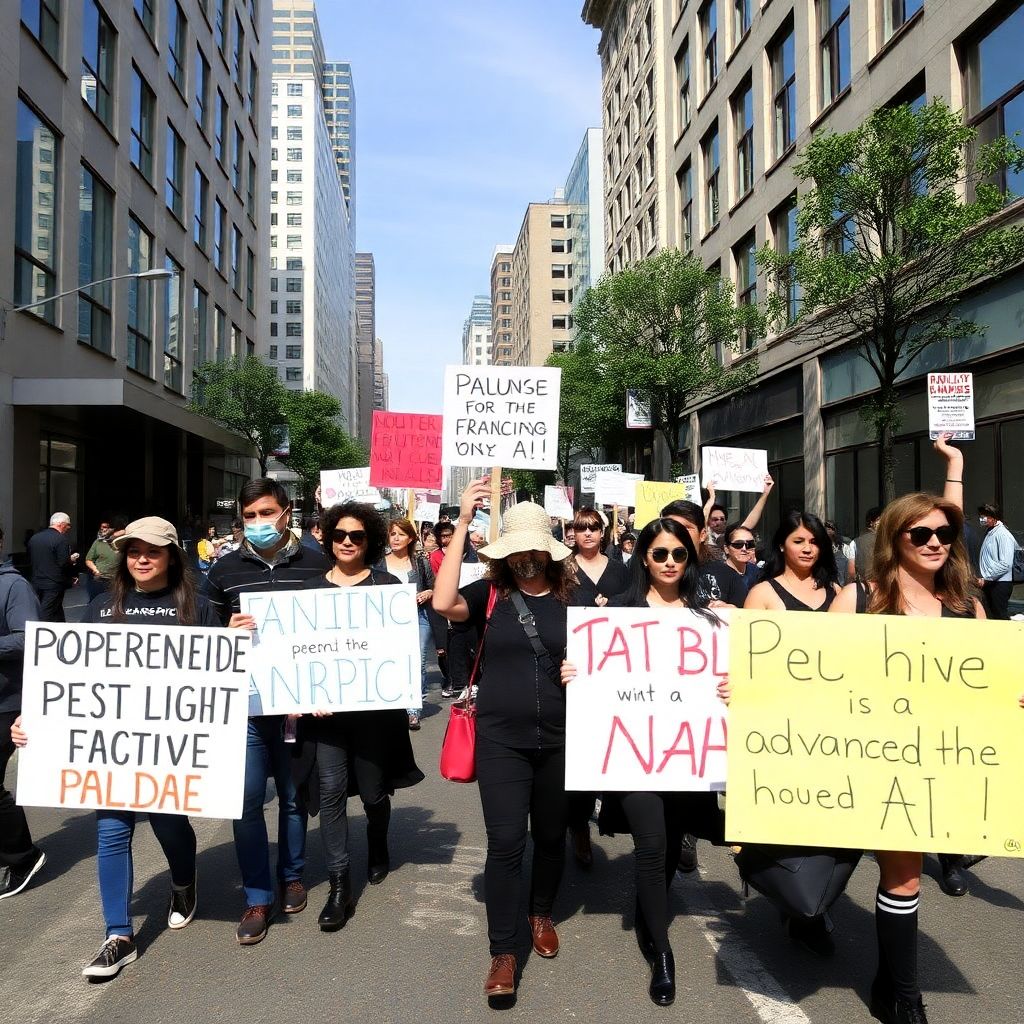
Protesters Rally Outside OpenAI, Anthropic, and xAI Offices to Demand a Pause in Advanced AI
Demonstrators filled the streets of San Francisco on Saturday, marching between the headquarters of leading artificial intelligence firms Anthropic, OpenAI, and xAI to protest the rapid escalation of AI capabilities and to press for a conditional halt on building more powerful systems.
The action was organized by Stop the AI Race, a group founded by documentarian Michael Trazzi. He estimated that around 200 people took part in the protest. Among them were AI researchers, university academics, and members of several advocacy organizations focused on AI safety and regulation, including the Machine Intelligence Research Institute, PauseAI, QuitGPT, StopAI, and Evitable.
“There are a lot of people who care about this risk from advanced AI systems,” Trazzi said in an interview at the event. “Having everyone marching together shows people are not isolated in thinking about this by themselves. There are a lot of people who care about this.”
A Call for a “Conditional Pause” in AI Development
The protesters’ central demand was not a blanket shutdown of artificial intelligence research, but a conditional pause on building and deploying more powerful AI systems until stricter safeguards are in place.
In practice, that idea generally means:
– Slowing or suspending the training of models significantly more capable than today’s leading systems.
– Requiring robust, independently verified safety testing before frontier models are released or scaled.
– Tying further capability increases to the development of reliable technical and regulatory controls.
Demonstrators argued that the current race among major AI labs to achieve ever-more-powerful models creates structural incentives to cut corners on safety, governance, and transparency. The march was intended to signal that some members of the public-and a slice of the technical community-want that dynamic to change before AI systems become substantially more capable than they are today.
Why San Francisco and These Three Companies?
San Francisco has become a focal point of the AI boom, with many of the most influential developers headquartered in or near the city. Anthropic, OpenAI, and xAI are all working on “frontier models”-large-scale AI systems that their creators hope will push the boundaries of what machine intelligence can do.
By marching specifically between these companies’ offices, organizers aimed to:
– Put pressure directly on the organizations they view as most responsible for the pace of AI escalation.
– Draw media attention to the physical locations where decisions about training powerful models are made.
– Underscore that their concerns are not abstract or purely academic, but targeted at concrete corporate strategies and development roadmaps.
The choice of route symbolically tied together the major players in what critics describe as an “AI arms race,” emphasizing that the issue is industry-wide rather than confined to a single company.
Who Was in the Crowd?
While the demonstration was open to the public, it also attracted people deeply involved in AI safety research and advocacy. Participants included:
– Technical researchers familiar with the inner workings and limitations of large language models and other advanced AI systems.
– Academics studying the social, economic, and ethical implications of increasingly capable AI.
– Advocates from groups such as the Machine Intelligence Research Institute, PauseAI, QuitGPT, StopAI, and Evitable, which promote a range of measures from risk-aware governance to more radical slowdowns in development.
This mix of technical and non-technical participants gave the march a dual character: part scientific warning, part grassroots protest. Some attendees framed the event as an attempt to communicate to the broader public that concerns about AI risk are not limited to science fiction or fringe speculation, but are shared by people who work closely with these systems.
What Are the Risks Protesters Are Worried About?
Although not everyone at the event agreed on every detail, several broad categories of concern surfaced repeatedly in speeches and conversations:
– Loss of control over increasingly capable systems
Protesters fear that as AI models grow more autonomous and general-purpose, it may become harder for human operators to predict or reliably constrain their behavior, especially when models are deployed at scale.
– Weaponization and malicious use
Powerful AI could, in their view, lower the barrier to creating persuasive disinformation, sophisticated cyberattacks, or even assisting in the design of biological or other dangerous weapons.
– Economic disruption and concentration of power
There were concerns about mass job displacement, growing inequality, and the consolidation of economic and political power in the hands of a few technology firms that control the most capable systems.
– Long-term existential risk
Some demonstrators referenced the more extreme scenario: that extremely advanced AI, if misaligned with human values and wielding substantial real-world influence, could pose a fundamental risk to humanity’s future.
For many participants, the “conditional pause” is meant as a breathing space to develop better technical safety methods, legal frameworks, and international agreements before capabilities cross thresholds that could be very hard to roll back.
Industry Progress vs. Precaution: A Growing Tension
The protest comes amid a wider public debate over how quickly AI should advance. Major companies emphasize the potential benefits of cutting-edge AI-accelerating scientific discovery, improving healthcare, boosting productivity, and enabling new forms of creativity.
Critics do not necessarily reject those benefits. Instead, they argue that:
– The current pace of deployment is outstripping society’s ability to adapt and regulate.
– Voluntary self-governance by AI labs is insufficient in an environment of intense commercial competition.
– Once models become significantly more powerful, it may be too late to retroactively impose strong safeguards.
This tension between innovation and precaution is increasingly visible not only on the streets, but in policy discussions, corporate statements, and internal debates within AI labs themselves.
What a “Pause” Could Actually Look Like
One source of confusion in public conversation is what a pause would entail in practice. Protesters and aligned organizations typically clarify that they are not calling for an end to:
– Basic AI research.
– Development of smaller, domain-specific, or clearly safe systems.
– Work on AI safety, robustness, and interpretability.
Instead, they envision measures such as:
– Setting internationally recognized capability thresholds above which new models cannot be trained without satisfying strict safety criteria.
– Mandatory independent audits and “red-teaming” of high-risk systems before release.
– Binding commitments, backed by law rather than just pledges, for companies to halt or roll back deployment if safety benchmarks are not met.
From this perspective, a pause is portrayed not as anti-technology, but as an attempt to steer technology within boundaries that reduce catastrophic downside risk.
Why Protests Like This Matter for Policy
Public demonstrations do not, by themselves, change corporate roadmaps or national laws. However, they can influence the broader environment in which decisions are made by:
– Raising visibility
Marches and rallies signal to policymakers that there is organized, vocal concern about AI risk, potentially encouraging more ambitious regulation or international coordination.
– Shaping narratives
They help frame advanced AI as not only a tool of innovation, but also a subject of democratic oversight. That framing can affect how journalists, think tanks, and legislators talk about AI.
– Legitimizing caution
When technical experts stand alongside ordinary citizens calling for restraint, it makes it socially and politically easier for leaders to advocate for stronger controls without being painted as anti-progress.
In this sense, the San Francisco march functions as both a warning and a test: a warning about what protesters see as unsustainable risk, and a test of whether public pressure can meaningfully alter the course of a fast-moving technology.
How Companies Might Respond
Anthropic, OpenAI, and xAI have all publicly acknowledged that powerful AI systems pose serious risks and have published various safety principles and governance frameworks. However, protesters argue that current industry safeguards fall short of what is needed.
Potential responses from companies to demonstrations like this might include:
– Increasing transparency about how they evaluate and mitigate risks in their most advanced models.
– Committing to clearer, verifiable limits on model capabilities and deployment contexts.
– Supporting-or at least not obstructing-stronger national and international regulations on frontier AI.
Whether such steps would satisfy critics is uncertain. Many activists believe that meaningful risk reduction will require binding, external constraints rather than voluntary commitments from the same companies that benefit economically from rapid progress.
A Sign of Steady Opposition
While the AI industry continues to grow rapidly, events like the San Francisco march highlight a steady undercurrent of resistance to the current trajectory. Instead of focusing solely on near-term issues like copyright or data privacy, this protest centered squarely on the long-term risks of highly capable AI-and on the norms that should govern its development.
For participants, walking together between the offices of Anthropic, OpenAI, and xAI was about more than a single day of action. It was an attempt to show that concern about advanced AI risk is organized, persistent, and unlikely to fade as the technology advances.
As debates over AI regulation, safety standards, and corporate responsibility intensify, protests of this kind may become a regular feature of the political landscape surrounding artificial intelligence-reminding both companies and governments that the public expects a say in how far and how fast the most powerful systems are allowed to go.