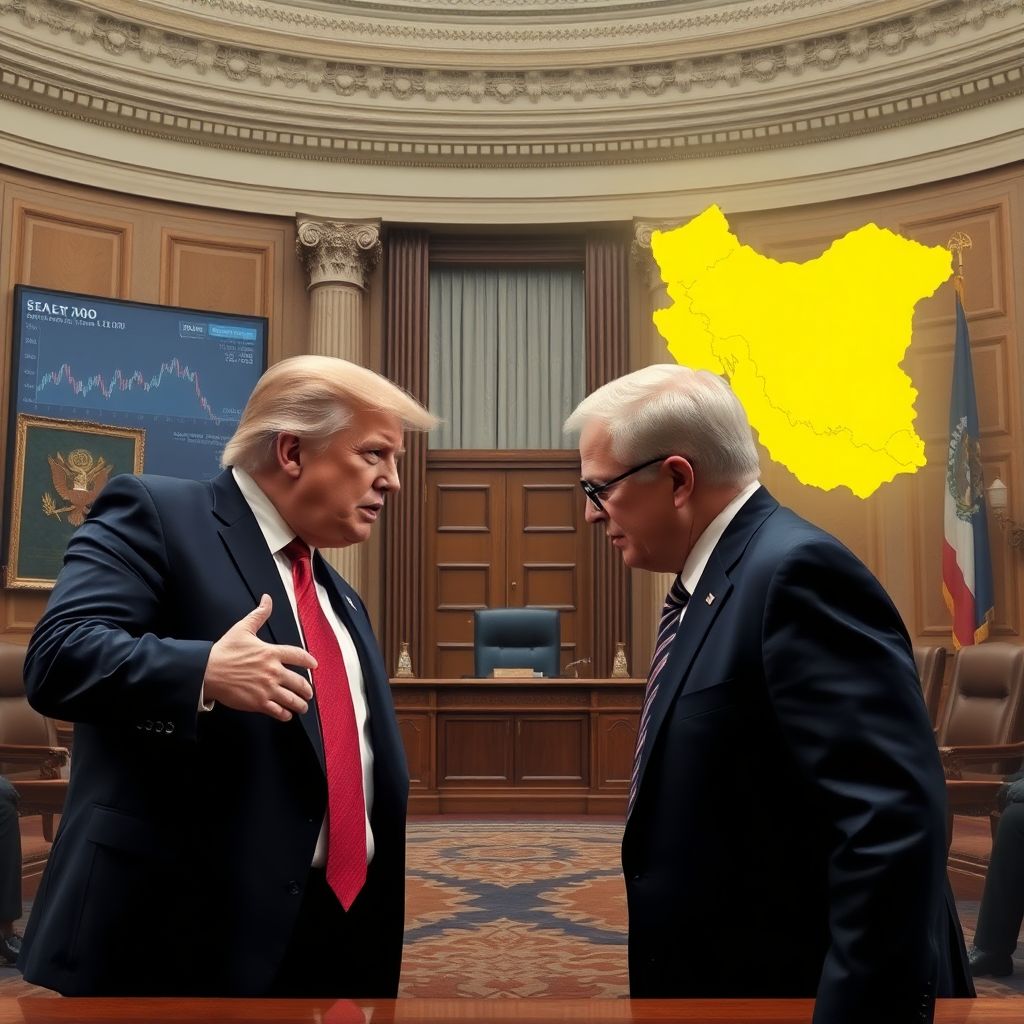
Trump pressures Powell to slash rates as Fed braces for Iran-driven inflation shock
U.S. President Donald Trump has dramatically escalated his campaign against Federal Reserve Chair Jerome Powell, demanding an aggressive round of interest rate cuts even as the central bank hardens its stance against inflation risks fueled by the Iran oil shock.
Trump is publicly urging Powell to drive the federal funds rate down toward 1%, a level far below the Fed’s current target range of 3.50%-3.75%. His pressure comes just a day after the central bank voted to leave rates unchanged and signaled that, at most, it foresees a single quarter‑point cut in all of 2026 – and increasingly sees the possibility of no cuts at all.
Trump’s escalation: “Drop rates immediately”
The president’s latest broadside, reported on Thursday, continues a pattern of increasingly confrontational rhetoric that has intensified since the outbreak of war involving Iran on February 28. On March 12, Trump used his social platform to deride Powell as “Jerome ‘Too Late’ Powell” and insisted that the Fed should be cutting rates “IMMEDIATELY, not waiting for the next meeting!”
Behind the rhetoric lies a clear preference: Trump has repeatedly floated the idea that rates should be driven down to roughly 1%, arguing that cheaper borrowing costs are necessary to counteract a slowing economy and turbulent financial markets. His demands come despite a fresh surge in oil prices that is already pushing inflation expectations higher and reviving memories of the 1970s stagflation era.
Fed holds firm at 3.50%-3.75%
At its March 18 policy meeting, the Federal Reserve’s rate‑setting committee opted to keep the benchmark federal funds rate in a 3.50%-3.75% corridor. Powell emphasized that the economic outlook has become more uncertain due to two overlapping shocks:
– The Iran‑linked conflict and its impact on global energy supplies
– The lingering effects of Trump’s 15% global tariff regime on prices and trade flows
Powell acknowledged that a further rate hike is not the Fed’s base case, but he refused to take it fully off the table. The central bank, he said, must “assess how enduring this situation is” as the global energy crisis unfolds. That language leaves the door open not only to staying on hold, but – in the worst case – to tightening policy again if inflation reaccelerates.
Inflation forecasts move higher, rate cuts look less likely
The Fed’s updated projections now point to a more stubborn inflation path than previously hoped. Many economists expect the central bank to pencil in consumer price growth that remains near 3% even by late 2026, well above the Fed’s formal 2% target.
A 3% inflation outlook is difficult to square with deep rate cuts. If the Fed slashed rates toward the 1% level Trump favors, real (inflation‑adjusted) interest rates would likely turn negative, risking a renewed wave of price pressures just as an oil shock is already lifting costs across the global economy.
Complicating the picture further, Trump has previously nominated former Fed governor Kevin Warsh to succeed Powell when his term expires in May. That move had been interpreted as an attempt to pivot toward a more dovish, growth‑focused Federal Reserve. But the Iran conflict and its inflationary fallout may delay or even derail any smooth transition toward looser policy.
A textbook stagflation dilemma
At the heart of the confrontation is a classic central‑bank dilemma: how to navigate a potential stagflation trap, where growth weakens even as inflation remains elevated.
– Trump’s priority: Lower rates to stimulate demand, support hiring, and prevent further stock and crypto market turmoil in the face of geopolitical uncertainty and trade frictions.
– The Fed’s priority: Prevent a repeat of the 1970s, when policymakers cut rates too quickly in the face of oil shocks, allowing inflation to become entrenched and forcing much more painful tightening later.
Cutting rates aggressively while oil prices are surging could fuel second‑round effects – higher wages, rising rents, and broader price increases that persist long after the immediate energy shock fades. Yet keeping policy tight into a slowdown risks amplifying demand destruction, driving up unemployment and undermining corporate investment just as businesses are absorbing higher energy and tariff costs.
Markets bet on “higher for longer”
Market pricing reflects growing skepticism that the Fed will deliver the kind of easing Trump wants. Data from derivatives tied to the federal funds rate signal that traders see a more than 99% chance of no move at the current meeting and increasingly view 2026 as a “zero‑cut” year.
Lydia Boussour, chief U.S. economist at Oxford Economics, noted that their baseline outlook now includes only a single 25‑basis‑point cut in 2026 – and even that may be optimistic. Given elevated forecasts for both headline and core PCE inflation, she argues that it is “entirely plausible” the Fed will not cut at all this year if energy shocks and tariffs keep price pressures alive.
Oil shock erases the inflation cushion
Earlier in 2026, declining energy prices had provided a modest buffer against Trump’s tariff‑driven inflation. That cushion has now disappeared. Brent crude has vaulted above 110 dollars per barrel, and Iranian strikes on Gulf energy infrastructure have intensified, raising fears of more persistent supply disruptions.
As oil filters through to gasoline, transport, and production costs, the Fed’s room to maneuver is shrinking. Every additional dollar on the crude price makes it harder for Powell to justify rate cuts without risking another inflation spike – even as political pressure from the White House continues to build.
Crypto markets trade the policy tug‑of‑war in real time
Digital assets have become a barometer for this policy struggle. Bitcoin, which recently spiked into the mid‑73,000 range, has slipped back below 70,000, while Ethereum has retreated toward the low‑2,200s. Futures tied to Fed policy now price in barely a single cut for 2026, pushing traders to rethink earlier expectations of a friendlier monetary environment.
This has left Bitcoin straddling two conflicting narratives:
– Stagflation hedge: If Powell buckles under political pressure and allows real rates to fall, hard assets like Bitcoin could be cast as protection against both currency debasement and inflationary shocks.
– High‑beta risk asset: If the Fed holds its ground and keeps rates high while oil shocks drain liquidity from traditional markets, crypto could behave more like a leveraged bet on global risk appetite – and suffer alongside equities and credit.
The tension between these roles is playing out in sharp intraday swings across major tokens as traders attempt to front‑run the next policy signals from the Fed and the White House.
Historical echoes: Fed independence under strain
The clash between Trump and Powell also revives a long‑running question in U.S. economic governance: how independent should the Federal Reserve be from the president and Congress?
History offers cautionary tales. In the late 1960s and early 1970s, political pressure to keep money loose contributed to an inflation spiral that eventually forced the Volcker Fed to engineer a brutal recession to regain control. Since then, formal independence has been treated as a cornerstone of U.S. monetary credibility.
Trump’s very public demands risk blurring that line. If investors begin to believe the Fed will bow to political imperatives, inflation expectations could unanchor even without immediate policy changes. Conversely, if Powell overcompensates to prove his independence, he may err on the side of tighter policy for longer, increasing recession risks.
What this standoff means for the broader economy
For households and businesses, the debate in Washington is not an abstract academic fight – it has direct consequences:
– Borrowing costs: Mortgage rates, auto loans, and corporate borrowing terms remain elevated with policy locked at 3.50%-3.75%. A sharp cut to 1% would quickly spill over into cheaper credit, but at the risk of renewed price surges.
– Labor market: Slowing growth, higher energy costs, and tighter financial conditions may gradually cool hiring. An overly aggressive Fed could accelerate job losses; an overly dovish one could ignite another wave of cost‑of‑living pressure.
– Investment decisions: Companies weighing long‑term projects face unusual uncertainty. Volatile energy prices, shifting tariffs, and unpredictable rate policy complicate capital budgeting and may encourage firms to delay expansion.
The longer the tug‑of‑war between the White House and the Fed continues, the greater the risk that uncertainty itself becomes a drag on growth.
Possible scenarios from here
Several broad paths now present themselves:
1. Powell holds, inflation stays elevated:
The Fed sticks to its current stance, tolerating slower growth and softer asset prices to prevent inflation from re‑accelerating. Markets gradually price in “higher for longer,” putting downward pressure on speculative assets and rate‑sensitive sectors.
2. Powell blinks under pressure:
Rising unemployment or sharp financial stress pushes the Fed to cut more aggressively despite awkward inflation optics. In this scenario, risk assets and hard‑asset hedges could rally, but the risk of a renewed, more entrenched inflation wave rises substantially.
3. Oil shock eases unexpectedly:
A diplomatic breakthrough or supply response brings crude prices down, giving the Fed space for modest cuts without reigniting inflation. This is the soft‑landing scenario markets would most like to see, but it depends heavily on geopolitics beyond the Fed’s control.
4. Worst‑case stagflation:
Oil remains expensive, tariffs stay in place, growth falters, and inflation remains stuck around or above 3%. The Fed is forced into a prolonged holding pattern, with limited ability to help the real economy without sacrificing price stability.
Implications for investors and savers
In the near term, investors face an environment where both policy and prices are unusually hard to forecast:
– Volatility is likely to remain high across equities, bonds, and crypto as each new data release and policy comment is repriced.
– Interest‑rate‑sensitive sectors – from real estate to small‑cap growth stocks – will continue to trade as leveraged bets on the Fed’s resolve.
– Defensive and real‑asset strategies may gain attention if stagflation risks rise, though they carry their own drawdowns when growth slows sharply.
For savers and households, the combination of relatively high nominal rates and persistent inflation creates a difficult mix: cash yields are more attractive than in the ultra‑low‑rate era, but the real purchasing power of savings can still erode if inflation remains stuck near 3%.
The road ahead: Policy trapped between politics and prices
Trump’s calls for a rapid plunge in interest rates to around 1% collide head‑on with the Fed’s determination to avoid repeating the mistakes of past oil shocks. With Brent crude above 110 dollars, inflation forecasts drifting higher, and markets increasingly betting on a year with little or no easing, Powell is navigating some of the narrowest policy space a Fed chair has faced in decades.
Whether the central bank can maintain its course without igniting a full‑blown confrontation with the White House – and without tipping the economy into a deeper slowdown – will define not just the path of inflation and growth in 2026, but also the perceived credibility and independence of U.S. monetary policy for years to come.