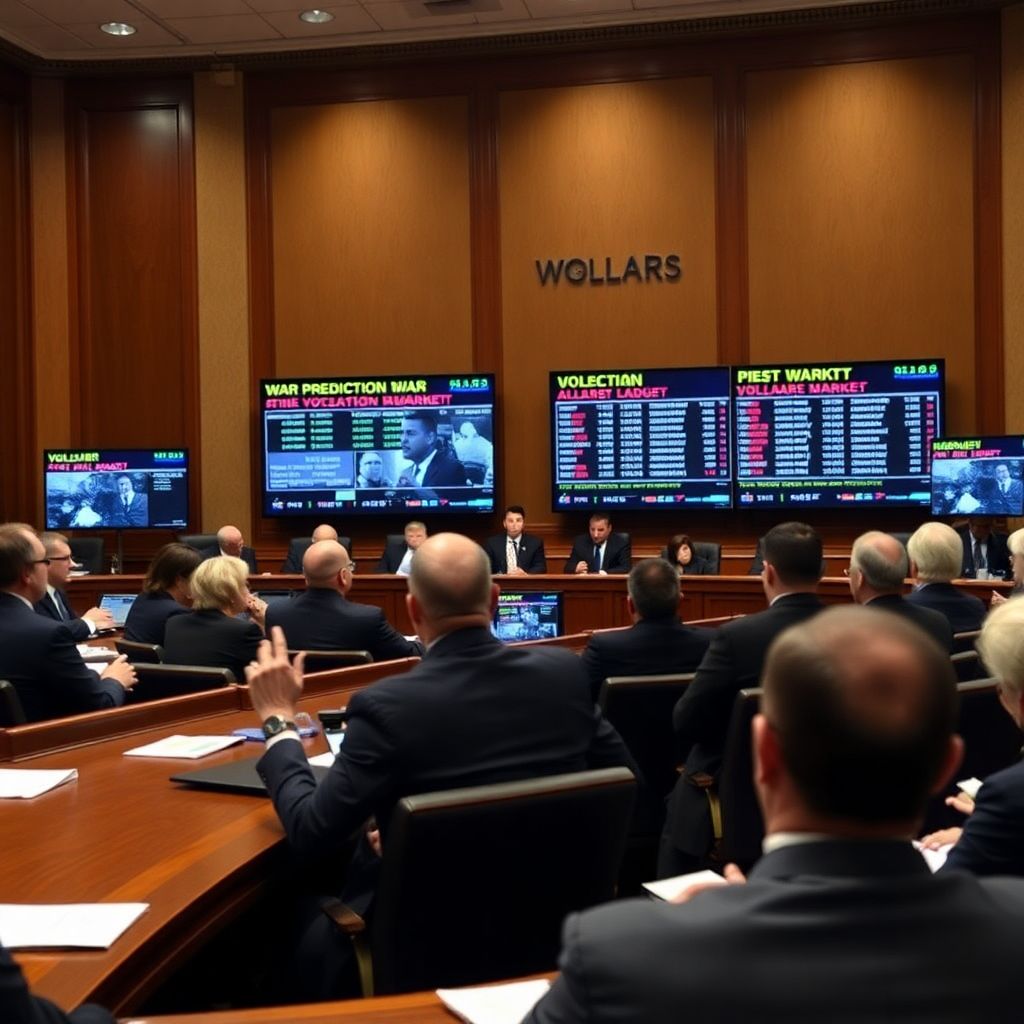
Polymarket’s Iran boom sparks a ‘death bets’ backlash in Washington
A trading frenzy around the prospect of a U.S. strike on Iran has turned prediction markets from a niche financial experiment into a political flashpoint – and given U.S. lawmakers a clear target. After weeks of record activity on platforms such as Polymarket, Democrats are now rallying behind new legislation aimed squarely at what they describe as “death markets”: contracts that allow traders to profit from war, terrorism and individual deaths.
At the center of the storm is the proposed DEATH BETS Act, introduced by Democratic senator Adam Schiff. The bill would rewrite a key piece of U.S. financial law – the Commodity Exchange Act – to explicitly prohibit federally regulated prediction markets from offering contracts tied to armed conflict, terror attacks, assassinations or the death of a specific person. While U.S. regulators have long had broad discretion over which “event contracts” are permissible, this proposal would codify a bright, statutory boundary around any product that looks like a wager on human catastrophe.
The timing is no coincidence. For the week ending March 9, both on‑chain and regulated event markets shattered previous records. Industry data show that nominal trading volume on Polymarket reached roughly 2.49 billion dollars in that seven‑day span, while Kalshi, a U.S. venue supervised by the Commodity Futures Trading Commission (CFTC), posted around 2.85 billion dollars. Taken together with other smaller platforms, total nominal volume across the sector climbed to about 14.5 billion dollars, with an estimated 2.8 million unique users participating.
The catalyst was clear enough: escalating tensions between the United States and Iran. As headlines darkened, traders rushed to price the odds of an American military strike, turning geopolitical fear into a highly liquid market. Contracts tracking whether, when, and how the U.S. might use force against Iran quickly became some of the most actively traded products in the entire prediction ecosystem.
Those same markets have now become Exhibit A for critics on Capitol Hill. For lawmakers like Schiff, the sight of millions of dollars changing hands on the likelihood of war crosses a moral red line, regardless of the academic case for prediction markets as information aggregators. The DEATH BETS Act is, in effect, an attempt to draw a clear line between socially acceptable forecasting – inflation, elections, economic data – and what opponents see as the commodification of human suffering.
The backlash has been intensified by an insider trading scandal that cut directly against the industry’s claims of neutrality and transparency. According to allegations now circulating among regulators and investigators, six Polymarket users are accused of exploiting non‑public, potentially sensitive information to place roughly 1 million dollars’ worth of winning bets on the timing of a U.S. strike on Iran. In practice, that meant individuals with privileged insight into security decisions could profit by front‑running the rest of the market.
For critics of the sector, this episode crystallizes their worst fears. Instead of being a pure “wisdom of crowds” mechanism that reveals collective expectations, prediction markets can become a shadow venue where those with access to classified or confidential geopolitical intelligence quietly monetize their advantage. The optics are brutal: while the broader public treats these contracts as an information discovery tool, insiders allegedly turn them into a private payoff scheme tied to military action.
For crypto‑native platforms, the message from Washington could not be more blunt. Just as trading volumes are reaching institutional scale, the very categories that drive the most engagement – war, national security, terrorism – are the ones now being targeted for outright prohibition in the regulated U.S. market. If Schiff’s framework is adopted and then mirrored by other jurisdictions, the industry could be forced into a narrower product set focused on relatively “safe” topics such as macroeconomic indicators, sports outcomes, weather events, and elections.
That shift would have deep market implications. The most informationally rich and liquidity‑dense contracts often cluster around high‑stakes geopolitical and security questions, precisely because those events matter enormously to investors, governments and citizens alike. If regulated platforms are barred from hosting those markets, activity is likely to fragment: some trading would migrate to offshore companies beyond U.S. reach, while the rest might flow into fully decentralized finance (DeFi) protocols operating in regulatory gray zones with little or no oversight.
In market terms, Washington is making an important philosophical statement: not all “truth markets” are acceptable, even if they produce useful forecasts. Lawmakers are effectively saying that certain lines of inquiry – especially where human life and violent conflict are at stake – cannot be turned into tradable contracts on regulated U.S. venues, no matter the informational value or demand from traders.
Supporters of prediction markets argue that this instinct, while understandable, may be counterproductive. By aggregating bets from thousands or millions of participants with different information sets, these platforms can generate probability estimates that sometimes outperform traditional experts and polls. In the context of war or terrorism, a liquid market could, in theory, serve as an early warning signal of rising risk, offering policymakers and the public a clearer view of what informed observers believe is likely to happen.
The counterargument, now gaining traction in Congress, is that some forms of information discovery simply cost too much in ethical terms. Allowing people to profit directly from the timing of an airstrike or the assassination of a public figure raises questions about incentives: could such markets encourage bad actors to influence events to benefit their positions? Even if that risk is low, critics say, the symbolism of turning life‑and‑death outcomes into speculative playthings is corrosive to public trust.
Regulators also worry about the intersection between prediction markets and national security. If individuals with access to confidential military or intelligence briefings can trade on that information, these platforms start to resemble a leak channel – one that can both signal sensitive plans to adversaries and reward those who breach secrecy rules. Traditional financial markets already struggle with insider trading; extending that battle into the realm of war and terror raises the stakes dramatically.
From a legal standpoint, the DEATH BETS Act would simplify enforcement by converting what is currently a matter of regulatory interpretation into a clear statutory ban. Today, the CFTC has broad authority to approve or reject specific event contracts on a case‑by‑case basis, often invoking a vague standard about the “public interest” or “gaming” concerns. Hard‑coding explicit prohibitions on war, terrorism and death‑linked contracts would remove some of that discretion and give agencies a firm basis for shutting down or punishing offending venues.
For platforms like Polymarket and Kalshi, the strategic calculus now shifts. To retain access to the U.S. market and banking rails, they may be forced to redesign their product lineups, migrating controversial categories to geofenced or offshore entities while promoting a sanitized, regulation‑friendly offering at home. That could split liquidity, weaken price discovery, and reduce the overall usefulness of their markets for serious analysts and institutional users.
At the same time, the looming crackdown may accelerate innovation in DeFi‑based prediction protocols that are harder to regulate directly. Fully on‑chain systems with no centralized operator and open, permissionless listing of markets are significantly more difficult to police. Lawmakers can prohibit U.S. intermediaries from supporting them, and target front‑end interfaces, but the underlying smart contracts can continue to operate globally. The more Washington clamps down on regulated players, the more incentive traders have to seek out these unregulated alternatives.
Beyond the immediate policy fight, the controversy over “death bets” touches a wider debate about how societies want to govern emerging data‑driven finance. Prediction markets sit at the intersection of economics, politics and ethics. They promise sharper forecasts and transparent probabilities, yet they also raise uncomfortable questions about who gets to profit from knowledge of dark events, and where the line should be drawn between useful foresight and voyeurism.
For now, the sector’s rapid growth has guaranteed it a place on the legislative agenda. What began as a niche experiment in harnessing crowd wisdom has, in the span of a volatile week in U.S.-Iran relations, become a test case for how far governments will go to curb the more unsettling edges of financial innovation. Whether the DEATH BETS Act passes in its current form or is watered down in negotiation, the era when prediction markets could quietly expand without political scrutiny is clearly over.
The next phase will likely be defined by compromise and divergence. Some platforms will lean into strict compliance and accept a narrower universe of tradable events in exchange for legitimacy and institutional capital. Others will embrace decentralization, anonymity and jurisdictional arbitrage, betting that user demand for unfiltered “truth markets” will outweigh regulatory risk. In between, policymakers will be forced to confront a difficult question: how to preserve the benefits of collective forecasting without normalizing a financial system that turns war and death into just another asset class.