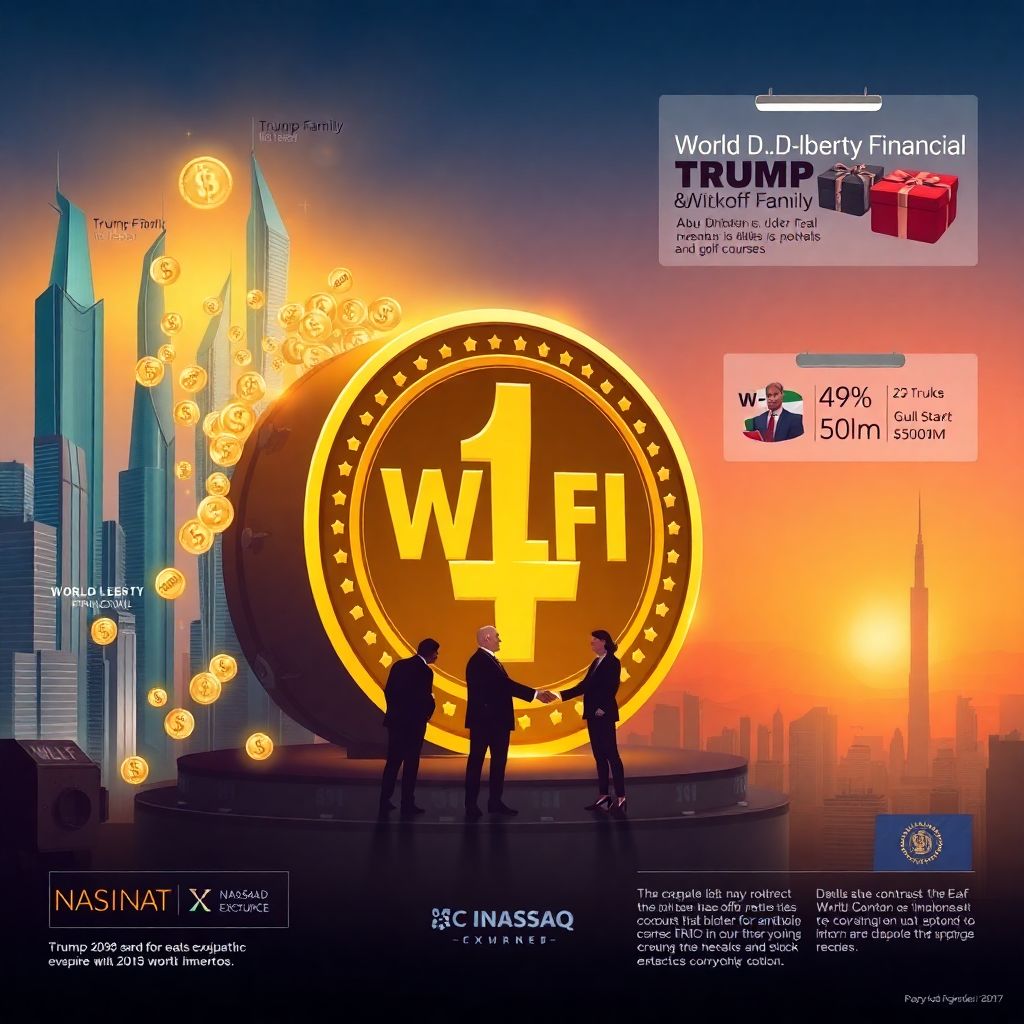
World Liberty Financial’s crypto operation has quietly become a cash machine for Donald Trump and his partners, eclipsing what his traditional real estate business managed to produce over much longer stretches of time. Since late 2024, deals tied to the World Liberty (WLFI) token and related structures have funneled at least 1.4 billion dollars to the Trump and Witkoff families, transforming a political brand into one of the most lucrative ventures in digital assets.
According to financial disclosures and people familiar with the arrangements, the Trump clan alone has collected at least 1.2 billion dollars in cash in roughly 16 months, while also sitting on an additional 2.25 billion dollars in unrealized gains linked to WLFI tokens. The Witkoff real estate family, long‑time Trump allies and deal partners, has taken in a minimum of 200 million dollars over the same period.
At the core of this windfall is the way WLFI token revenue is structured. Filings indicate that 75 percent of all proceeds from WLFI token sales are funneled to an entity controlled by the Trump family. The remaining 25 percent is split evenly: 12.5 percent goes to the Witkoffs, and 12.5 percent is directed to co‑founders Zak Folkman and Chase Herro. Within the Trump share, Donald Trump himself owns 70 percent of the controlling entity, with the balance distributed among his relatives, further reinforcing how tightly the economic benefits are held within the family circle.
One of the biggest single infusions of cash came from the Gulf. In January 2025, a consortium of investors backed by Abu Dhabi purchased a 49 percent stake in World Liberty for 500 million dollars. That transaction alone delivered about 187 million dollars in immediate cash to Trump‑aligned entities and roughly 31 million dollars to the Witkoff family. For a newly built crypto venture, those are figures more commonly associated with major private‑equity exits than with nascent token projects.
The timing raised eyebrows. Eric Trump, who has become the family’s key operator on crypto deals, is reported to have pushed the Abu Dhabi stake sale over the finish line just days before the 2025 presidential inauguration. The closing coincided with a period when the United Arab Emirates was intensifying its push to secure access to advanced U.S. artificial intelligence chips, a national‑security sensitive arena. That overlap has fueled questions about whether geopolitical and regulatory considerations intersected with a transaction that was, at least on paper, purely commercial.
Beyond the Abu Dhabi sale, World Liberty Financial engineered additional liquidity through a more complex – and controversial – structure built around Alt5 Sigma, a Nasdaq‑listed company. World Liberty acquired a controlling stake in Alt5, which then went out and raised approximately 750 million dollars from outside investors. Instead of plowing that capital into a diversified business plan, Alt5 used the bulk of the funds to buy WLFI tokens directly from World Liberty at a premium price.
That roundabout loop of capital effectively turned Alt5’s shareholders into a deep‑pocketed customer base for WLFI. More than 500 million dollars from that structure ended up in Trump‑controlled entities, while the Witkoffs received around 90 million dollars. For World Liberty insiders, the result was clear: large amounts of cash extracted upfront, while the risks shifted to the public investors who had bought Alt5 shares and, indirectly, exposure to WLFI tokens at elevated prices.
After the transaction, the market reaction was swift. Alt5’s stock price dropped sharply, and WLFI tokens themselves declined in value, undercutting paper gains and stoking criticism that insiders had cashed out at the expense of later investors. The pattern fed a broader narrative that many token‑driven ventures are effectively financial engineering exercises, designed first around monetizing hype rather than building long‑term utility.
Eric Trump’s crypto activities are not limited to World Liberty. He also holds a substantial personal stake in American Bitcoin, another digital asset company whose valuation spiked around its debut and then sank once public trading began. That boom‑and‑bust trajectory has become familiar in the crypto sector, but it takes on added weight when tied to the sitting president’s family, amplifying concern over conflicts of interest and preferential access to capital.
The White House has pushed back against those concerns, insisting that the companies in which Eric Trump is involved operate independently of government decision‑making. Officials have framed the ventures as private, market‑driven enterprises, arguing that no special treatment, regulatory favors, or policy carve‑outs have been granted. Nevertheless, the optics of large foreign and domestic investors enriching the president’s family through opaque token structures remain politically sensitive.
What makes World Liberty’s success particularly striking is how it compares with Trump’s legacy business. For decades, his fortune and public image were tied to hotels, golf courses, licensing deals, and branded real estate. Yet the cash harvested from WLFI and associated crypto deals in barely more than a year has surpassed what those traditional holdings generated over an eight‑year stretch. That contrast underscores a fundamental shift: the Trump brand, once monetized through physical assets and media appearances, has now been repackaged and sold directly into speculative digital markets.
The WLFI token itself sits at the intersection of politics, fandom, and finance. Backers are not only betting on a project; many are effectively expressing allegiance to a political figure, hoping that exposure to a “patriotic” or “America First” crypto brand will pay off. That blending of political identity and investment decision‑making creates an unusual dynamic where enthusiasm can inflate prices quickly, but disappointment or controversy can trigger equally rapid reversals.
From a governance and regulatory standpoint, the World Liberty model highlights unresolved questions for the crypto sector. When a token issuer channels such a high percentage of proceeds directly to insiders, critics argue that it begins to resemble a highly concentrated, loosely regulated securities offering rather than a decentralized, community‑driven project. Regulators may take interest in whether investors clearly understood how much of their money would go straight into the pockets of a small group of owners.
Risk for retail investors is also substantial. The Alt5 structure, in particular, shows how complex intermediaries can mask who ultimately benefits from capital raises. Public shareholders may have believed they were funding a broad crypto infrastructure business, only to discover that much of their money effectively bought tokens from a related party at a premium. If token prices and share prices fall in tandem, those investors bear the losses, while insiders retain their earlier cash outs.
For the Witkoff family, the World Liberty partnership represents a notable pivot from conventional property development into digital finance. Their 200 million dollar payday underscores how established real estate players are increasingly willing to align with high‑profile political brands and experimental financial products to capture upside that simply does not exist in slower, heavily regulated asset classes. At the same time, such moves expose them to heightened scrutiny from regulators, lenders, and institutional partners.
Looking ahead, World Liberty’s future will depend on whether it can evolve beyond being perceived as a monetization engine for a small circle of insiders. Sustaining the project’s value may require building real‑world use cases, forging partnerships that extend beyond politically aligned investors, and demonstrating transparency about token economics. If it fails to do so, WLFI risks being remembered primarily as a spectacular transfer of wealth rather than as a durable piece of financial infrastructure.
For now, the numbers tell a clear story. In a relatively short window, clever structuring, global investor interest, and the drawing power of the Trump brand have combined to produce at least 1.4 billion dollars in realized gains for the Trump and Witkoff families, with several billion more on paper. Where traditional real estate once defined their fortunes, crypto has become the new frontier – and, so far, an extraordinarily profitable one.