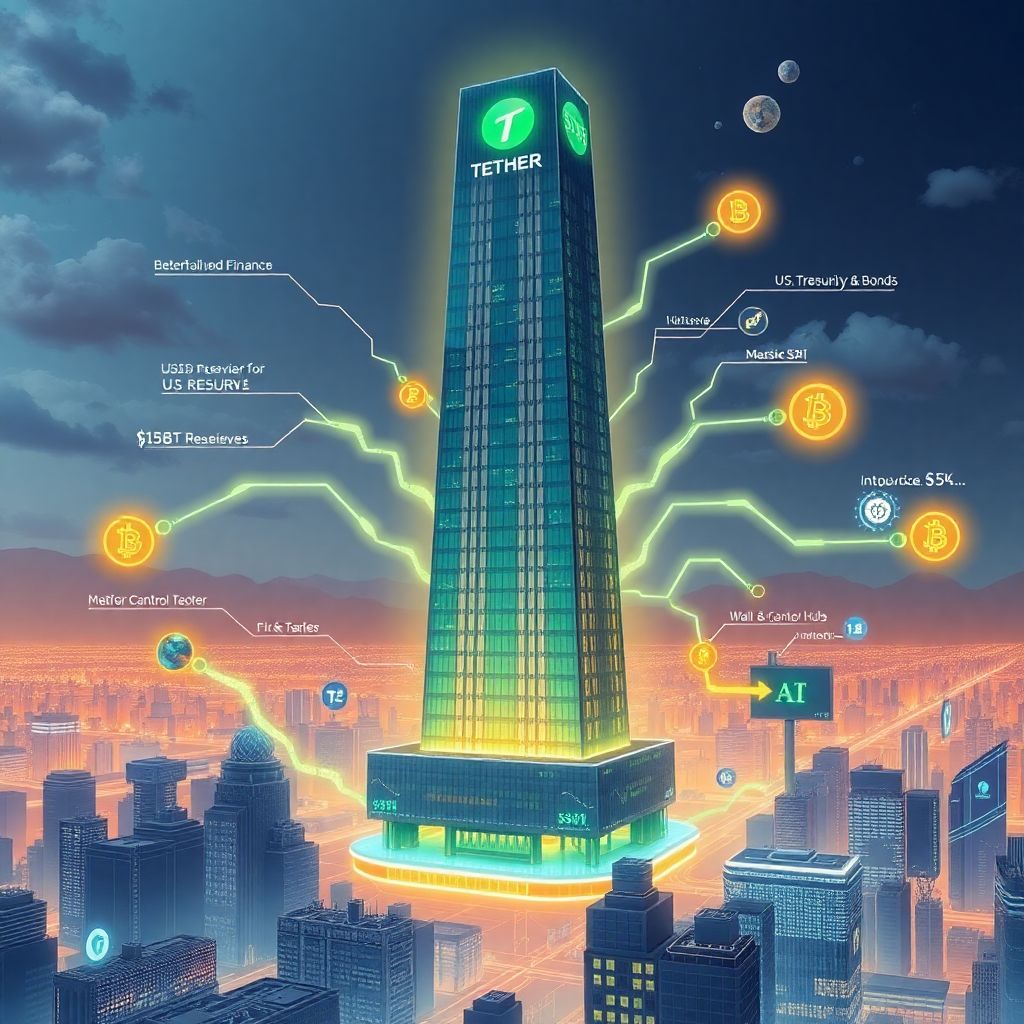
Tether builds sprawling venture empire as USDT tops $185B and hiring surges
Tether, the issuer of the world’s largest stablecoin, has quietly transformed itself into a sprawling investment and technology conglomerate, assembling a portfolio of around 140 bets that now stretch far beyond crypto and finance into AI, energy, media, agriculture, and even professional sports.
According to people familiar with the company’s strategy, Tether has taken stakes in businesses as varied as South American farming operations and Italian football giant Juventus, while simultaneously pushing into bitcoin mining infrastructure, AI tooling, and digital communications platforms.
This expansion coincides with explosive growth of its flagship stablecoin. The market capitalization of USDT has soared from roughly $5 billion in 2020 to about $185 billion, with the token now used by an estimated 500 million people worldwide as a primary conduit between digital assets and the US dollar ecosystem.
Unlike traditional financial institutions, Tether retains the vast majority of the income generated from the reserves backing USDT—primarily US Treasuries and other interest-bearing instruments. Those assets produce tens of billions of dollars in annual profit, none of which is distributed to token holders. Instead, the firm is plowing substantial portions of that cash into a highly eclectic venture-style portfolio and a global hiring spree.
Aggressive hiring drive and global footprint
Tether’s headcount has swelled to around 300 employees, and the company plans to bring on roughly 150 more over the next year and a half. Most of those roles will be technical, with an emphasis on engineering talent capable of building what executives describe as a vertically integrated technology stack that spans finance, communications, AI, and energy.
But the hiring push is not limited to coders. Job postings show openings for an AI filmmaker based in Italy, venture investment associates in the United Arab Emirates, and regulatory affairs leads in emerging markets such as Ghana and Brazil. The pattern points to a company trying to embed itself simultaneously in content creation, venture capital, and policy engagement across multiple continents.
Officially registered in El Salvador and operating from a base in Switzerland, Tether is governed by a relatively tight-knit leadership group that exerts strong control over strategic decisions. A newly formed London-based team, led by chief financial officer Simon McWilliams, now supervises finance and operational functions, adding another hub to the firm’s increasingly distributed structure.
Many employees reportedly operate with limited visibility into other departments, interacting in person primarily during periodic gatherings in El Salvador or Lugano. That compartmentalized model—more reminiscent of a secretive tech firm than a traditional financial institution—underlines how Tether centralizes decision-making while expanding its global reach.
“Freedom tech stack”: Tether’s broader vision
At a recent conference in San Salvador, CEO Paolo Ardoino articulated Tether’s ambition to assemble what he called a “freedom tech stack.” The idea is to weave together finance, intelligence tools, communications infrastructure, and energy systems into a cohesive layer that reduces reliance on legacy financial and telecommunications intermediaries.
On display at the event were several of Tether’s in-house or affiliated products, including:
– MOS, an operating system tailored for bitcoin mining operations
– QVAC, a platform designed to coordinate and deploy AI agents
– WDK, a wallet toolkit enabling AI agents to receive and use Tether-based payments
These projects highlight how Tether is positioning itself not merely as a stablecoin issuer, but as a builder of the underlying rails that could power an AI- and crypto-native economy. By tying digital payments to autonomous software agents and energy-intensive mining infrastructure, Tether is trying to control key components of an emerging technological stack.
Unconventional media and political bets
Among Tether’s more controversial investments is a roughly $775 million position in Rumble, a right-leaning video platform that pitches itself as an alternative to YouTube. Rumble also hosts Truth Social via its cloud services, tying Tether’s capital directly into a highly politicized corner of the US media landscape.
That choice of investment, alongside the company’s recruitment of figures with ties to the Trump administration and the hiring of seasoned American lobbyists, has attracted heightened scrutiny—especially as Tether explores a large fundraising round reportedly in the $15–20 billion range, aimed at valuing the company at around $500 billion. Some investors are said to have pushed back on both the valuation and the political overtones of the firm’s portfolio.
Tether’s relocation of its headquarters to El Salvador in the previous year further adds to the political texture. President Nayib Bukele’s administration has embraced bitcoin and digital assets, providing a highly supportive environment. Tether is now building a dedicated office tower in the country, cementing its physical presence and reinforcing close ties between its executives and El Salvador’s pro-crypto leadership.
Before settling in El Salvador, Tether cycled through a series of offshore jurisdictions, including the Isle of Man and the British Virgin Islands. The company’s evolving legal footprint reflects both the regulatory pressure it faces and its preference for jurisdictions that offer flexibility for crypto-related enterprises.
Deep links to Cantor Fitzgerald and Wall Street
Despite its offshore and crypto-native image, Tether also maintains significant relationships with established Wall Street institutions. One of the most important is Cantor Fitzgerald, the US investment bank that acts as custodian for Tether’s vast US Treasury holdings and is itself an investor in the company.
Howard Lutnick, the long-time head of Cantor Fitzgerald and the current US Commerce Secretary, has been described as a close ally of Tether. His son and successor as bank chair, Brandon Lutnick, attended Tether’s El Salvador conference, publicly referring to Paolo Ardoino as one of Cantor’s closest partners and a personal friend.
These links to a major US financial player highlight a central paradox: Tether often casts itself as an outsider to the traditional banking system, yet its reserves—and thus the stability of USDT—are heavily intertwined with mainstream finance and US government debt markets.
Compliance, transparency, and ongoing criticism
On the regulatory front, Tether remains under sustained scrutiny. The company publishes quarterly attestations from BDO Italia that outline the status and composition of reserves backing USDT, but it still has not produced a full, comprehensive audit. That gap continues to fuel skepticism among regulators, policymakers, and some institutional investors.
In 2021, Tether reached a settlement with US state and federal authorities over allegations that it misrepresented the quality and composition of its reserves. The case centered on claims that the company did not hold a full equivalent of US dollars or dollar-like assets for every USDT in circulation at all times, as previously suggested.
More recently, the New York District Attorney and State Attorney General Letitia James sent a letter to Democratic lawmakers expressing concern that Tether only offers assistance to law enforcement agencies in limited situations. The implication is that, unlike US-regulated financial institutions which have broad legal obligations to monitor and report suspicious activity, Tether’s cooperation is largely voluntary and therefore potentially inconsistent.
Tether counters that it works closely with American enforcement and intelligence bodies despite not being bound by the same blanket rules as US banks. The firm emphasizes that it regularly freezes addresses, shares data, and takes action when presented with compelling evidence of illicit use.
What Tether’s strategy means for the crypto ecosystem
Tether’s transformation from a niche stablecoin issuer into a global venture and infrastructure player has significant implications for the broader digital asset space.
First, its sheer size makes it a systemic actor. With USDT now the primary liquidity bridge for many crypto exchanges and DeFi protocols, Tether’s decisions around reserves, regulation, and product direction can ripple through the entire market. An expansion into AI, media, and energy suggests that Tether wants to anchor itself in multiple sectors so that its influence is not limited to crypto trading.
Second, the “freedom tech stack” vision hints at a world where stablecoins, AI agents, and distributed energy resources become tightly interwoven. If MOS, QVAC, and WDK gain traction, Tether could end up controlling critical infrastructure used by miners, developers, and AI-based applications—consolidating both technical and financial power.
Third, by retaining all profits from reserves instead of sharing yield with USDT holders, Tether is creating a giant capital machine that funds its own growth. This model is attractive from a corporate standpoint but increasingly raises questions about fairness and competition, especially as regulated stablecoin issuers start exploring interest-sharing structures or consumer-yield products.
Why Tether’s investment choices draw attention
The eccentric nature of Tether’s portfolio—ranging from agriculture in Latin America to European football and right-leaning media—signals a strategy that prioritizes both diversification and narrative control.
Investments in media and content platforms can give Tether indirect influence over public discourse around crypto, regulation, and financial sovereignty. Stakes in energy and mining infrastructure help secure the physical backbone of the bitcoin and stablecoin economy. Agricultural and regional bets in the Global South support the company’s messaging around financial inclusion and real-economy impact.
However, these same moves raise the stakes of any regulatory crackdown. If Tether were to face serious legal or market stress, the repercussions could extend beyond the crypto market into sectors where it has quietly become a significant investor.
The funding round and valuation puzzle
The reported push for a $15–20 billion capital raise at a $500 billion valuation places Tether in the same league as the world’s most valuable tech and financial companies. For a business whose core product is a dollar-pegged token and whose revenues are heavily contingent on interest rates and continued trust in its reserves, such a valuation is far from straightforward.
Prospective investors are likely evaluating not just Tether’s current cash generation but also the future value of its “freedom tech stack,” venture portfolio, and potential dominance in AI-enabled payments. At the same time, concerns over transparency, political entanglements, and regulatory risk are weighing on negotiations and prompting some to walk away.
Regulatory trajectory: where Tether goes next
Regulatory pressure on stablecoins is intensifying worldwide. In the US and Europe, lawmakers are debating frameworks that could effectively force large issuers to adopt bank-like standards, including capital requirements, strict reserve rules, and rigorous audits.
If such regimes are implemented and aggressively enforced, Tether may have to decide whether to fully embrace high-regulation markets like the US and EU—potentially sacrificing some operational flexibility—or double down on friendly jurisdictions and emerging markets where oversight remains lighter.
Its expansion into countries such as El Salvador, Ghana, and Brazil suggests a dual-track approach: maintain access to major capital markets through partnerships with institutions like Cantor Fitzgerald, while building a parallel network of operations in regions that welcome crypto innovation.
How this affects users and the stablecoin race
For everyday users and businesses relying on USDT, Tether’s growth presents both opportunities and risks.
On the positive side, a well-capitalized issuer with a broad technology stack can offer more reliable infrastructure, deeper liquidity, and integration with new tools like AI agents and specialized wallets. In markets with weak banking systems or capital controls, USDT often functions as a de facto dollar account, and Tether’s expansion may further entrench that role.
On the other hand, concentration of power in a single private issuer, especially one with limited transparency and complex political ties, introduces systemic risk. A shock to Tether’s reputation, legal standing, or access to US Treasuries could disrupt payment flows and trading across the crypto ecosystem.
Tether’s aggressive hiring, eccentric investment portfolio, and growing political clout indicate that it does not plan to remain a background player. Instead, it is positioning itself as a central infrastructure provider for a new, AI-infused digital economy—one that blends finance, media, energy, and communications under a single, highly profitable corporate umbrella.