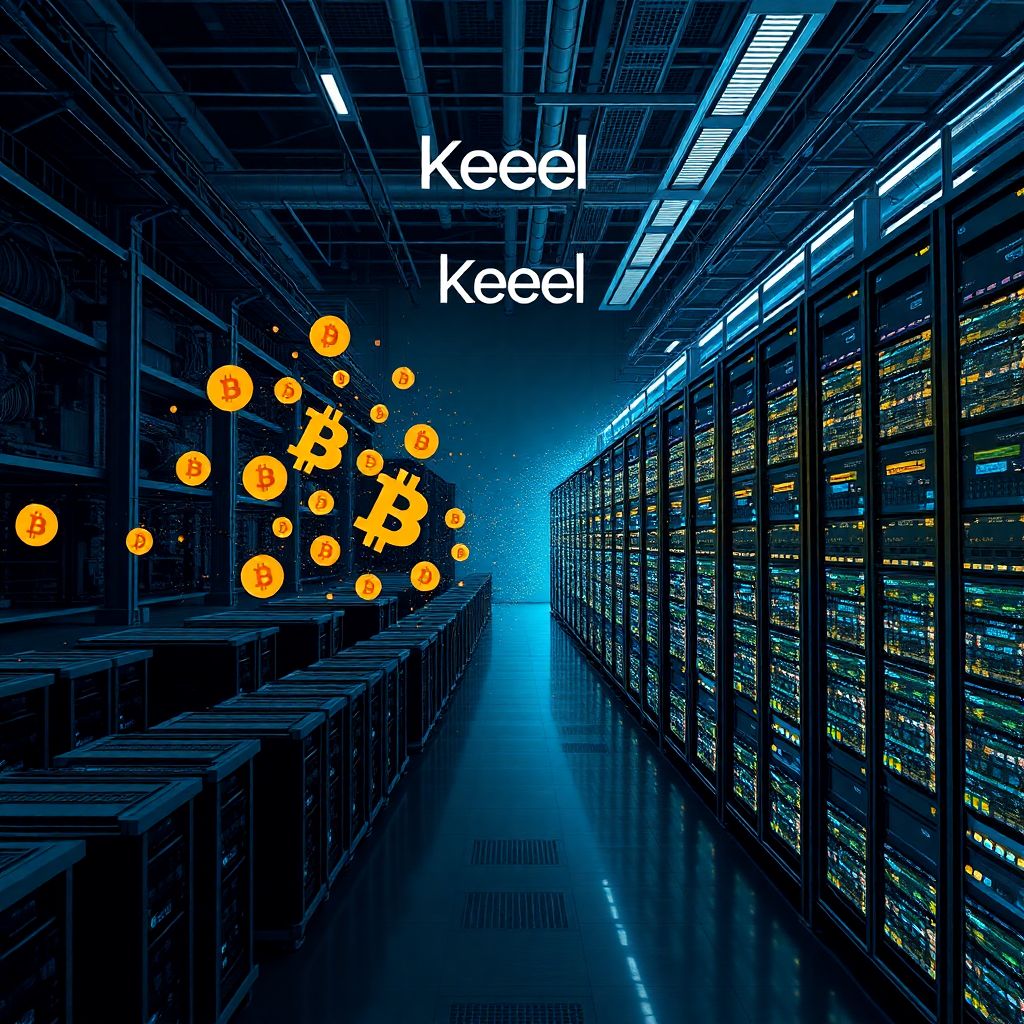
Bitfarms, long known as one of the more prominent publicly traded Bitcoin mining companies, is cutting ties with its original core business and reinventing itself around artificial intelligence infrastructure. As part of the makeover, the firm plans to relocate its corporate domicile to the United States and rebrand under a new name: Keel Infrastructure.
The strategic shift was first telegraphed in November, when the company revealed it intended to exit traditional Bitcoin mining and redirect its resources to building and operating infrastructure tailored for AI workloads. Management framed the decision as a way to tap into higher-margin opportunities and bolster net operating income, rather than remain exposed to the volatility and tightening profitability of crypto mining.
Chief Executive Officer Ben Gagnon said in a statement on Friday that the new identity is meant to capture the company’s long-term vision. “Our new name reflects how we think about infrastructure, how we’re building this company, and how we want to serve our future customers,” he explained, underscoring that the pivot is not a side project but a comprehensive reorientation of the business.
The board of directors has now formally approved a plan to redomicile the company in the U.S., a move intended to place the business closer to the world’s largest capital markets and many of the hyperscalers, AI startups, and enterprise customers driving demand for high-performance computing. Operating as Keel Infrastructure, the firm aims to position itself as a key provider of the massive power and compute capacity required to train and run modern AI models.
The new name is deliberately symbolic. In nautical terms, the keel is the central structural element of a ship—the backbone that stabilizes and supports the entire vessel. By choosing “Keel,” the company is trying to signal its ambition to become foundational infrastructure beneath the AI economy: largely unseen, but critical to keeping the whole system balanced and moving forward.
Investors have responded quickly to the narrative of reinvention. News of the rebrand and strategic migration toward AI compute helped push the company’s stock higher, reflecting a broader trend in markets where firms repositioning themselves as AI-adjacent often see short-term valuation boosts. For shareholders, the bet is that AI infrastructure, unlike Bitcoin mining, could offer more predictable, long-term demand from enterprise clients locked into multi-year compute contracts.
The rationale for exiting Bitcoin mining is rooted in economics as much as in branding. Mining margins have been pressured by rising energy costs, increasing network difficulty, and periodic Bitcoin halving events that reduce block rewards. At the same time, capital-intensive AI projects are hungry for precisely the kind of infrastructure miners already understand—large data centers, robust power arrangements, advanced cooling, and specialized hardware such as GPUs or AI accelerators.
In practice, that means the company can repurpose parts of its existing footprint rather than starting from zero. Many Bitcoin mining facilities are already located near relatively cheap power sources and built for high-density computing setups. With the right upgrades—especially new hardware, networking, and cooling systems—those sites can be converted into data centers tailored to AI and other high-performance computing tasks.
Shifting the corporate base to the United States also has strategic implications. The U.S. is currently the epicenter of large-scale AI model development, cloud infrastructure expansion, and venture funding for AI startups. By moving closer to customers, regulators, and capital, Keel Infrastructure is betting it can secure better partnerships and financing terms than it could as a crypto miner headquartered abroad.
However, the transition won’t be without challenges. Entering the AI infrastructure market means competing with major incumbents, including hyperscale cloud providers and specialized data center operators that already have deep relationships with large customers. The company will need to prove it can deliver reliable uptime, efficient power usage, and competitive pricing, all while managing the huge upfront capital expenditures associated with building and upgrading facilities.
Another key question for investors is the speed of the pivot. Transforming a Bitcoin mining business into a profitable AI infrastructure provider involves complex logistics: winding down or selling off existing mining operations, negotiating new power contracts suitable for continuous high-load AI clusters, sourcing scarce GPU and accelerator hardware, and securing long-term customer commitments. Execution risk is significant, and any delays could test market patience.
Regulatory dynamics also play a role. While AI itself faces growing scrutiny around data privacy, model safety, and antitrust concerns, infrastructure providers must navigate a different set of issues: environmental regulations, local zoning and permitting for data centers, and energy-grid constraints. The company’s earlier experience dealing with energy regulators and local authorities as a miner may offer an advantage, but the regulatory spotlight on data centers is intensifying as they consume more power.
From a strategic positioning standpoint, the rebrand suggests the company wants to be seen less as a speculative play on a single digital asset and more as a long-duration infrastructure business. That could broaden its appeal to institutional investors who might have shunned pure-play crypto miners but are actively seeking exposure to the AI supply chain, particularly in areas like data center real estate and specialized compute services.
The broader industry context also matters. Several Bitcoin miners have begun experimenting with or partially shifting to AI and high-performance computing, recognizing that their existing capabilities—access to power, industrial-scale facilities, and experience running large fleets of specialized chips—are transferable. This trend reflects a gradual convergence between crypto infrastructure and more general-purpose computing, as companies hunt for the most profitable way to monetize their energy and hardware footprints.
For customers, the emergence of new players like Keel Infrastructure could introduce more competition into the AI infrastructure market. Startups and mid-sized enterprises, which might find hyperscale cloud providers inflexible or expensive for certain workloads, could turn to smaller but specialized operators capable of offering tailored solutions, colocation, or dedicated GPU clusters with more negotiable terms.
On the financial side, the company’s long-term valuation will hinge on whether this AI-centric strategy can generate steadier, recurring revenue streams. Whereas Bitcoin mining income fluctuates heavily with token prices and network conditions, AI infrastructure typically relies on service contracts, usage-based billing, or multi-year leases. If managed effectively, that can smooth cash flows and make the company’s earnings profile more predictable.
Still, there is no guarantee that investor enthusiasm around AI will last indefinitely or that supply-demand imbalances in GPUs and data center capacity won’t normalize. If capital floods into the sector too quickly, the industry could face overcapacity and margin compression. For Keel Infrastructure, timing the buildout and maintaining discipline on costs will be critical to avoiding the boom-and-bust cycles that characterized much of the crypto mining era.
Ultimately, the planned transition from Bitfarms the Bitcoin miner to Keel Infrastructure the AI backbone provider encapsulates a broader shift in the digital economy. As markets re-price the relative value of different forms of compute—hash power for crypto versus GPU power for AI—companies sitting on large-scale infrastructure are reevaluating where their assets can earn the highest returns. For this firm, the answer is clear: less Bitcoin, more AI, and a new identity to match.