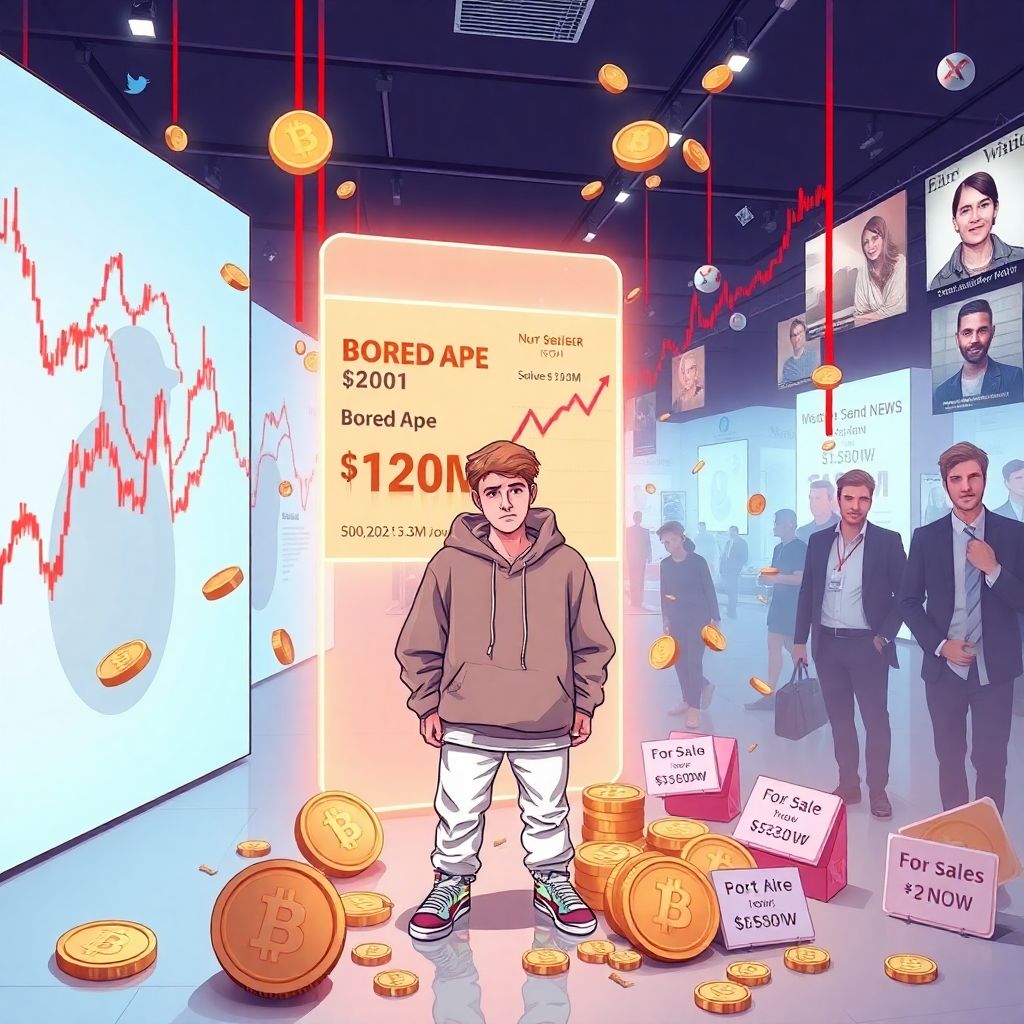
Justin Bieber’s splashy entrance into the NFT craze has turned into one of the most prominent examples of how brutally the market has cooled.
In January 2022, at the peak of the non-fungible token boom, the pop superstar spent 500 ETH—around $1.3 million at the time—on Bored Ape #3001, a cartoon primate from the hugely hyped Bored Ape Yacht Club collection on Ethereum. The purchase instantly became headline news, cementing Bieber as one of the most visible celebrity collectors in the space.
Today, that same NFT is estimated to be worth about $12,000, based on the going market rate for similar Bored Apes with comparable visual traits. In percentage terms, Bieber would be staring at roughly a 99% paper loss if he chose to sell at current prices.
What makes the figure even more striking is that Bieber’s ape isn’t visually rare or especially distinctive within the collection. In terms of attributes—background color, clothing, facial expression, and overall rarity—it sits firmly in the middle of the pack. During the mania of early 2022, those details mattered far less than the hype, celebrity attention, and status associated with “joining” the Bored Ape Yacht Club.
Now, that dynamic has flipped. The floor price—the lowest listing price—for Bored Apes has tumbled from six and seven figures in dollar terms during the bull run to low five figures. While precise valuations can vary between marketplaces and appraisal tools, the consensus is clear: comparable Apes to Bieber’s have suffered a dramatic collapse in price.
To be fair, art and collectibles aren’t priced by math alone. Value can be subjective and influenced by elements beyond rarity and aesthetics. Provenance—who owned something before—can give an item added cachet. In theory, the fact that Bored Ape #3001 has belonged to Justin Bieber could make it more desirable to certain collectors, particularly those who care about pop culture history or celebrity memorabilia.
That said, even a “celebrity premium” is unlikely to erase the reality of the wider market downturn. The Bored Ape Yacht Club, once a symbol of crypto wealth and digital cool, has lost much of its cultural momentum. Trading volumes are down, mainstream attention has shifted elsewhere, and many buyers from the boom period are underwater on their purchases.
Bieber’s Bored Ape has therefore become a kind of shorthand for the excesses of the NFT era—an emblem of how fast momentum-driven markets can rise and fall. In January 2022, NFTs were being touted as the future of digital ownership, community membership, and identity online. Celebrities, athletes, and major brands were piling into the space. Prices were justified with narratives about metaverse status symbols and permanent cultural significance.
Just a few years later, the picture looks very different. The broader NFT market has seen prices for once-sought-after collections plummet. Many projects have gone quiet, communities have thinned out, and speculative interest has retreated. What remains is a much smaller, more hardened group of participants who believe in NFTs as a long-term technology but are operating in a far less euphoric environment.
Bored Apes still retain some status as one of the landmark collections of the 2021–2022 cycle. They were widely seen as successors to CryptoPunks in terms of cultural cachet, and they helped define the idea of NFTs as membership passes to exclusive clubs, live events, and online experiences. For a period, owning a Bored Ape functioned as a visible badge of wealth and early-adopter cred.
The implosion in prices doesn’t erase that history, but it does raise hard questions for both collectors and creators. How much of the value was tied to pure speculation and bull-market liquidity, and how much to lasting artistic or cultural merit? Were sky-high valuations ever sustainable, or were they always destined to collapse once the influx of fresh money slowed?
Bieber’s case underscores several lessons for anyone looking at NFTs—or any speculative asset:
1. Celebrity does not guarantee profit. Many buyers assumed that anything promoted or owned by a major star would hold value. The reality is that markets don’t permanently reward celebrity association if underlying demand fades.
2. Rarity and hype are different things. Bored Ape #3001 is not particularly rare. Bieber effectively paid a massive premium to buy during a frenzy, when demand and social pressure were at their peak. Once that cooled, prices normalized closer to what the actual scarcity might justify.
3. Illiquid markets can reverse violently. Unlike stocks in major indices, NFTs trade in relatively thin markets. When sentiment turns, there may be few buyers at previous price levels, causing sharp, sudden drops.
4. Narratives change faster than technology. The technology behind NFTs still exists and continues to evolve, but the story the market tells about them has changed. What was once framed as “the next big thing” in culture and finance is now approached with much more skepticism.
It’s also worth noting that Bieber is far from alone among high-profile NFT buyers facing big losses on paper. Numerous celebrities, influencers, and everyday speculators bought at or near peak valuations across a variety of collections. For many, NFTs functioned less as long-term digital collectibles and more as lottery tickets in a rapidly inflating bubble.
Yet, despite the carnage in prices, NFTs as a concept have not disappeared. A segment of the industry is trying to move beyond pure speculation toward more functional use cases: tokenized tickets, gaming assets, digital identity, and blockchain-based loyalty programs. Some artists continue to use NFTs as a direct-to-fan monetization channel, even if the days of multi-million-dollar profile picture sales are largely over.
Bieber’s Bored Ape sits at the intersection of these two narratives. On one hand, it is a stark example of speculative excess—an asset that cost more than many homes, now worth about the price of a mid-range used car. On the other, it is still an on-chain artifact of a uniquely intense moment in internet and crypto history, tied to one of the world’s most recognizable musicians.
In a future where digital provenance and celebrity memorabilia are more routinely traded on-chain, a buyer might decide that owning “Justin Bieber’s ape” carries its own kind of collectible value, distinct from the broader Bored Ape floor price. That would depend on how much cultural significance is ultimately assigned to the NFT boom years, and whether they are remembered as a passing fad or a foundational era for digital ownership.
For traditional collectors and investors watching from the sidelines, the story offers a cautionary tale. High visibility, buzzy branding, and viral marketing can make any new asset class look irresistible in the short term. But long-term value typically depends on more grounded questions: What problem does this solve? Who will still care about it ten years from now? And is the price remotely connected to any durable benefit?
The NFT bust has also opened a broader conversation about financial literacy in the age of social media. Many people, inspired by celebrities or influencers, poured savings into volatile assets they didn’t fully understand. Bieber himself has never publicly framed his ape purchase as an “investment thesis,” but his experience illustrates how easily a spotlight moment can double as an expensive lesson.
From a market-structure perspective, episodes like this tend to have a cleansing effect. After speculative manias unwind, builders who remain are often more focused on utility, sustainability, and user experience. NFT projects that survive this cycle are likely to be those that offer real benefits—whether that’s exclusive content, meaningful community engagement, or interoperability in games and digital worlds—rather than purely status-based collectibles.
For collectors still interested in NFTs, Bieber’s story highlights a set of pragmatic strategies:
– Treat big-ticket NFTs more like art or luxury goods than guaranteed investments.
– Evaluate the health of a project’s ecosystem: ongoing development, transparent teams, and engaged holders.
– Be wary of buying at peak hype; “fear of missing out” is often a sign to slow down, not speed up.
– Consider whether the token has additional utility beyond being a tradable image.
In the end, Justin Bieber’s Bored Ape may yet find a second life—as a cultural artifact, a niche collector’s prize, or a textbook case study in digital speculation. For now, it stands as a striking example of how quickly fortunes can turn in emerging markets, and a reminder that even the biggest stars are not immune to the brutal math of a collapsing bubble.