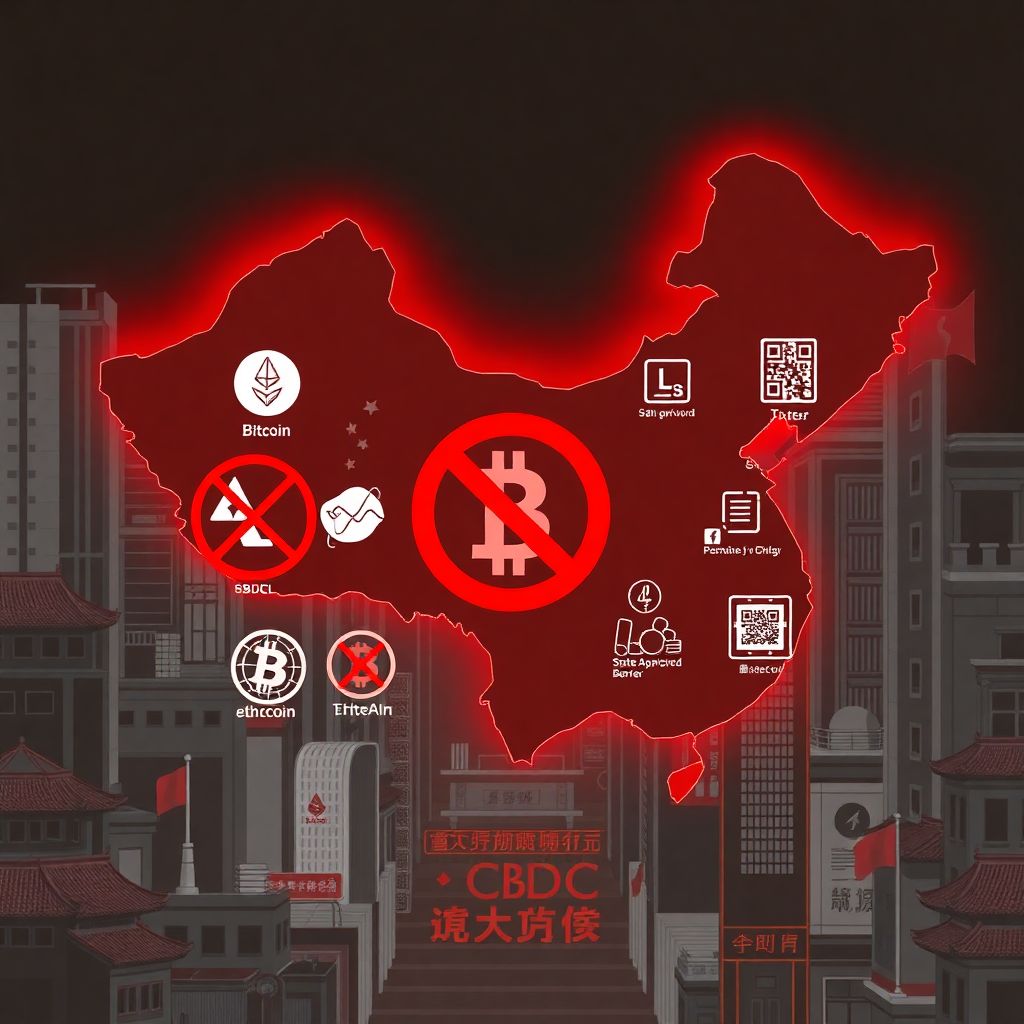
China cements sweeping ban on crypto trading and RWA tokenization
China has moved from sporadic crackdowns to a fully codified prohibition on nearly every form of cryptocurrency activity and real‑world asset (RWA) tokenization, issuing a new directive that classifies such operations as illegal financial conduct and extends liability across the entire ecosystem of providers and intermediaries.
At the core of the notice, jointly released by the People’s Bank of China (PBoC) and seven other government bodies, is a categorical rejection of the idea that digital tokens can function as money. The document states that so‑called “virtual currencies” have no equivalence to legal tender, stressing that assets such as Bitcoin, Ether and Tether do not possess legal compensation status and therefore “must not and cannot be used as currency in the market.”
On that basis, the circular designates all business models built around virtual assets as violations of financial law. This includes fiat‑to‑crypto exchanges, crypto‑to‑crypto trading pairs, market‑making operations, brokerage and information intermediation, token issuance and distribution, and any financial products that are structurally linked to cryptocurrencies. Authorities instruct that these activities be “strictly prohibited” and “resolutely banned,” eliminating any ambiguity that may have existed under earlier guidance.
RWA tokenization is explicitly placed in the same risk category as traditional crypto. Regulators define tokenization of real‑world assets as the process of converting ownership rights or income streams into transferable tokens for issuance, trading or securitization. The notice declares that such practices are banned within mainland China unless they occur under tightly controlled, pre‑approved schemes on designated financial infrastructure. Offshore entities are equally restricted: they are forbidden from providing RWA tokenization services into the mainland market without proper authorization, even if the operation is technically based abroad.
The new framework significantly reinforces and extends the rules first set out in the 2021 Yinfa No. 237 document, which labeled core crypto activities as illegal and attempted to cut off mainland Chinese users from offshore exchanges. This time, the net is cast wider. Banks, securities firms, and payment institutions are no longer permitted to open accounts, process payments, transfer funds, provide settlement, custody or insurance for any product tied to virtual assets. The message is clear: regulated financial rails must not, in any way, touch crypto- or tokenization‑linked flows.
Technology platforms are also pulled into the enforcement perimeter. Internet and app‑store operators are barred from offering online trading venues, storefronts, promotional placements, traffic acquisition tools, or paid advertising for crypto or RWA services. They are instructed to monitor and swiftly shut down websites, mobile applications and public accounts that facilitate or promote banned activity. This places responsibility not only on financial firms and token issuers, but also on the broader digital infrastructure that has historically enabled access to crypto services.
Beijing’s long‑running campaign against crypto mining is restated in uncompromising terms. Provincial and local authorities must “thoroughly identify and shut down” existing mining projects, regardless of size or sophistication, and are told to block any attempts to add new mining capacity. This maintains the country’s hard line against high‑energy, computation‑intensive mining operations that once made China the dominant hub for Bitcoin hash power.
The directive also targets sophisticated legal and corporate structuring that aimed to keep one foot in China while operating offshore. Regulators adopt a “same business, same risk, same rules” principle: if a domestic company effectively controls an overseas entity, that vehicle may not issue virtual currencies, list tokenized products, or conduct RWA‑style securitizations tied to Chinese onshore assets without prior approval, filing or registration. Using foreign shells or affiliates will not shield such activity from Chinese supervision or sanctions.
The announcement lands in a global environment where digital assets continue to trade as high‑beta instruments that react sharply to macroeconomic sentiment, liquidity conditions and regulatory headlines. Following the notice, major cryptocurrencies showed notable weakness: Bitcoin hovered around 66,005 dollars, roughly 7.9% lower over a 24‑hour period; Ethereum traded near 1,890 dollars, down about 11.6%; Solana slid to approximately 77.8 dollars, a decline of around 15.4% on the day. While China is no longer the primary driver of crypto volumes as it once was, its policy shifts still resonate in global pricing.
Legally, the document takes immediate effect and simultaneously rescinds the landmark 2021 circular on virtual‑currency speculation. That repeal does not signal any softening; instead, it marks a transition from episodic enforcement campaigns to a permanent, high‑pressure regulatory regime. The stated objective is to protect “economic and financial order and social stability,” leaving no grey areas where crypto trading, token issuance or experimental RWA projects might otherwise attempt to operate.
Why China is drawing a hard line on crypto and RWA tokenization
Behind the legal wording lies a clear policy calculus. Chinese authorities have long viewed cryptocurrencies as channels for capital flight, financial fraud, illegal fundraising and money laundering. Decentralized assets, by design, sit outside the state’s stringent capital controls and challenge its ability to monitor cross‑border flows. By classifying almost all crypto‑related activity as illegal, regulators are closing one more loophole in the country’s already tight financial perimeter.
RWA tokenization, although presented globally as a tool for efficiency and financial innovation, raises additional red flags in the Chinese context. Turning claims on real estate, commodities, infrastructure or receivables into tradable tokens can, in theory, create parallel markets that compete with regulated exchanges and bond markets. For a system that relies heavily on centralized oversight and curated channels for credit allocation, this kind of decentralized securitization is perceived as a threat to macro‑prudential stability and policy control.
Authorities are also acutely aware of the speculative waves that have accompanied crypto cycles worldwide. From leveraged retail trading to high‑yield lending schemes and opaque cross‑exchange arbitrage, crypto markets have repeatedly produced boom‑and‑bust dynamics. The new notice essentially concludes that the consumer‑protection risks, social discontent from losses, and systemic spillovers outweigh any perceived innovation upside within China’s borders.
Impact on domestic innovation and blockchain strategies
The ban does not mean China is abandoning digital finance altogether; rather, it is drawing a sharp line between state‑approved experimentation and uncontrolled market activity. While public, permissionless cryptocurrencies are being squeezed out, Beijing continues to push ahead with its own central bank digital currency (CBDC), the digital yuan, and with permissioned blockchain platforms under strict regulatory oversight.
Chinese tech giants and financial institutions are likely to redirect resources away from open crypto projects and toward these government‑aligned initiatives. Enterprise‑grade blockchains focused on supply‑chain traceability, trade finance, document verification and interbank settlement can still operate, as long as they avoid token issuance and speculative trading. The message to innovators is: build within the sandbox defined by the state, not outside it.
This approach may slow China’s participation in global DeFi, open‑source tokenization standards and cross‑border Web3 platforms, but it could accelerate the development of domestic digital infrastructures that are tightly integrated with existing regulations. Over time, China may attempt to export its model of controlled tokenization and CBDC‑based settlement to trading partners, especially within regional initiatives and bilateral financial agreements.
Consequences for Chinese users and offshore workarounds
For individual users inside China, the new rules further shrink the avenues for legal exposure to crypto assets. Opening accounts on offshore exchanges, subscribing to tokenized products, or participating in token issuance and trading now risk not only personal regulatory consequences but also the shutdown of the service providers themselves. Payment channels are likely to be monitored more closely, and any suspicious patterns tied to crypto will attract scrutiny.
Historically, traders have tried to circumvent bans through VPNs, peer‑to‑peer trading, stablecoins and offshore platforms. The “same business, same risk, same rules” principle signals that authorities are prepared to look through corporate structures and technical obfuscation. While full eradication of underground activity is unlikely, the cost of operating such channels — both legal and operational — is expected to rise considerably.
Over time, this may push Chinese investors who still desire exposure to digital assets toward more traditional vehicles outside the country, such as foreign-listed companies with crypto treasuries or regulated investment products domiciled abroad, accessed through legal foreign accounts. However, such routes are tightly constrained by China’s existing capital‑control framework, limiting their accessibility to the broader population.
Global market and regulatory signaling
Internationally, China’s hardened stance sends a powerful signal to other regulators that are still debating how far to go in policing crypto markets. While many jurisdictions are pursuing a “regulation‑not‑prohibition” strategy — imposing licensing regimes, capital rules and investor‑protection standards — China is demonstrating that a major economy can opt for outright exclusion of public cryptocurrencies and open tokenization.
This creates a sharper policy contrast with regions that have chosen to integrate digital assets into their financial systems under supervision. For global firms in the crypto and RWA space, China is effectively a no‑go market for retail‑oriented products and most trading services. Instead, their focus will likely concentrate on jurisdictions that are adopting structured licensing frameworks and sandbox regimes, where experimentation is encouraged but constrained by regulatory guardrails.
At the same time, China’s move could indirectly benefit competitors by pushing liquidity and innovation further into markets that welcome, or at least tolerate, crypto activity. Exchanges, custodians, RWA platforms and Web3 startups may concentrate their efforts where legal clarity exists, even if regulatory demands are high.
What this means for the future of tokenization
The inclusion of RWA tokenization in the ban is especially notable because many financial institutions worldwide see tokenized assets as the next major frontier in capital markets. From tokenized government bonds and money‑market funds to fractionalized real estate and trade receivables, the concept promises more efficient settlement, 24/7 trading and expanded investor access.
China’s decision to treat these experiments as illegal unless they occur within officially sanctioned channels suggests that tokenization, in its open, market‑driven form, will be largely absent from the country’s domestic financial evolution. Instead, any Chinese version of tokenization is likely to be tightly integrated with existing regulatory architecture, run by licensed institutions, and designed to complement, not disrupt, the state‑dominated financial order.
For global RWA developers, this underscores the importance of jurisdictional strategy. Products built for open, borderless participation may find themselves completely excluded from a large market like China, even as they gain traction elsewhere. Conversely, firms targeting institutional tokenization might find opportunities to collaborate with Chinese banks and infrastructure providers, but only under carefully negotiated, regulator‑approved schemes that avoid public speculation and secondary markets.
A durable regime, not a temporary crackdown
The immediate repeal of the 2021 circular, combined with the more expansive and integrated framework in the new notice, indicates that China is moving from ad‑hoc enforcement toward a stable, long‑term policy position. Rather than relying on periodic campaigns to suppress surges in trading or mining, authorities are embedding a structural prohibition into the fabric of financial and internet regulation.
For the crypto industry, this undercuts any residual hope that China might one day reverse course and embrace public cryptocurrencies as an asset class. Instead, the country is doubling down on a model where state‑issued and state‑approved digital instruments monopolize the space once occupied by open blockchain projects. In practical terms, the new regime is designed to prevent future grey zones where entrepreneurs or investors might attempt to test boundaries.
Outlook
In the near term, the notice will likely accelerate the exit of any remaining onshore crypto operations and force service providers catering to Chinese users to reassess their risk exposure. Global price reactions may ebb as markets digest the change and refocus on other macro and regulatory drivers. Over the longer horizon, China’s firm stance will remain a defining feature of the geopolitical landscape around digital assets: a major economic power opting for controlled, sovereign digital finance, while much of the rest of the world experiments with more open, market‑based models of crypto and RWA tokenization.