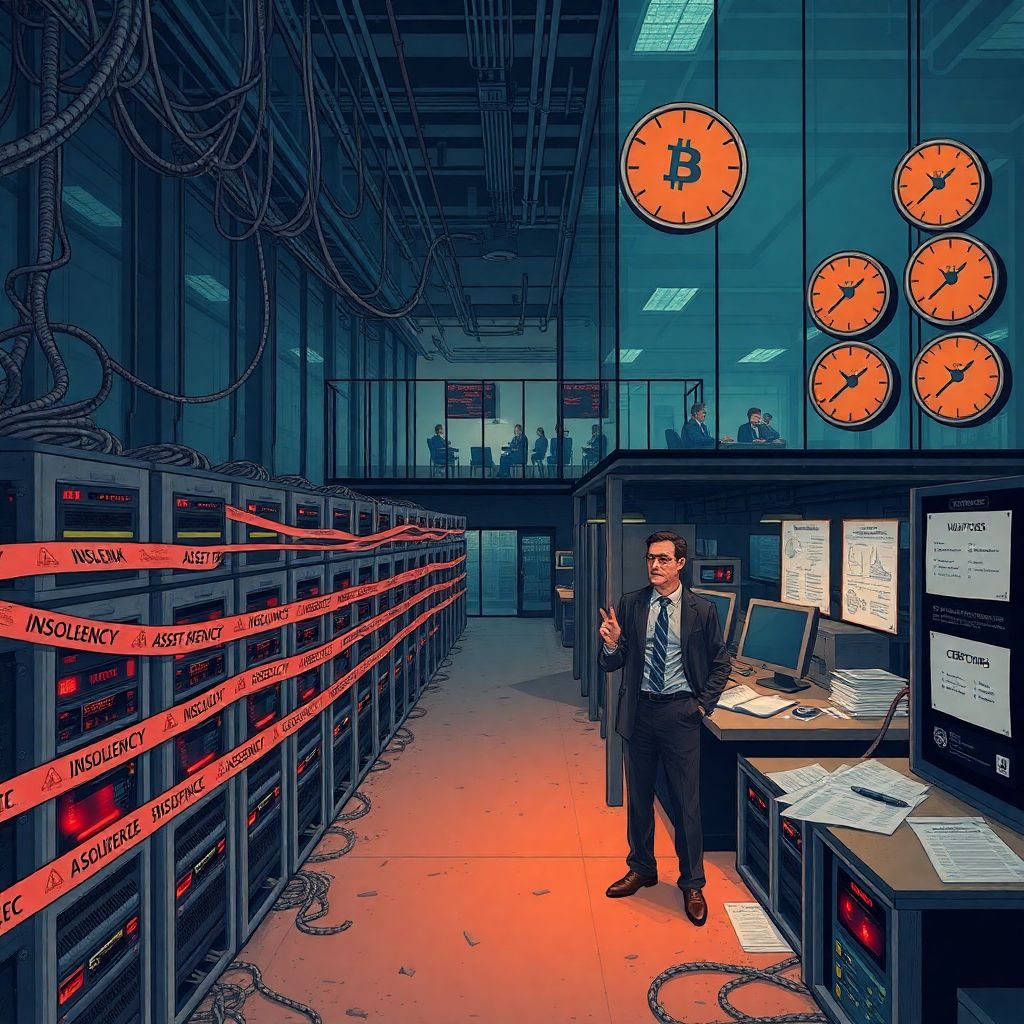
Russia’s biggest bitcoin miner BitRiver is moving closer to bankruptcy after a Russian arbitration court formally opened insolvency proceedings against the company over millions of dollars in unpaid obligations.
The case was initiated after several creditors filed coordinated claims, citing overdue payments for technical services, electricity supply, and data center maintenance. According to the filings, BitRiver repeatedly delayed or failed to meet payment schedules, leaving suppliers with few options other than seeking legal protection and court-managed recovery of their funds.
Following review of the claims, the court approved the start of standard bankruptcy procedures. As part of the ruling, restrictions were placed on a number of BitRiver’s bank accounts in an effort to secure remaining assets and prevent their withdrawal or dissipation while the process is underway. This is a common step in Russian insolvency cases, aimed at preserving value for all creditors rather than allowing a small group to be paid first.
A temporary administrator has been appointed to oversee the company’s finances. This court-appointed specialist is tasked with auditing BitRiver’s books, identifying its full list of creditors, estimating the value of its assets, and presenting options such as restructuring, partial asset sales, or liquidation. Any significant decision now requires the administrator’s consent and, ultimately, judicial approval.
The company’s most acute problem is energy-related debt. Large-scale bitcoin mining is extremely power-intensive, and BitRiver’s entire business model has depended on access to vast amounts of relatively cheap electricity. Several energy providers have reportedly restricted or entirely suspended supplies to facilities associated with the company after bills went unpaid for extended periods. As a result, mining output has dropped substantially, with some data centers shutting down equipment completely and others operating at only a fraction of previous capacity.
These power cuts have disrupted not only BitRiver’s own proprietary mining, but also hosting services provided to third-party clients who colocated their mining rigs in BitRiver’s data centers. For many of those clients, the appeal of working with BitRiver was access to industrial-scale infrastructure and low regional energy costs. With machines powered down or running intermittently, revenue streams for those clients have also shrunk, adding pressure and potentially triggering additional contractual disputes.
Asset freezes connected to the insolvency case have further complicated operations. Limits on the use of corporate accounts and restrictions on the disposal of property mean the company is struggling to pay contractors, cover routine maintenance, or restore full-scale operations, even in facilities where power supply has not been completely cut. This creates a feedback loop: the weaker the operations, the harder it becomes to generate cash flow that could be used to settle debts.
Against this backdrop, discussions are reportedly taking place around a potential change of ownership. Court documents hint at negotiations focused on restructuring BitRiver’s obligations while keeping at least its most important facilities running. Scenarios under consideration may include the entry of a new investor, transfer of control to a creditor or consortium of creditors, or the sale of individual data centers. So far, however, no binding agreement has been announced, and the outcome remains uncertain.
The financial and legal turmoil has already triggered internal shake-ups. Several members of BitRiver’s senior management team are said to have resigned or departed during the insolvency process, amid mounting financial difficulties and continuing legal scrutiny. Leadership instability could further undermine negotiations with creditors and potential investors, especially in a sector that relies heavily on trust in operational continuity and technical expertise.
Adding to the company’s headaches is the legal trouble facing its founder, Igor Runets. Local media report that Runets has been placed under house arrest on tax-related charges. Authorities have released few specifics, and the investigation is ongoing, but any criminal case involving top management tends to complicate restructuring efforts and negotiations with banks, regulators, and partners. For a business already under formal insolvency supervision, this introduces an additional layer of uncertainty over future governance.
For years, BitRiver was one of the flagship examples of Russia’s ambition to leverage its energy surplus and cold climate for industrial-scale bitcoin mining. The company built and operated large mining campuses, often in regions with inexpensive electricity and natural conditions favorable to cooling hardware. By working closely with regional utilities and local authorities, BitRiver positioned itself as a professional, institutional player rather than a loosely organized mining collective.
The current crisis shows how fragile that model can become when key inputs—chiefly electricity and stable financing—are disrupted. Mining profitability is tightly linked to bitcoin’s price, network difficulty, and electricity costs. During bullish cycles, companies often expand aggressively, adding hardware and power capacity. If market conditions change or if financing tightens, those expansion commitments can quickly turn into unsustainable fixed costs. In BitRiver’s case, unpaid power bills and service fees suggest that cash flow was no longer sufficient to cover operational obligations at scale.
A central question for the market is whether BitRiver will be forced to liquidate some or all of its digital assets to satisfy creditors. Officially, there is no confirmation that the company intends to sell any bitcoin it may hold on its balance sheet. Court documents are reportedly focused on the classic elements of an insolvency proceeding: debt recovery, valuation of tangible and intangible assets, and the ranking of creditor claims. Any sale of cryptocurrencies would have to be evaluated by the temporary administrator and sanctioned by the court to ensure fairness and transparency.
If large-scale sales were to happen, that could have local market implications, especially for over-the-counter trading desks and mining-related liquidity channels in the region. However, the global bitcoin market is deep enough that even a sizable liquidation from a single miner is unlikely by itself to create lasting price shock. The more significant impact may be psychological: a high-profile miner in distress sends a message about the operational and regulatory risks of the industry.
The BitRiver case also illustrates how regulatory and legal pressures are reshaping the mining landscape. In many jurisdictions, including Russia, authorities have become more attentive to tax compliance, energy usage, and the origin of funds flowing through mining companies. Investigations into executives, stricter oversight of electricity contracts, and closer scrutiny of financial reporting can all affect how miners structure their businesses and where they choose to locate.
For creditors and hosting clients, the insolvency proceedings are a test of how well existing legal frameworks can handle crypto-related businesses. Traditional bankruptcy law was designed around factories, warehouses, and machinery—not around mining rigs, digital wallets, and hash rate. Questions such as how to value specialized equipment, how to treat digital assets, and how to prioritize different categories of claims are becoming more pressing as cases like BitRiver’s move through the courts.
Other Bitcoin miners, both in Russia and abroad, are likely watching these developments closely. Many operate on thin margins and are exposed to the same set of risks: volatile crypto prices, rising electricity tariffs, hardware obsolescence, and increasingly demanding regulators. BitRiver’s difficulties may prompt some competitors to reduce leverage, renegotiate power contracts earlier, improve transparency around reserves, or diversify into adjacent services such as AI computing, data center hosting for non-crypto clients, or grid-balancing energy services.
For the regions where BitRiver built its data centers, the outcome of the case carries economic implications beyond the crypto industry. Mining facilities generated demand for local electricity, created technical jobs, and sometimes contributed to local budgets through taxes and infrastructure investments. A full-scale collapse could mean lost employment and idle energy capacity, while a managed restructuring or sale to new operators could preserve at least part of the economic activity.
From a technological standpoint, the situation is also a reminder that physical infrastructure remains the backbone of the digital asset ecosystem. Behind every block mined and every transaction confirmed stand real-world contracts with power suppliers, hardware manufacturers, and service providers. When those relationships break down, even the largest players can quickly find themselves in existential trouble, regardless of how many petahashes of computing power they once controlled.
As the insolvency process progresses, the court-appointed administrator will need to balance competing interests: creditors seeking maximum recovery, employees hoping to keep their jobs, clients wanting their equipment back or their services restored, and potential investors looking for distressed assets at attractive prices. The court’s decisions over the coming months—on asset sales, restructuring plans, and the ultimate fate of the company—will shape not only BitRiver’s future, but also the broader perception of large-scale crypto mining in Russia.
For now, BitRiver operates under tight legal oversight. Its accounts are restricted, its leadership is under pressure, and its mining farms are running far below peak capacity. Whether the company emerges as a restructured entity under new ownership, is broken up and sold piece by piece, or is eventually liquidated entirely will depend on negotiations in courtrooms rather than movements in the bitcoin price chart.