Wall Street pushes back as SEC weighs crypto exemptions amid legislative stall
Top U.S. financial institutions are ramping up resistance to the Securities and Exchange Commission’s evolving stance on digital assets, deepening the rift between traditional finance and the crypto industry at a time when formal legislation remains stuck in Congress.
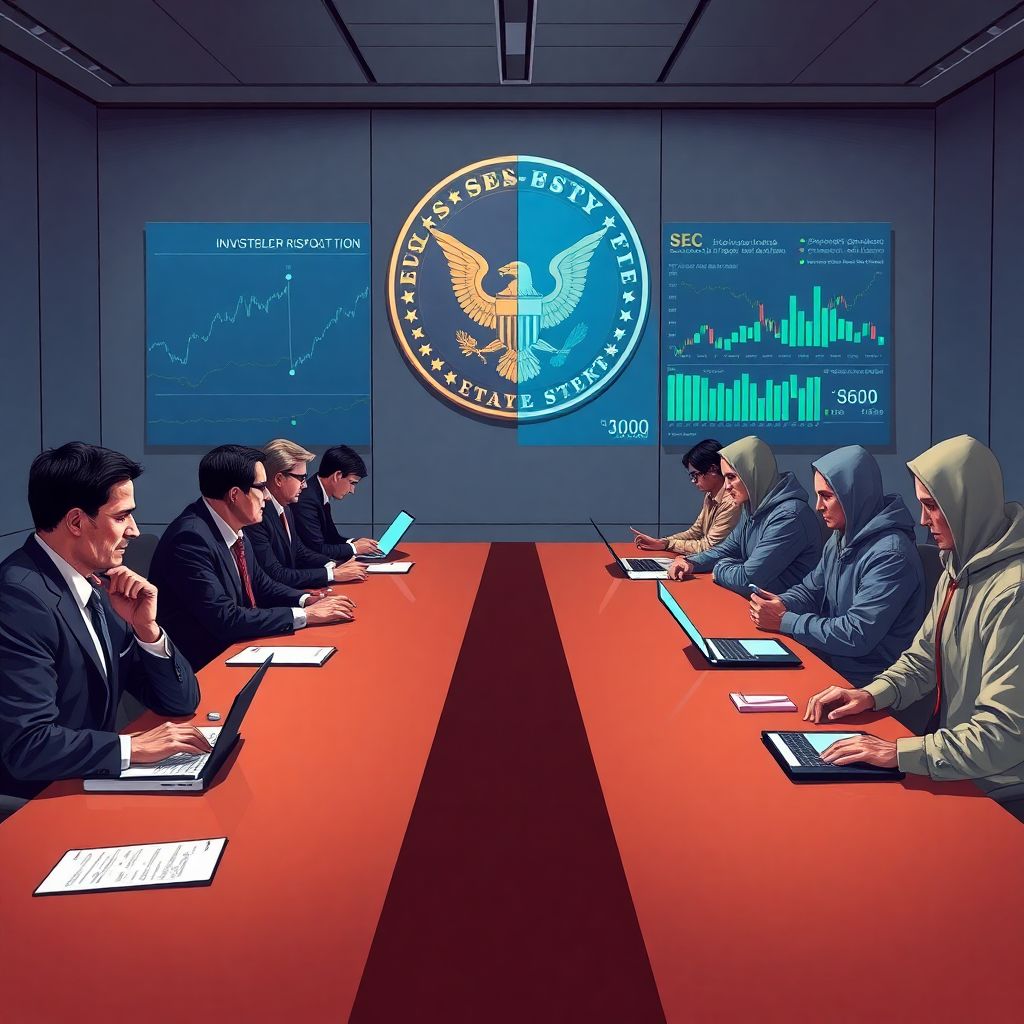
This week, heavyweight firms including JPMorgan, Citadel, and representatives from the Securities Industry and Financial Markets Association (SIFMA) met with members of the SEC’s dedicated crypto task force. Behind closed doors, they challenged the regulator’s emerging plan to carve out broad exemptions for tokenized securities and selected decentralized finance (DeFi) protocols.
According to briefing materials prepared for the meeting, Wall Street lobbyists warned that loosening rules based primarily on whether an asset is “crypto” or “tokenized” — rather than on its underlying economic function — could dilute investor protections and introduce new systemic threats. They argued that financial instruments performing the same role in the market should face consistent oversight, regardless of the technology used to issue or trade them.
Officials at the meeting pointed to last October’s sudden crypto flash crash, which erased an estimated $19 billion in value within a single trading day. They framed the episode as a cautionary tale about the fragility of tokenized markets operating without robust guardrails, underscoring how rapid price cascades and thin liquidity can cascade across platforms and products in minutes. Industry representatives warned that similar shocks, if allowed to spill over into tokenized versions of mainstream assets, could ricochet into the broader financial system.
Against that backdrop, the delegation pressed the SEC to avoid exemptions that might unintentionally undermine market stability. Their message was clear: if tokenized versions of bonds, equities, and money-market instruments enjoy laxer standards than their traditional counterparts, arbitrage and regulatory gaps could emerge, inviting both speculative excess and hidden leverage.
The tension comes at a pivotal moment, as SEC Chair Paul Atkins is reportedly finalizing a sweeping package of so‑called “innovation exemptions” aimed at giving crypto firms more breathing room. These measures would offer targeted legal assurances to companies experimenting with tokenized assets or running DeFi protocols, shielding some activities from being treated as full‑blown securities violations while pilots and sandboxes are in place.
Supporters of this approach inside the industry argue that without such flexibility, promising use cases — from on‑chain settlement of securities to programmable treasury products and decentralized lending — will migrate offshore, where oversight is weaker and U.S. regulators have less influence. They say that measured exemptions could actually enhance investor protection in the long term by bringing more activity into observable, regulated perimeters rather than pushing it into gray zones.
Yet Wall Street’s major players see potential unevenness. Large banks and broker‑dealers are tightly bound by capital rules, reporting obligations, and conduct standards that have accumulated over decades. If crypto platforms and DeFi projects can offer similar financial products under lighter rules, incumbents fear not only unfair competition, but a replay of pre‑crisis “shadow banking” — critical market functions shifting into less‑regulated venues, where risks can build unnoticed.
Complicating matters further, the legislative process that was supposed to create a coherent national framework for digital assets has stalled. A much‑anticipated crypto market structure bill, designed to clarify which tokens fall under securities law, how trading platforms should be supervised, and where stablecoins fit into the regulatory map, has run into political and industry friction in the Senate.
The deadlock is not just partisan. It reflects a fractured industry landscape: DeFi advocates push for maximal decentralization and minimal intermediary obligations; traditional financial associations such as SIFMA press for consistent, function‑based regulation; and even within the crypto sector, fault lines are widening. One prominent dispute centers on stablecoin rewards, where established banks and large crypto exchanges have clashed over how yield‑bearing products should be regulated and who should be allowed to offer them.
Analysts say this stalemate leaves the SEC and other regulators in an uncomfortable position. With Congress failing to define clear boundaries, agencies are forced to stretch existing securities, commodities, and banking laws to cover technologies they were never designed to address. That, in turn, feeds industry complaints about “regulation by enforcement” on one side and accusations of regulatory overreach or under‑reach on the other.
The clash between Wall Street and crypto over exemptions is thus part of a broader struggle over who will set the rules for the next era of finance. Large banks and market‑makers want a framework that preserves hard‑won safeguards and limits the scope for regulatory arbitrage. Crypto entrepreneurs argue that clinging to legacy rules could suffocate technologies that promise faster settlements, lower costs, and broader access to capital.
At the heart of the debate is a simple but unresolved question: should tokens and DeFi systems be judged primarily by their code, their governance model, or by the economic realities they represent? Traditional finance insists that if a token behaves like a security or a derivative, it must be regulated as such. Many in crypto counter that open‑source protocols and non‑custodial designs fundamentally change who bears responsibility and how risks should be measured.
For investors, both retail and institutional, this regulatory limbo creates a double‑edged environment. On one hand, innovation continues at a rapid pace: tokenized treasuries, on‑chain funds, and algorithmic liquidity pools are gaining traction. On the other, the lack of consistent rules means that rights and protections can vary dramatically from one platform to the next, and legal recourse may be uncertain when things go wrong.
The specter of another flash crash looms large in these discussions. While last October’s $19 billion wipeout was largely contained within crypto markets, regulators worry that as tokenization of real‑world assets accelerates, a similar liquidity shock could hit instruments directly tied to traditional finance — for example, tokenized government bonds used as collateral across multiple platforms. A disorderly unwinding in such markets could transmit stress into banks, hedge funds, and corporate treasuries.
Proponents of tokenization counter that with the right design, on‑chain markets can actually improve resilience. Real‑time transparency, programmable risk controls, and automated margining, they argue, can allow problems to surface and be addressed more quickly than in opaque, fragmented legacy systems. But they concede that this vision depends on careful rule‑setting and standards that align smart‑contract dynamics with existing prudential norms.
The stalled Senate bill was intended to start drawing those lines. Draft versions have sought to delineate where the SEC’s jurisdiction ends and the commodities regulator’s begins, set baseline disclosures for token issuers, and outline how DeFi protocols might register or comply without undermining their decentralized nature. Each of those points, however, has become a battleground in its own right, as different stakeholders fight to protect their business models.
For now, the SEC’s planned innovation exemptions may become a de facto bridge policy while Congress debates. If implemented, they could create a temporary environment in which certain tokenized securities and DeFi experiments operate with more clarity but under specific conditions, such as limits on asset size, participant eligibility, or duration of pilots. How strict or permissive those conditions are will shape whether Wall Street sees them as a manageable sandbox or a dangerous loophole.
This transitional phase also challenges corporate strategy. Large financial institutions exploring tokenization must decide how aggressively to move while the rules remain in flux. Too cautious an approach risks ceding ground to nimbler crypto‑native firms; too bold a move could expose them to regulatory backlash or reputational damage if an exemption is narrowed or revoked after the fact.
Ultimately, the confrontation over crypto exemptions underscores a delicate balancing act. Regulators are under pressure to prevent past mistakes — from speculative bubbles to under‑regulated credit booms — from replaying in digital form. At the same time, they face mounting evidence that blockchain‑based systems are beginning to reshape how capital is raised, traded, and managed across borders.
Until Congress breaks the deadlock and delivers a durable statutory framework, the U.S. path on crypto will likely continue to be defined by incremental policy moves, ad hoc exemptions, and contested enforcement actions. Wall Street’s pushback against the SEC’s latest initiative signals that each of those steps will be closely fought. For the industry, that means an extended period of cautious anticipation, where innovation proceeds — but always under the shadow of regulatory uncertainty.