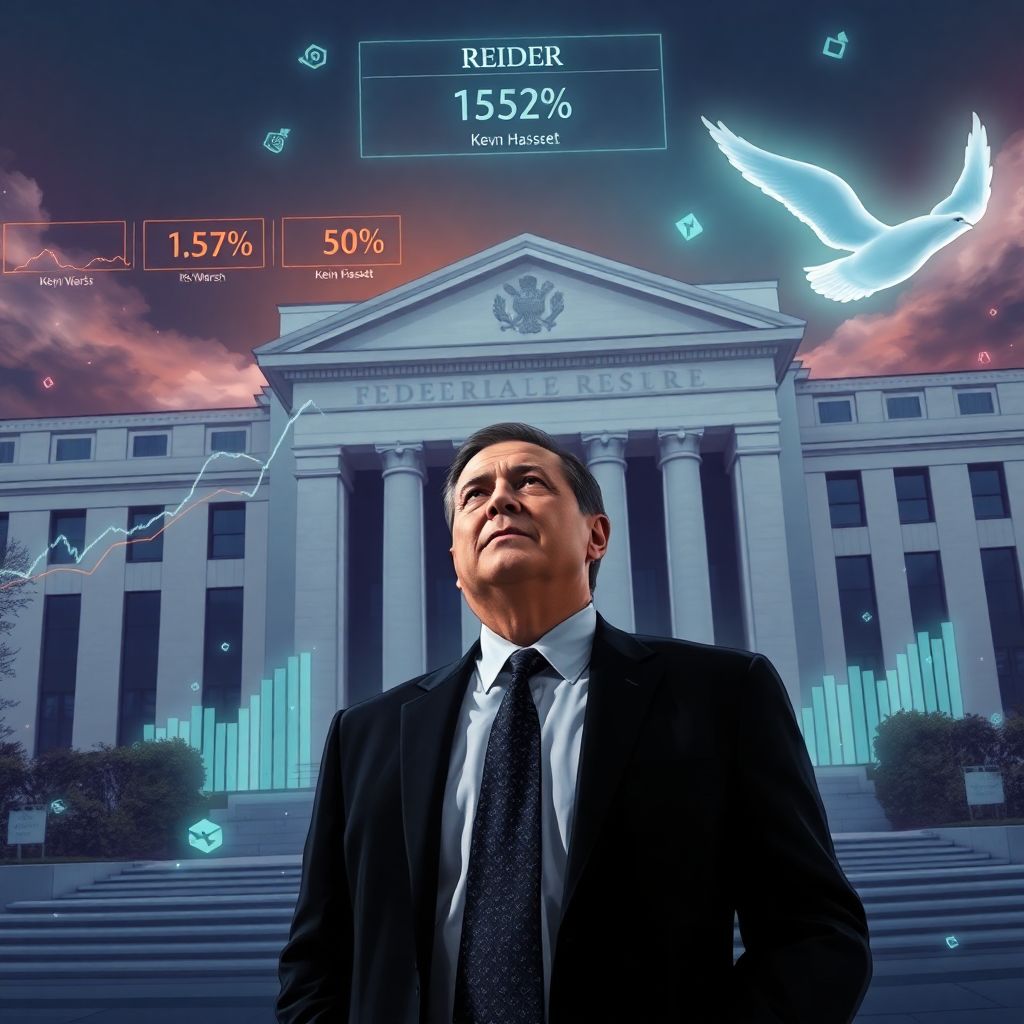
Crypto advocate Rick Rieder has rapidly climbed to the top of betting markets as the most likely candidate to lead the US Federal Reserve, with traders increasingly pricing him in as Donald Trump’s preferred pick for Fed Chair.
Rieder, a senior executive at BlackRock responsible for managing more than $2.4 trillion in assets, has seen his odds surge on prediction platforms such as Polymarket and Kalshi following a reportedly strong impression during a recent interview with Trump. On Polymarket, contracts tied to his nomination show him with a probability of about 51%, well ahead of former Fed Governor Kevin Warsh at 31% and former Trump economic adviser Kevin Hassett at 6%. A similar contract on Kalshi places Rieder at roughly 52%, with Warsh again in second place around 29%, signaling a clear consensus among speculators that Rieder is now the frontrunner.
Other names once seriously floated for the role — including current Fed Governor Christopher Waller, hedge fund figure Scott Bessent, and economist Judy Shelton — have seen their implied odds retreat as traders consolidate around Rieder and, to a lesser extent, Warsh.
Why Rieder Is Gaining Momentum
Rieder first drew heightened attention in Washington several months ago when he publicly argued the Fed was moving too cautiously on monetary easing. While the central bank opted for a 25‑basis‑point rate cut at the time, Rieder said he believed a 50‑basis‑point reduction would have been more appropriate, citing the need to support growth and financial markets more aggressively.
His broader message has been consistently dovish: he favors easier financial conditions, believes the economy can handle lower rates, and maintains a constructive view on risk assets such as equities. That stance aligns closely with markets’ appetite for looser policy after an extended period of aggressive tightening to tame inflation.
This profile — a market-savvy insider who understands both Wall Street and macro policy, and is inclined toward rate cuts — has made Rieder an appealing candidate in the eyes of traders trying to anticipate Trump’s decision.
A Crypto-Friendly Policy Voice
What notably distinguishes Rieder from many traditional central banking figures is his openness to digital assets. He has repeatedly spoken positively about Bitcoin and other alternative stores of value. In recent commentary, Rieder argued that investors could benefit from diversifying their portfolios into assets like stocks, Bitcoin, and gold, framing them as complementary components of a modern asset allocation strategy rather than fringe speculations.
Other potential nominees, including Kevin Warsh and Kevin Hassett, have also expressed support for the cryptocurrency sector or at least a willingness to engage constructively with it. This cluster of crypto-friendly attitudes among top contenders is feeding optimism within the digital asset community that the next Fed leadership may be less skeptical and more pragmatic about the role of crypto in global markets.
However, it is crucial to recognize the limits of what a Fed Chair can directly do for the industry.
What the Fed Chair Can – and Can’t – Do for Crypto
Despite the market’s focus on Rieder’s positive view of Bitcoin, the Federal Reserve does not regulate cryptocurrencies in any direct sense. The core mandate of the Fed remains monetary policy: setting interest rates, overseeing balance sheet operations such as quantitative easing or tightening, and safeguarding financial stability.
From that vantage point, a dovish Fed Chair who favors lower rates and abundant liquidity can indirectly benefit crypto markets. Historically, risk assets — including Bitcoin, growth stocks, and other speculative plays — have tended to perform better in environments of cheap money and strong liquidity. If Rieder were to push for faster or deeper rate cuts, or signal comfort with renewed asset purchases in a downturn, that backdrop could make it easier for crypto prices to climb.
Yet the real levers of power over digital assets lie elsewhere. In the United States, the regulatory fate of cryptocurrencies is primarily shaped by agencies such as the Securities and Exchange Commission and the Commodity Futures Trading Commission. These bodies determine how tokens are classified, which products can be offered to retail investors, and what compliance burdens fall on exchanges, custodians, and issuers. Even the most crypto-sympathetic Fed Chair would have limited authority to change that framework.
Nevertheless, the Fed’s tone matters. A central bank leadership that views innovation and digital assets as part of a broader evolution in finance — rather than as a systemic threat — can influence how other regulators and lawmakers frame their own responses.
The Timing: First Rate Decision of the Year
Rieder’s surge in betting odds coincides with the Federal Reserve’s first interest rate decision of the year. Most economists anticipate that the central bank will leave rates unchanged at this meeting, opting to wait for more data on inflation, growth, and labor markets before altering course.
This pause keeps the focus squarely on what the Fed will do over the rest of the year — and, by extension, what kind of policy posture the next Chair might adopt. Traders who believe that Trump will want a more aggressive easing cycle if he returns to the White House are effectively wagering that he will choose someone like Rieder, who has already made the case for stronger rate cuts.
As markets comb through every public appearance and comment from potential nominees, the gap between Rieder and his rivals in prediction markets reflects a growing belief that his blend of Wall Street experience, dovish instincts, and openness to new asset classes fits that desired profile.
How a Rieder Fed Could Shape the Macro Backdrop
If Rieder were ultimately nominated and confirmed, his views suggest several potential macro scenarios that matter for investors:
– Faster pivot to rate cuts: Rieder has already argued that the Fed should err on the side of more aggressive easing. Under his leadership, the central bank could move more quickly to cut rates if growth slows or if inflation falls convincingly back toward target.
– Supportive stance toward markets: With his background managing trillions in assets, Rieder understands the knock-on effects monetary policy has on credit, equities, and alternative assets. This might translate into a communication style that seeks to avoid unnecessary market shocks.
– Greater tolerance for risk assets: While a Fed Chair cannot target asset prices directly, a leadership that views robust capital markets and innovation as positives may be less inclined to overreact to volatility in newer sectors such as crypto.
Such an environment would not guarantee a bull market for Bitcoin or other digital assets, but it would remove one of the headwinds that have weighed on the sector during the tightening cycle: persistently higher rates and reduced liquidity.
Implications for Bitcoin and Digital Assets
For Bitcoin specifically, a Rieder-led Fed could matter in several ways:
1. Cost of capital: Lower interest rates tend to reduce the opportunity cost of holding non‑yielding assets like Bitcoin and gold. When cash and bonds pay less, store‑of‑value narratives become more appealing.
2. Risk sentiment: Dovish policy typically boosts risk appetite. Allocators may become more willing to experiment with modest crypto exposure as part of a diversified portfolio, especially if influential figures like Rieder publicly endorse that approach.
3. Narrative shift: A Fed Chair known to take Bitcoin seriously — even if only as a portfolio diversifier — may help further normalize institutional engagement with digital assets.
At the same time, investors should avoid overestimating how much any single policymaker can change the trajectory of a technology-driven asset class. Price cycles in crypto are still heavily influenced by halving events, network growth, speculative flows, and regulatory decisions outside the Fed’s remit.
Comparing Rieder to Other Contenders
While Kevin Warsh and Kevin Hassett are trailing in prediction markets, they remain relevant potential nominees and are also viewed as relatively friendly to crypto and market-oriented policymaking.
– Kevin Warsh previously served as a Fed Governor and has long been seen as a critic of excessively loose policy, although his thinking has evolved. Markets see him as more traditional and potentially more hawkish than Rieder, which may explain the lower odds in a context where traders expect a preference for stronger easing.
– Kevin Hassett, best known for his role as chair of the Council of Economic Advisers under Trump, has been outspoken on growth-friendly policies and has signaled receptiveness to innovation in digital finance. However, he lacks direct experience running a major asset management platform or serving on the Fed’s Board, which may make his candidacy appear less likely.
In contrast, Rieder occupies a middle ground between market practitioner and policy thinker, giving him a profile that many see as both politically viable and acceptable to financial institutions.
What Investors Should Watch Next
For now, the shift in prediction markets is more about expectations than certainties. Several factors could still alter the landscape:
– Changes in the macro environment that push the Fed toward a different path.
– New public comments from Trump or his advisers signaling a preference for a different style of central bank leadership.
– Emerging scrutiny of potential nominees’ past statements or decisions as vetting intensifies.
Investors tracking crypto, equities, and bonds should pay close attention not only to the Fed’s actual rate decisions but also to the evolving lineup of likely successors. The identity of the next Chair will shape the tone of monetary policy communications, the degree of caution or boldness in responding to economic data, and—indirectly—the liquidity environment that feeds into digital asset markets.
Strategic Takeaways for Crypto Market Participants
For participants in the crypto ecosystem, Rieder’s rise in prediction markets offers several practical points to consider:
– Macro still drives crypto: While the sector is often framed as independent of traditional finance, global liquidity and interest rates remain powerful drivers of price cycles.
– Personality and narrative matter: A Fed Chair who publicly acknowledges Bitcoin as a legitimate component of diversified portfolios strengthens the narrative that crypto is part of mainstream finance, even if policy doesn’t change overnight.
– Regulation remains the key battleground: Regardless of who leads the Fed, the most consequential decisions for crypto adoption will continue to come from securities and derivatives regulators, tax authorities, and lawmakers setting the legal framework for digital assets.
In that sense, Rick Rieder’s crypto-friendly stance is best seen as a supportive macro and narrative tailwind rather than a singular game‑changer.
For now, markets have made their judgment: among the names in circulation, Rieder is the one to beat. Whether those odds translate into a real nomination — and how that would reshape the economic and crypto landscape — is the question that will dominate the months ahead as the Fed navigates its next moves on interest rates and the future of US monetary policy.