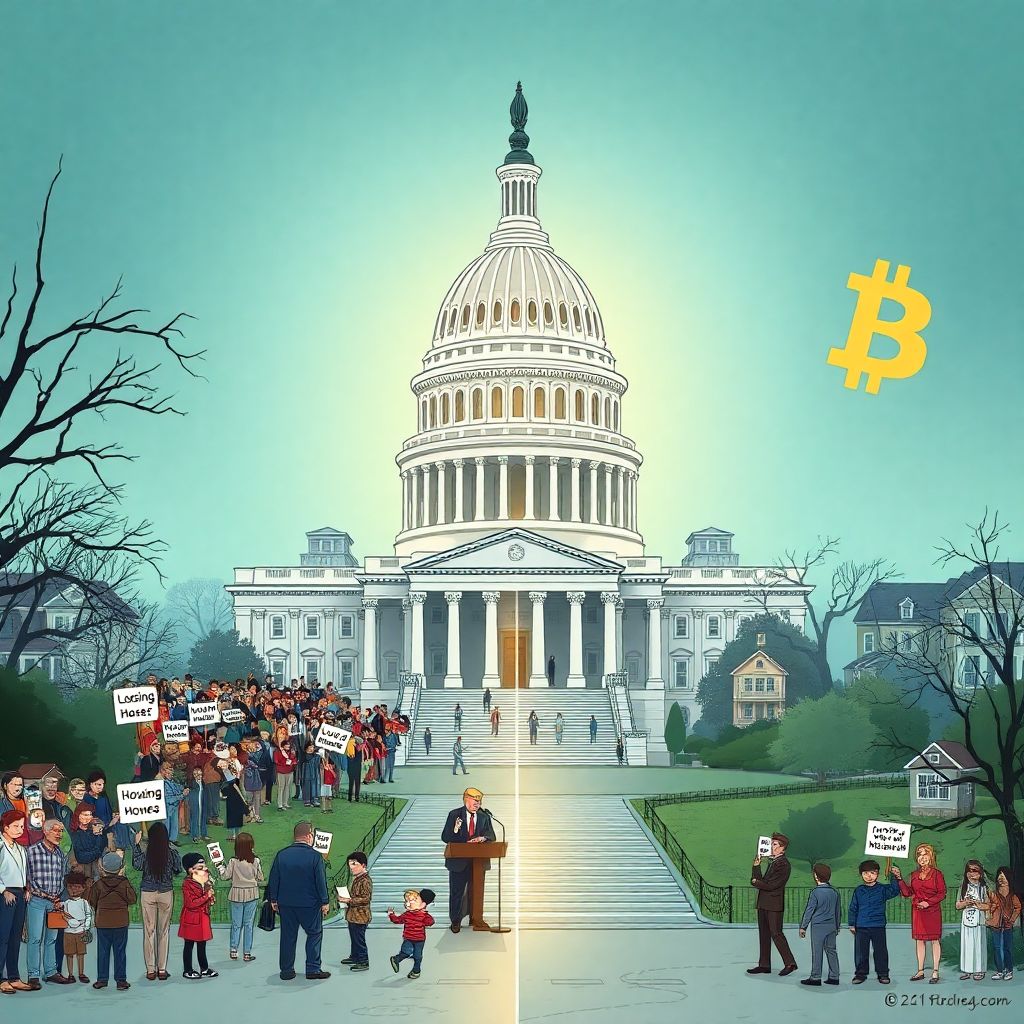
Crypto bill sidelined as US Senate pivots to housing costs
America’s housing crunch has just pushed crypto policy to the back of the line on Capitol Hill.
The Senate Banking Committee is expected to shelve its work on a sweeping digital-asset market-structure bill until at least late February or March, according to multiple reports, as lawmakers refocus on the cost of housing — a pocketbook issue viewed as far more urgent by voters heading into this year’s congressional elections.
The pause comes on the heels of an earlier delay last week, deepening doubts that a comprehensive crypto framework will make it through Congress anytime soon. For an industry that has spent years demanding regulatory clarity, the latest setback signals yet another season of waiting.
Housing beats hash rates on the Hill
Instead of debating how tokens should be classified or which regulator gets what turf, senators are now zeroing in on housing affordability. With mortgages, rent and insurance now consuming a large share of household income, strategists in both parties see shelter costs as a major electoral liability — especially after Republicans lost several high‑profile races late last year.
The political calculation is blunt: voters notice their monthly payment more than they notice token prices. While senior officials in the new administration have repeatedly cast crypto as a strategic priority, inflation‑sensitive households are more worried about keeping a roof over their heads than catching the next memecoin rally.
Adding to the political drama, President Donald Trump has publicly dismissed the broader “affordability” debate as a democratic fabrication, even as his own team moves to address specific cost pressures in housing. That tension between rhetoric and policy is now shaping what does — and does not — get time on the Senate calendar.
Trump’s housing move and its limits
Lawmakers are now exploring legislation designed to complement Trump’s recent executive order that restricts institutional investors from buying single‑family homes. The goal is to curb what critics describe as Wall Street “hoarding” of residential property and to make more houses available for families, not funds.
Yet by most estimates, institutional buyers own less than 1% of all US single‑family homes. That small footprint raises a practical question: even if large investors are pushed out of the market, will it meaningfully reduce prices or rents in most communities?
Still, in politics optics matter. Even a marginal policy that can be framed as “taking on Wall Street” and “protecting homeowners” is easier to sell on the campaign trail than technical debates about custody, stablecoins or derivatives oversight. That narrative advantage is one reason housing has eclipsed crypto, at least for now.
Crypto bill put on ice — again
The crypto legislation now stuck in limbo is designed to answer a question that has dogged the industry for years: who is actually in charge? The proposal aims to define the regulatory boundaries between the Securities and Exchange Commission (SEC) and the Commodity Futures Trading Commission (CFTC), clarifying which digital assets are treated as securities and which fall under commodities rules.
Both agencies have said only Congress can settle that jurisdictional fight. Without a statute, the current system of regulation by enforcement — headline‑driven lawsuits, settlements and case‑by‑case guidance — is likely to continue.
Progress on the bill suffered a major blow last week when Coinbase Global Inc., one of the biggest and most vocal advocates for federal crypto rules, abruptly withdrew its support. That move fractured a fragile industry consensus and opened the door to renewed lobbying, as both traditional financial firms and crypto‑native companies attempt to reshape the legislation in their favor.
Agriculture Committee pushes ahead
While the Banking Committee taps the brakes, the Senate Agriculture Committee — which shares oversight of derivatives and commodities — is moving in the opposite direction. It plans to unveil its own version of a digital-asset bill and is eyeing a committee vote as soon as January 27.
If that schedule holds, the two committees’ approaches would eventually need to be reconciled into a single package before any vote by the full Senate. The split pathway underscores how fragmented crypto oversight has become in Washington: multiple committees, overlapping mandates, and no clear champion capable of forcing a final compromise.
For market participants, that means more months of uncertainty over everything from token listings and staking services to how stablecoin reserves should be managed and audited.
A civil war inside crypto
The policy delay in Congress is amplifying long‑simmering divisions within the crypto community itself. With no final bill to rally around or oppose, factions are turning on each other over what “good” regulation should look like — or whether any near‑term compromise is acceptable.
Cardano founder Charles Hoskinson has unleashed sharp criticism at Ripple CEO Brad Garlinghouse for supporting what Hoskinson deems a deeply flawed market‑structure bill. Hoskinson’s warning is stark: if the industry accepts “good enough” rules today, those compromises could become permanent and structurally damaging, locking in a framework that privileges incumbents and marginalizes more open, decentralized systems.
Garlinghouse takes the opposite view. In his telling, regulatory clarity — even if imperfect — is better than the current patchwork of lawsuits and contradictory guidance. He has praised lawmakers who are at least trying to create a workable framework that can be refined during markup, arguing that chaos and uncertainty are more harmful to innovation and investor protection.
Hoskinson rejects that logic outright, mocking the idea that a “bad bill is better than no bill” and stressing how hard it is to unwind entrenched rules once they crystallize into law. In his view, rushing into a compromise could freeze US crypto in a second‑tier position while other jurisdictions experiment with more flexible approaches.
The deeper fault line: pragmatism vs. principle
Beneath the public spat lies a strategic question that now defines much of the industry’s political debate: should crypto accept incremental, imperfect regulation to gain legal certainty, or should it refuse to endorse any law that entrenches the power of big banks, custodians and centralized intermediaries?
On one side are pragmatists — major exchanges, large token issuers, and some institutional players — who argue that capital and mainstream users will not fully enter the market without clear rules. For them, even a restrictive framework might be preferable if it opens the door to regulated products, listings, and broader adoption.
On the other side stand decentralization purists and smaller projects that fear being regulated out of existence. They worry that hasty legislation will lock in high compliance costs, favor custodial models over self‑custody, and treat permissionless protocols like traditional financial firms, undermining much of what made crypto different in the first place.
This clash is not merely philosophical. It will help determine who dominates the next phase of the industry: regulated, vertically integrated platforms that look like digital banks, or a web of composable protocols where no single entity controls the rails.
What the delay means for investors and builders
In the near term, the Senate’s pivot to housing likely means business as usual for crypto in the United States:
– Ongoing enforcement actions by the SEC against exchanges, token issuers and staking products
– Case law, rather than statute, continuing to define which assets are treated as securities
– Stablecoin issuers operating in a grey area, with state regimes and banking rules doing most of the heavy lifting
– Institutional players remaining cautious, particularly around spot markets and yield‑generating products
For builders, the message is mixed. The absence of a new law preserves room for experimentation, especially in decentralized finance and non‑custodial services. But it also prolongs legal risk: projects can be reclassified years after launch, and business models that look compliant today may be challenged tomorrow.
Investors face a similar trade‑off. Short‑term price moves may respond more to macro conditions and Bitcoin cycles than to legislative headlines, but the long‑term value of many tokens depends on whether they can operate in the US with clear legal status, access to banking, and inclusion in regulated products.
Why housing is crowding out crypto — and what could change that
The political prioritization of housing over crypto is driven by three simple realities:
1. Salience: Nearly every voter either pays rent or a mortgage. Only a minority hold crypto.
2. Timing: Housing affordability can swing elections; crypto policy rarely does.
3. Narrative: It is easier to explain “we’re lowering housing costs” than “we’re clarifying the jurisdiction of two federal regulators over digital bearer instruments.”
That calculus could shift, however, if one of two things happens:
– A major crypto‑related crisis — such as a large stablecoin failure or systemic hack — forces Congress to act defensively and quickly.
– A breakthrough use case, such as widely adopted tokenized dollars or real‑world asset markets, becomes too large and economically important to operate without a bespoke legal framework.
Until then, crypto will likely remain a second‑tier agenda item, jostling for space behind housing, healthcare, immigration and foreign policy.
The risk of falling behind globally
The US delay is not happening in a vacuum. Other major economies are already rolling out comprehensive regimes for digital assets, staking, custody and token issuance. That divergence raises the risk that innovation — and in some cases, liquidity — will migrate to jurisdictions that can offer clearer ground rules, even if they are stricter.
For US policymakers, the trade‑off is delicate: move too fast and they risk codifying bad rules; move too slowly and they risk exporting talent, tax revenue and strategic infrastructure. The current housing‑first agenda effectively chooses delay, betting that crypto can wait another quarter or two.
Industry advocates warn that the cost of waiting is cumulative. Each year without a coherent framework makes it harder for US‑based firms to compete in an increasingly global market, and easier for foreign platforms to define standards by default.
What to watch next
Despite the current pause, several developments could quickly reshape the outlook:
– The exact language of the Agriculture Committee’s digital-asset bill and how aggressively it defines CFTC authority over spot crypto markets
– Whether Coinbase and other large players coalesce around an alternative proposal or remain fragmented
– How aggressively the SEC continues to pursue enforcement, especially if courts start narrowing its reach
– Any signs that housing legislation stalls, potentially freeing up floor time for other priorities
For now, crypto finds itself in an uncomfortable limbo: too big to ignore, but not urgent enough to displace the political firestorm over housing. As Congress turns to mortgage payments and rent burdens, the industry is left to argue among itself over whether compromise is a necessary step forward — or an irreversible surrender.
Until lawmakers resolve that tension, and until the Senate can spare the calendar space, the promised era of clear, comprehensive US crypto regulation will remain at least one more election season away.