Lummis–Wyden bill seeks to shield non‑custodial crypto developers from money transmitter rules
A new bipartisan proposal in the U.S. Senate aims to draw a bright legal line between those who build blockchain technology and those who actually handle customer funds. The Blockchain Regulatory Certainty Act, introduced on January 12, 2026, by Senators Cynthia Lummis (R‑WY) and Ron Wyden (D‑OR), would explicitly exempt non‑custodial crypto developers from federal and state money transmitter licensing requirements.
At the core of the bill is a simple premise: writing code, creating software, or maintaining decentralized networks should not, by itself, trigger the same obligations that apply to businesses holding or moving money on behalf of customers. Under the proposed framework, a person or entity that does not have unilateral control over user assets would not be treated as a “money transmitter.”
The legislation spells out that activities such as building blockchain software, contributing to open‑source protocols, operating non‑custodial infrastructure, or offering self‑custody tools do not constitute regulated money transmission. In other words, if developers never take possession of user funds and cannot independently move those funds, they would fall outside the scope of money transmitter rules.
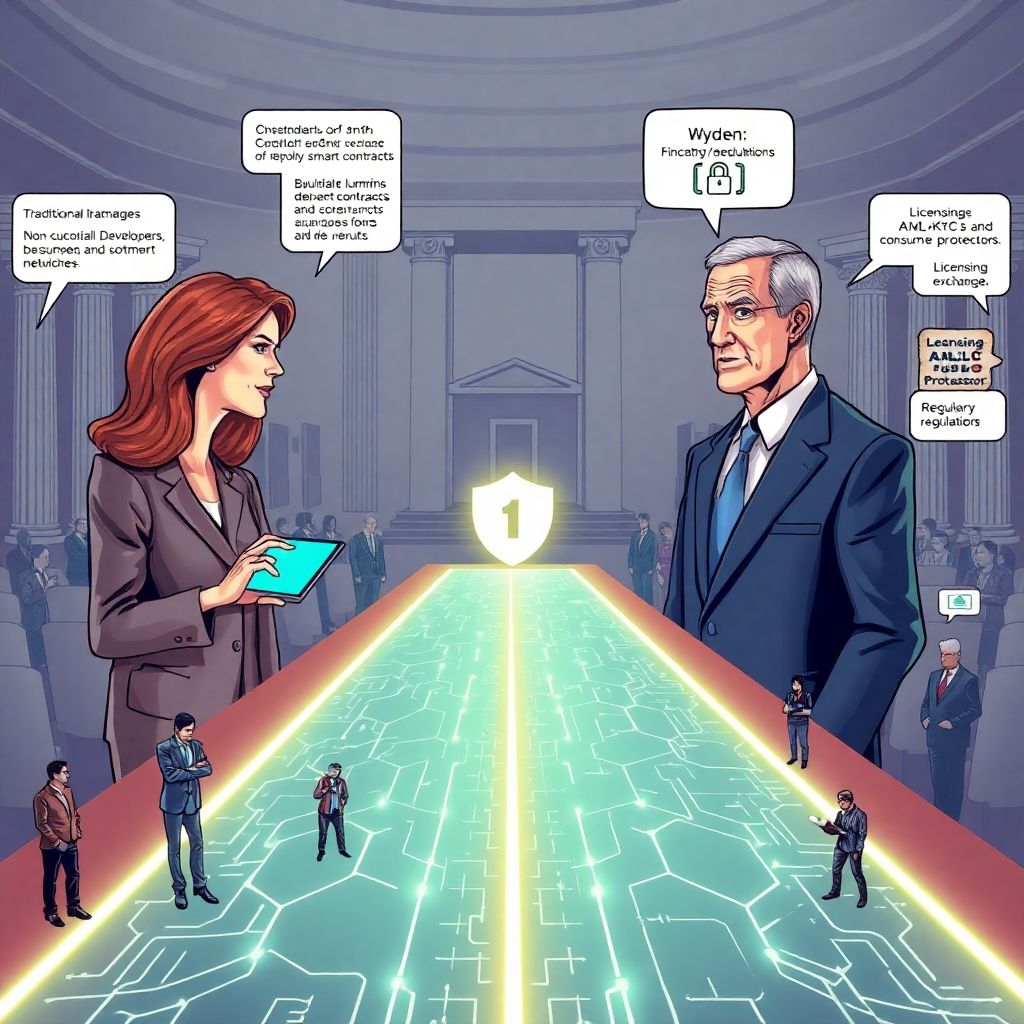
By formalizing this distinction, the bill draws a boundary between two roles that regulators have often blurred: on the one hand, infrastructure providers and protocol developers; on the other, custodial intermediaries like centralized exchanges, brokers, and payment processors. The former group would gain a significant measure of legal certainty, while the latter would remain fully subject to existing licensing, anti‑money‑laundering, and consumer protection requirements.
Senator Lummis has argued that developers who simply publish or maintain code have increasingly found themselves under the shadow of enforcement, even when they never touch user funds. She has criticized attempts to classify such actors as money transmitters, saying this approach stifles innovation without meaningfully advancing the fight against money laundering or other financial crimes.
Senator Wyden has emphasized the civil liberties dimension, pointing to both privacy and free speech concerns. In his view, treating code writers and protocol maintainers as if they were financial intermediaries reveals a fundamental misunderstanding of how decentralized systems work. He has framed the bill as an effort to ensure that longstanding protections for software development and online expression extend into the digital asset era.
The backdrop to this legislative push is a growing anxiety in the developer community. Many blockchain builders fear that they could be held criminally or civilly liable for how third parties use their software, even when that software is non‑custodial and open‑source. This has contributed to a trend of teams relocating abroad or restricting access to U.S. users to avoid uncertain and potentially severe regulatory consequences.
In recent years, enforcement actions involving non‑custodial or partially decentralized protocols have intensified those concerns. Cases targeting protocol front‑ends, liquidity providers, or infrastructure operators have been widely interpreted as a warning shot to the broader ecosystem. The Lummis–Wyden bill is, in part, a reaction to that climate of fear and ambiguity.
The bipartisan nature of the proposal stands out in a policy area often marked by partisan division. Lummis, a prominent Republican voice on digital assets, and Wyden, a senior Democrat with a long history on technology and privacy issues, rarely land on exactly the same side of crypto debates. Their joint sponsorship signals a shared recognition that the U.S. needs a more nuanced legal approach to distinguish between technological innovation and financial intermediation.
At this stage, the Blockchain Regulatory Certainty Act has been introduced as standalone legislation in the Senate. However, congressional aides have indicated it could be folded into broader digital asset or market structure packages that are still under negotiation. Its ultimate shape and prospects will likely depend on how it fits into larger compromises around crypto regulation, consumer protection, and financial stability.
Industry participants have largely welcomed the attempt to formalize a split between developers and intermediaries. Many argue that the current gray area has forced startups to spend disproportionate resources on legal opinions and defensive structuring, instead of product development. By narrowing the circumstances in which a builder is considered a money transmitter, the bill could reduce compliance uncertainty and make it easier to launch open‑source and non‑custodial products from within the United States.
Supporters also frame the bill as a competitiveness measure. They warn that, without clear protections, highly skilled engineers and founders will continue to relocate to jurisdictions perceived as more predictable or hospitable to crypto innovation. Codifying the non‑custodial carve‑out, they say, would help keep that talent — and associated investment — onshore, reinforcing the country’s role in shaping the future of digital finance.
Importantly, the legislation is not a blanket deregulation of the crypto industry. It leaves intact the existing regulatory framework for exchanges, custodians, brokers, and other entities that actually take possession of customer assets or execute transactions on their behalf. Senator Wyden has been explicit that obligations related to taxation, reporting, and trading oversight would remain in force for those actors.
Instead, the bill is built around the principle of “technology neutrality”: regulators should focus on what a service does, not on the fact that it relies on a particular kind of code or network. This reflects earlier internet policy approaches, which tended to protect infrastructure providers and software developers while focusing rules on those offering traditional services — such as banking, payments, or communications — in a digital form.
If enacted, the act would provide a statutory firewall for a range of activities that today exist in a legal gray zone. Developers of self‑custody wallets, interfaces to decentralized finance protocols, key management tools, and non‑custodial staking or validation services could operate with significantly more confidence that they are not inadvertently stepping into the territory of money transmission.
The bill also implicitly acknowledges the difference between controlling infrastructure and controlling assets. A developer can deploy or maintain a protocol without having the ability to move user funds; similarly, a wallet provider can publish tools that help users transact without ever accessing the private keys themselves. By anchoring the legal analysis in unilateral control over assets, the proposal tries to align law with the technical realities of decentralization.
For builders, one practical impact would be clearer guardrails when designing product architectures. Teams could deliberately structure systems so that no single party has unilateral power over customer funds, thereby staying within the protected non‑custodial category. This could accelerate the trend toward “user‑controlled” or “self‑sovereign” designs, where end users hold their own keys and approve their own transactions.
From a policy standpoint, the act also raises the bar for enforcement agencies seeking to treat developers as financial actors. They would need to demonstrate that a given party actually exercises independent control over assets, rather than simply contributing code or network services. That shift could reduce the chilling effect many open‑source contributors feel when considering whether to participate in high‑profile crypto projects.
However, the proposal will likely face detailed scrutiny from regulators and some lawmakers who worry that too broad an exemption could create loopholes for illicit finance. The debate is expected to center on how precisely “unilateral control” is defined, and whether certain hybrid or semi‑custodial models might try to exploit the non‑custodial label while still enabling significant influence over user funds.
Another unresolved question is how the bill would interact with existing state‑level money transmitter laws. While the text aims to harmonize treatment across federal and state regimes, practical implementation often depends on how state regulators interpret and adapt their licensing frameworks. Even with a federal standard, there may be a transition period in which interpretations diverge and test cases emerge.
Legal experts also note that money transmitter rules are only one pillar of the broader regulatory stack. Securities law, commodities regulation, sanctions compliance, and consumer protection statutes remain highly relevant to many digital asset projects, regardless of whether they are custodial. The Lummis–Wyden bill, if passed, would reduce one major category of risk, but developers would still need to navigate others.
For the broader crypto ecosystem, the act could mark a pivot away from treating all crypto‑related activity as inherently financial. Instead, it encourages a layered view: at the base are protocol designers and infrastructure engineers; above them are application developers and interface providers; at the top are custodians and intermediaries that actually hold or move assets. Only this upper layer would consistently fall under money transmitter regimes.
In practical terms, this could reshape how new projects approach their go‑to‑market strategies. Rather than defaulting to offshore incorporation or geofencing U.S. users, teams might feel more comfortable launching from within the American regulatory perimeter, provided they keep their architecture strictly non‑custodial. Over time, that could influence where the most influential protocols and platforms are built.
The bill’s future will be determined by ongoing Senate negotiations and broader political dynamics around digital assets. Yet its introduction alone signals a growing willingness in Washington to modernize financial regulations to reflect the realities of decentralized technology. Even if the final version changes, the core idea — that building non‑custodial software is distinct from transmitting money — is likely to remain a focal point in the evolving U.S. crypto policy debate.