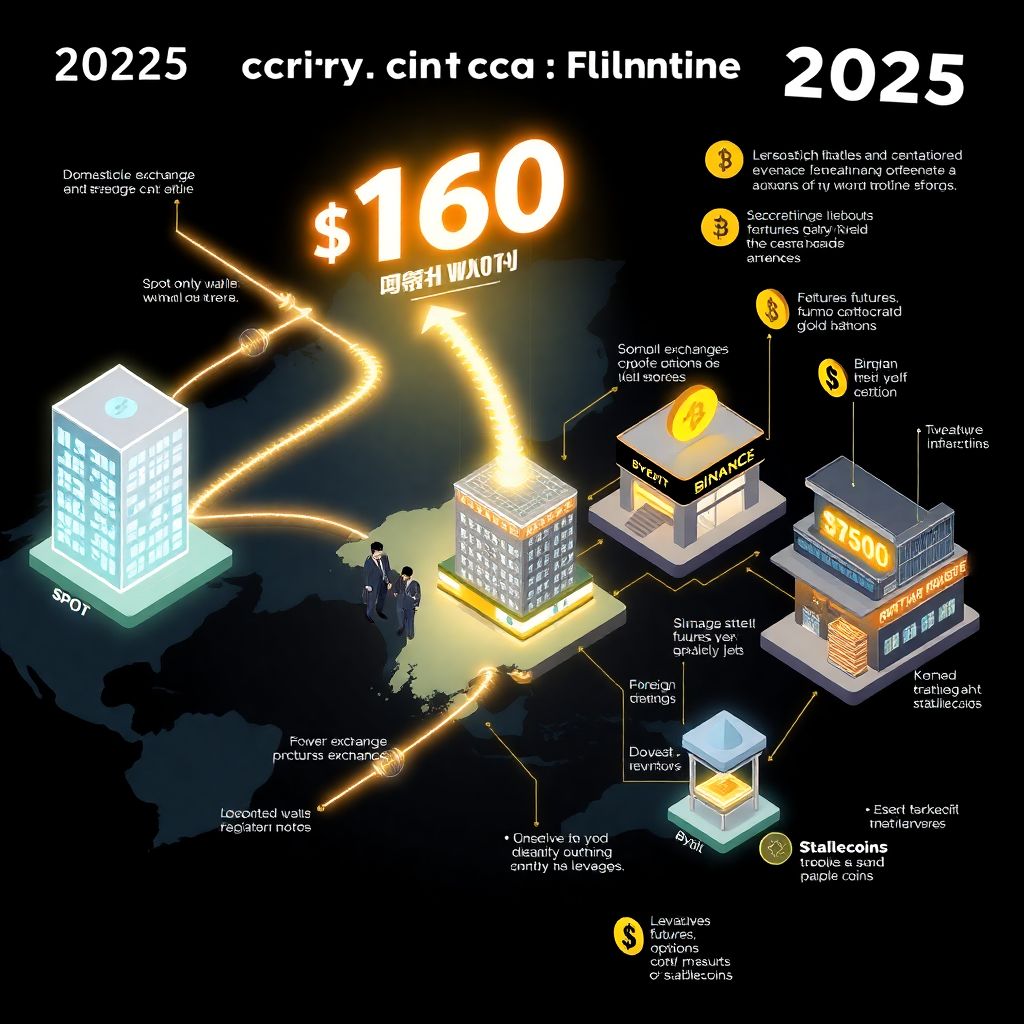
Crypto Capital Flight: Why $110 Billion In Digital Assets Left South Korea In 2025
Around 160 trillion won – roughly 110 billion dollars – quietly exited South Korean cryptocurrency exchanges in 2025, according to joint research cited by industry analysts. On paper, it looks like a massive outflow. In practice, it reflects something more nuanced: Korean traders didn’t abandon crypto, they largely moved their activity elsewhere.
Instead of disappearing from the market, a substantial portion of this capital migrated to offshore platforms, especially major centralized exchanges that offer a wider set of tools than local venues are currently allowed to provide.
Domestic Exchanges Boxed In By Spot-Only Rules
South Korea has spent the last few years tightening oversight of its digital asset sector. Local regulations, built to protect consumers after a series of industry shocks, have effectively restricted licensed exchanges primarily to spot trading.
For everyday investors, that means:
– No or severely limited access to derivatives
– Limited margin trading options
– Far fewer structured products and advanced strategies
As a result, while Korean exchanges remain active in spot markets, they cannot legally match the product range available on global platforms. That gap has become the main driver of the overseas shift.
According to the joint research, this regulatory ceiling is the single most important factor behind the 160 trillion won migrating from Korean platforms to foreign ones in 2025.
Binance, Bybit And Other Offshore Platforms Capture Korean Flows
The capital that left South Korea did not scatter randomly. It concentrated on a handful of large, global exchanges that can legally offer more complex and high-risk products to users outside Korea.
Platforms such as Binance and Bybit emerged as key beneficiaries:
– Estimated fee revenue from Korean users on Binance reached about 2.73 trillion won in 2025.
– Bybit’s user-based fees from Korean customers are estimated at around 1.12 trillion won for the same period.
Those numbers signal more than casual interest. They suggest a committed, active trading base that has deliberately shifted its primary market activity from domestic platforms to international ones where leverage, futures, and options are readily available.
Crypto Appetite Remains Strong — It Just Moved Offshore
Despite the eye‑catching headline number of 110 billion dollars leaving local exchanges, there’s little evidence that South Korean demand for digital assets collapsed. Trading volumes show a different story: enthusiasm has remained strong, but trading venues have changed.
Key points from the data:
– Spot volumes on Korean exchanges stayed substantial throughout 2025.
– Total demand, however, appears to have migrated toward offshore derivatives and margin products.
– The reported 110 billion dollars tracks transfers and holdings abroad, not realized losses or capital destruction.
In other words, value has been relocated across borders, not erased from the crypto ecosystem.
Regulation Tightens, But Market Structure Lags
South Korean lawmakers have taken visible steps to protect users in recent years. One of the cornerstone efforts was the Virtual Asset User Protection Act, passed in 2024. The law aimed to strengthen safeguards around custody, market manipulation, and fraud.
Yet for many in the industry, these measures had a critical limitation: they reinforced protections without simultaneously opening a path to a more complete market structure. While exchanges had to comply with stricter rules, they still lacked a clear regulatory framework to:
– Offer derivatives or structured products
– List certain types of tokens
– Provide more complex income-generating services
The oft-discussed Digital Asset Basic Act was meant to fill some of these gaps by laying out a broader foundational framework for virtual asset markets. However, political delays and extended debates left the bill in limbo. Those delays effectively froze innovation onshore while offshore venues raced ahead.
The result: domestic platforms were squeezed between tougher obligations and limited permissions, while foreign exchanges continued to serve Korean users through cross-border access.
Growing Balances Abroad And In Self-Custody
The capital shift is visible not only in volumes and fee data, but also in user behavior and wallet patterns.
Analyses referenced in the study highlight that:
– The number of Korean accounts holding large balances on foreign exchanges more than doubled year‑on‑year.
– A portion of capital left centralized platforms entirely and moved into self‑custody wallets.
This split strategy suggests Korean users are not simply chasing leverage or speculation:
– Some want access to derivatives, staking, and structured products offshore.
– Others are increasingly opting for self-custody to retain direct control over their coins, likely in response to both regulatory uncertainty and exchange risk.
Together, these trends show a maturing user base that understands custodial risk and is willing to navigate foreign platforms and private wallets to get the mix of safety and opportunity they want.
Oversight vs. Access: A Growing Policy Tension
Regulators and traders are effectively talking past each other.
From the regulator’s viewpoint, the cross‑border flow of funds raises several red flags:
– Anti‑money‑laundering enforcement becomes harder when assets move to offshore entities.
– Supervisory visibility declines as capital leaves jurisdictions where authorities have direct reach.
– Bank–exchange relationships must be closely managed to prevent abuse or systemic risk.
Financial authorities have therefore prioritized strong AML controls, strict know‑your‑customer requirements, and carefully vetted partnerships between banks and crypto platforms.
Traders look at the same landscape and see something entirely different:
– Limited product access at home
– A sense of “capital lock‑in” where their risk appetite cannot be matched by legal local offerings
– Frustration that innovation is happening offshore while domestic platforms are constrained
For many Korean investors, the choice has become binary: accept a narrow set of onshore services, or move capital abroad to participate in the wider global market. In 2025, a massive amount of money chose the second option.
Stablecoins And The Next Phase Of Korean Crypto Policy
Looking ahead, policymakers in Seoul are reportedly working on a more comprehensive set of statutes that go beyond user protection and begin to shape the market itself. A key part of those discussions involves stablecoins, which play an increasingly central role in global crypto liquidity.
New rules under consideration are expected to address:
– Issuance and backing standards for stablecoins
– How banks can interact with tokenized fiat and synthetic dollars
– The treatment of stablecoins within existing financial law
If lawmakers manage to deliver a coherent framework that covers both user protections and advanced market services, Korea could reopen the door to more complex, yet regulated, products on domestic exchanges. In that scenario, some of the offshore capital could plausibly flow back home, especially if traders can finally access a meaningful range of tools without leaving the jurisdiction.
Why Traders Prefer Offshore Platforms Today
Beyond regulations alone, several practical reasons make foreign exchanges attractive to Korean users right now:
1. Product Breadth
Offshore platforms typically offer futures, perpetual swaps, options, leveraged tokens, and a wide catalog of altcoins. Domestic platforms, confined mainly to spot, cannot compete on variety.
2. Liquidity And Pricing
Global exchanges aggregate users from around the world, often resulting in deeper order books and tighter spreads. Active traders see this as a key advantage.
3. Advanced Trading Tools
Features such as complex order types, automated strategies, and integrated charting tools are often more sophisticated on large international platforms.
4. Yield And Earning Programs
Staking, lending, and other yield-bearing products are more widely available abroad, even when such offerings occupy a gray zone under Korean rules.
5. Round‑The‑Clock Support For High‑Frequency Strategies
For arbitrageurs and high-frequency traders, access to multiple global venues is essential. Domestic spot-only exchanges cannot satisfy these strategies at scale.
As long as this gap remains, the incentive for sophisticated traders to stay offshore will persist.
Risks Of A Persistent Capital Drain
While the 2025 outflows did not erase wealth, a sustained exodus of trading activity and capital has longer-term implications for South Korea’s financial ecosystem:
– Weakened Local Platforms
Domestic exchanges risk losing top-tier talent, liquidity, and revenue as high-value users move abroad, making it harder for them to compete or innovate.
– Reduced Regulatory Influence
The more activity occurs offshore, the less effectively Korean regulators can protect their own citizens from fraud, abuse, or systemic shocks.
– Innovation Flight
Startups building new financial products may opt to incorporate and launch elsewhere, perceiving South Korea as a restrictive environment for experimentation.
– Tax And Reporting Complexity
Individuals trading abroad face more complicated tax reporting and potential compliance pitfalls, which can create friction between authorities and investors.
Balancing these issues will be central to any future overhauls of Korean crypto regulation.
What Could Bring The Money Back?
For capital to meaningfully return to domestic exchanges, several conditions would likely need to be met:
– Clear, Predictable Rules For Advanced Products
Traders and platforms need to know which derivatives and structured products are allowed, under what conditions, and with which capital and risk protocols.
– Regulated Stablecoin Access
Allowing regulated stablecoin markets would make it easier to build sophisticated trading and DeFi-like products within Korean law.
– Competitive Fee Structures
If domestic exchanges want to lure back high-volume traders, they will have to align their fee models with global standards.
– Institutional Onboarding
Clear rules and strong infrastructure could attract Korean financial institutions into the digital asset space, boosting liquidity and credibility.
– Consumer Education And Transparency
A robust framework that explains risks and rights transparently could make domestic platforms more appealing to retail investors who currently feel safer with large offshore brands.
If Seoul can deliver on these fronts, the 2025 outflows may eventually be seen not as permanent capital flight, but as a temporary response to a regulatory transition.
A Market In Transition, Not In Retreat
The movement of 110 billion dollars’ worth of crypto assets away from South Korean exchanges in 2025 signals a profound reconfiguration of where and how Korean investors choose to trade, not a retreat from digital assets altogether.
The core picture looks like this:
– Investor interest in crypto remains high.
– Domestic rules successfully tightened user protections, but unintentionally constrained market development.
– Traders responded by moving their capital to foreign exchanges and self-custody.
– The tension between access and oversight now defines South Korea’s crypto policy challenge.
What happens next will depend on how quickly lawmakers can move from a primarily defensive regulatory posture to a more balanced framework that safeguards users while letting legitimate market innovation happen at home. Until then, a large slice of South Korea’s crypto wealth is likely to remain on the move — and largely offshore.