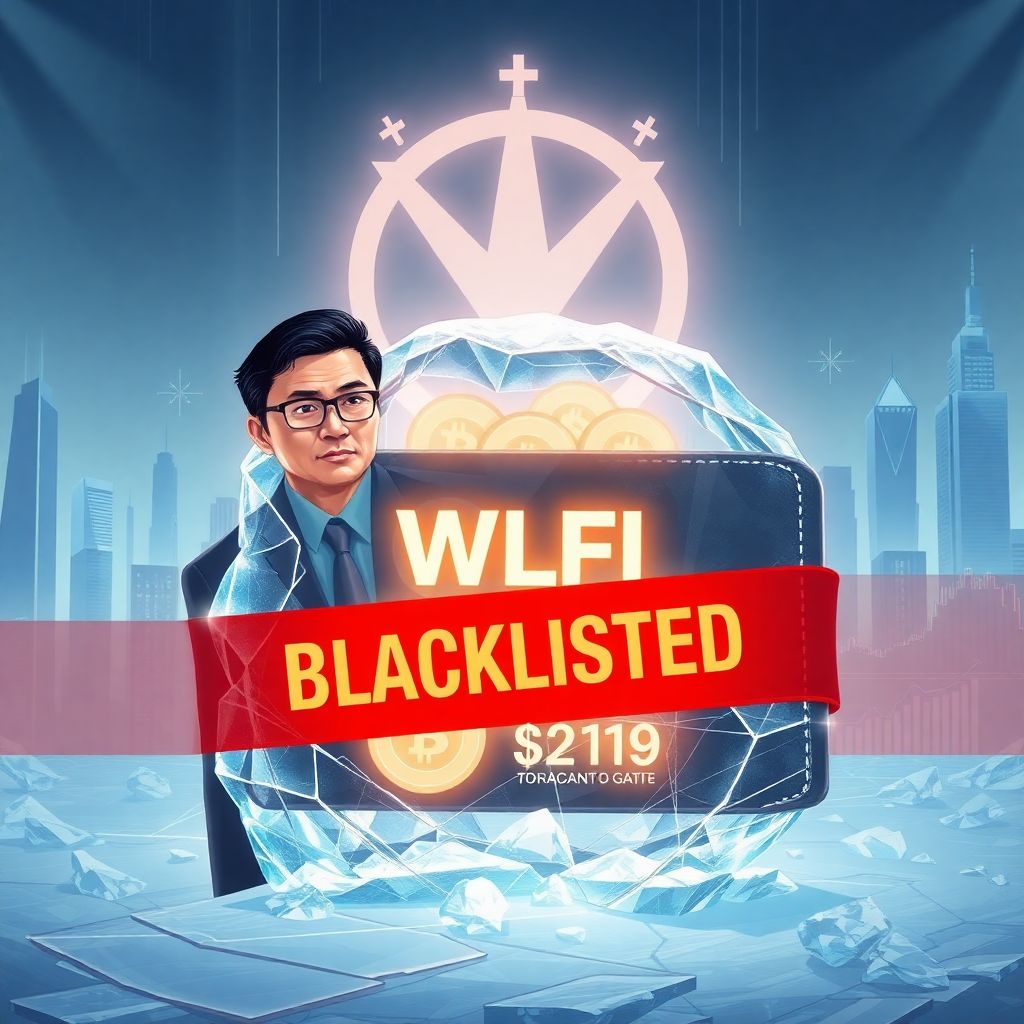
Justin Sun-linked WLFI wallet stays frozen as $60M vanishes on paper, governance doubts escalate
A wallet associated with entrepreneur Justin Sun remains locked out of the World Liberty Financial ecosystem, with tens of millions of dollars’ worth of WLFI tokens still frozen and steadily losing value amid a prolonged price slump and mounting questions over how the project is governed.
On-chain analytics data shows that a World Liberty Financial Tokens address tied to Sun has been blacklisted within the WLFI smart contract, blocking it from sending or receiving tokens. Over the last three months, the market value of the tokens trapped at that address has dropped by roughly $60 million, tracking a broader decline in WLFI’s price rather than any forced selling of the assets.
The blacklist status was imposed in September, after WLFI administrators flagged several wallets linked to Sun. The move followed on-chain evidence that approximately $1 million worth of WLFI — around 4.9 million tokens — had been sent from a Sun-linked address to centralized exchange HTX. That transfer appeared to violate internal expectations around token handling and triggered a governance response from the project’s operators.
Despite the freeze, Sun still commands substantial influence over the token’s supply. Analytics estimates suggest he controls close to 600 million WLFI tokens that are not locked, valued at roughly $135 million at current prices. Overall, his exposure to the World Liberty Financial ecosystem has been pegged at about $175 million, including a widely publicized $100 million allocation to the TRUMP memecoin and around $75 million directly into WLFI.
World Liberty Financial markets WLFI as its governance and utility token, describing the project as an effort to connect traditional financial services with decentralized finance infrastructure. The initiative attracted enormous capital before launch: company materials indicate that more than $550 million was raised during the presale phase, positioning WLFI as one of the largest token launches of its cycle.
WLFI began trading on the open market on September 1, 2025. The token surged in its initial sessions as speculative demand poured in, but that momentum reversed quickly. Since then, the price action has been dominated by a persistent downtrend, with the token now struggling to hold above key support areas. Market analysts warn that the failure to reclaim the current Point of Control level keeps the risk elevated for a renewed slide toward the 0.13 dollar region, especially as bullish trading volumes fade.
The growing tension around Sun’s frozen holdings has become a focal point for concerns about governance and centralization inside a project that markets itself as decentralized. The blacklist function in the WLFI smart contract allows administrators to freeze specific addresses, effectively disabling their ability to move tokens. While such tools are often justified as compliance or security measures, their use against a high-profile investor has ignited debate over who ultimately wields power in the protocol.
Sun has publicly condemned the decision to block his wallet, framing it as a betrayal of both financial support and confidence he says he placed in World Liberty Financial. He has argued that the token freeze is unjustified and deeply harmful, not only to his own position but to broader trust in the protocol’s governance. According to his statements, he intended to collaborate with the project’s team and user base over the long term and saw the blacklist as an unexpected and damaging escalation.
The inability to reposition his locked WLFI holdings has significantly constrained Sun’s room to maneuver during a period of heightened market volatility. While other large participants have had the option to hedge, rebalance or exit, his frozen wallet has remained entirely static, forcing him to absorb the full impact of the token’s price decline on that address. This has drawn attention to a key friction point in decentralized finance: the delicate balance between protecting a protocol and respecting the property rights and autonomy of large stakeholders.
The controversy lands against the backdrop of Sun’s broader strategy in politically adjacent crypto projects. He became the largest holder of the TRUMP memecoin and later attended a dinner with former United States President Donald Trump, where he was presented with a branded “Trump Golden Torbillon” watch. That high-profile appearance amplified his image as an influential figure in tokens that intersect with politics and public personalities, and has arguably increased scrutiny on his moves within World Liberty Financial.
For many observers, the WLFI–Sun dispute is now serving as a real-time case study of the limits of decentralization in practice. On paper, WLFI is described as governed by token holders and smart contracts. In reality, the ability of administrators to single out and freeze specific wallets suggests a more hybrid or semi-centralized power structure. That discrepancy is fueling investor anxiety over whether other addresses could face similar treatment if they fall out of favor with decision-makers.
Institutional participants and sophisticated traders are watching the fallout closely. Large presale raises can attract capital quickly, but they also concentrate influence in a small group of early backers and insiders. When one of those participants is publicly sanctioned, the resulting uncertainty can spill over into liquidity conditions, market-making activity, and long-term willingness to hold the token through drawdowns. Some analysts argue that WLFI’s recent price weakness reflects not only macro market conditions, but also a specific governance premium being priced in.
From a risk management perspective, the episode highlights a structural vulnerability for so-called governance tokens. If administrative controls such as blacklists or pausability are embedded in the token contract, then counterparty risk extends beyond trading partners to the protocol itself. For funds and high-net-worth investors, that may necessitate a closer look at smart contract permissions, admin keys, and upgrade mechanisms before committing large sums.
For retail participants, the situation is a reminder that the label “decentralized” can obscure a wide range of actual power dynamics. Some projects disperse control via multi-signature wallets, on-chain votes, and time-locked contract changes. Others retain the ability for a core team or foundation to intervene rapidly, whether for security, regulatory compliance or strategic reasons. WLFI’s handling of the Sun-linked wallets underscores the importance of reading token documentation, examining contract code, and understanding who can do what in an emergency — or in a disagreement.
The long-term impact on World Liberty Financial will likely depend on how transparently the team addresses these concerns. Clear disclosure of blacklist criteria, governance procedures, and any appeal mechanisms could restore some confidence. Conversely, continued opacity or ad hoc enforcement actions risk cementing a narrative that the project operates less as a decentralized protocol and more as a centrally curated platform with discretionary powers.
At the same time, the case is feeding into a larger industry-wide debate: should DeFi protocols build in strong administrative tools to respond to crises and regulatory pressures, or should they commit to irreversibility and neutrality even when it allows for behavior that the team or regulators may dislike? WLFI’s approach so far appears to favor control and optionality, but that choice comes with its own market and reputational costs.
For Justin Sun, the standoff may become a defining episode in his already crowded track record within crypto. His profile, capital base, and controversial reputation make him both a powerful ally and a potential flashpoint for any project he touches. Whether the dispute ends in reconciliation, formal governance reform, or a permanent split will shape not only the future of his WLFI position, but also how other protocols weigh the risks and rewards of partnering with high-visibility whales.
As WLFI’s price hovers under pressure and the value of the frozen tokens continues to erode on paper, all sides are confronted with the same underlying question: can a project meaningfully claim decentralization while still retaining the unilateral power to lock specific investors out of the system? Until that tension is resolved or at least clearly addressed, governance will remain central to how the market values World Liberty Financial and its flagship token.