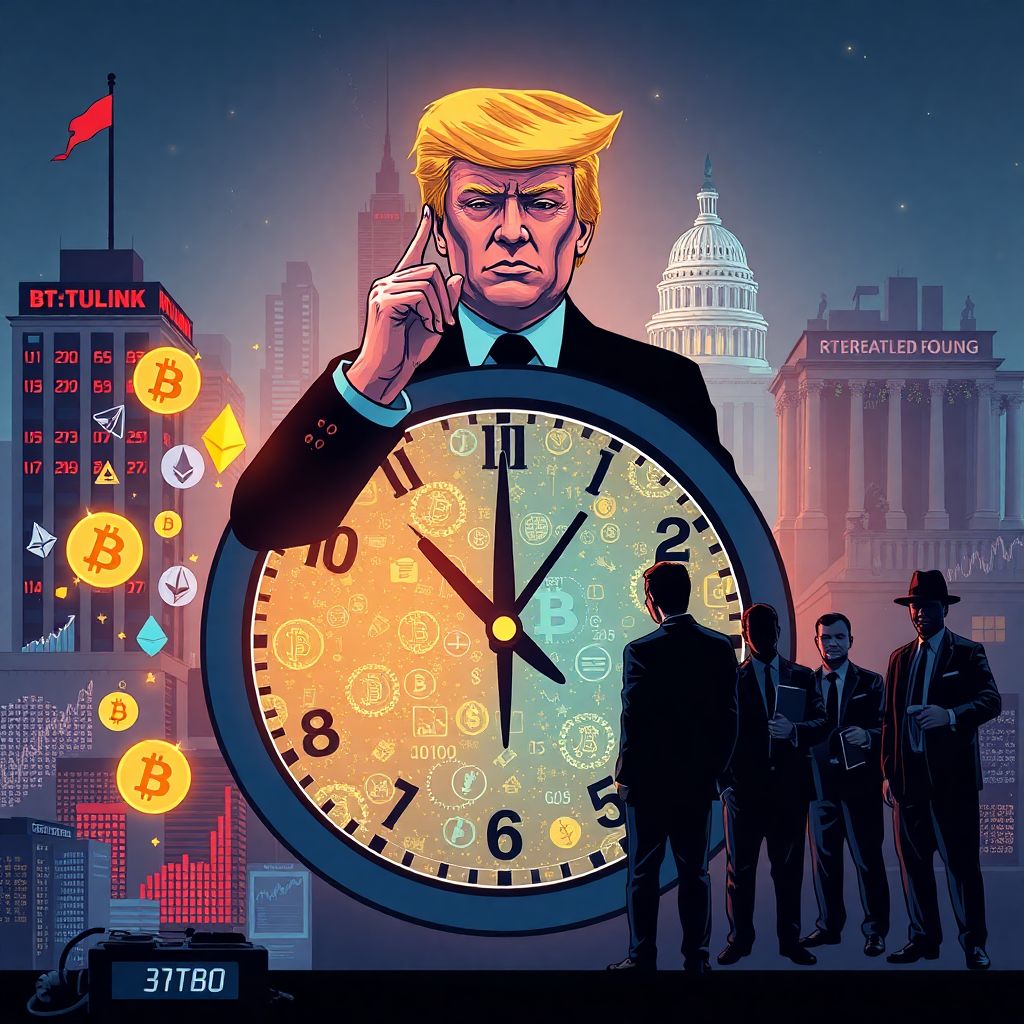
Crypto Industry Faces a Ticking Clock as Trump Era Nears Its End, Warns Etherealize Co-Founder
Donald Trump is widely framed as a “pro-crypto” president, thanks in part to his administration advancing legislation seen as favorable to digital assets. Yet, according to some industry insiders, that reputation is more complicated—and potentially dangerous for crypto’s long‑term prospects in Washington.
One of those voices is Danny Ryan, co-founder of institutional marketing firm Etherealize and a former Ethereum developer. Speaking recently, he argued that the sector is running on borrowed time: the current, relatively supportive environment could flip into outright hostility as soon as Trump leaves office. That looming shift, Ryan said, is precisely why the industry needs to lock in as much tangible progress as possible before the end of this administration.
Critics of the current moment point out that Trump’s personal exposure to the space—through companies that he and his family have supported or been associated with—has introduced a new kind of political risk. When a sitting president’s image becomes tightly interwoven with a controversial emerging industry, that industry can quickly transform into a lightning rod for partisan backlash. For crypto, that could mean that whatever one administration endorses, the next may feel compelled to undo.
Ryan’s concern is that crypto could be treated as a proxy for Trump himself. If digital assets are framed as a “Trump project,” a subsequent administration, especially one that campaigned on opposing his legacy, might instinctively move to crack down—whether through stricter enforcement, more restrictive rulemaking, or a halt to further legislative support. The stronger the association, the stronger the temptation for payback.
To reduce that risk, Ryan believes the industry must use this window to cement itself inside the mainstream of global finance. His argument is essentially strategic: once a critical mass of large financial institutions, capital markets players, and global investors are deeply integrated with crypto infrastructure, it becomes politically and economically harder for any new administration to simply turn the sector off. At that point, digital assets would be embedded in the financial system rather than sitting at its fringes.
As Ryan put it in essence, if during this current period the industry meaningfully onboards major financial institutions, international capital, and the broader capital markets ecosystem, the debate around crypto will no longer be a simple yes‑or‑no, “for or against” question. Instead of a binary argument over whether crypto should exist, policymakers would be forced to wrestle with how it exists—what guardrails are needed, how it is supervised, and how it interacts with traditional markets.
That subtle shift—from existential to operational—could make all the difference. Industries that reach a certain level of integration tend to become “too embedded to ban.” They might face stricter oversight, but wholesale elimination becomes nearly unthinkable because of the collateral damage it would cause to markets, investors, and institutions that policymakers also need to protect.
From Ryan’s perspective, “progress” in the remaining Trump window is not just about price rallies, new tokens, or retail hype. It means deep structural steps: getting large banks, asset managers, exchanges, and market infrastructure providers comfortable enough with crypto to commit real balance sheets and long‑term strategies. It means clearer frameworks for custody, settlement, tokenization, and compliance that let traditional finance plug in without betting their entire reputations on regulatory guesswork.
There is also a political dimension. The more diverse the coalition of stakeholders—pension funds, insurers, asset managers, payment companies, brokers, and even conservative institutional players—the less likely crypto is to be treated as a partisan trophy. When digital assets are tied not just to one political figure, but to the savings, portfolios, and business models of a wide spectrum of constituents, any administration will think twice before attacking the sector purely for symbolic reasons.
At the same time, Ryan’s warning highlights a vulnerability the industry has created for itself. For years, portions of the crypto world have gravitated toward celebrity endorsements and political branding as a shortcut to legitimacy. Aligning too closely with any single figure or party, however, can backfire. A post‑Trump political environment could easily feature calls to “roll back” what is perceived as captured or self‑interested policymaking on digital assets—especially if Trump’s personal financial ties to certain crypto ventures are heavily publicized.
To prepare for that scenario, many in the space argue that crypto needs to become visibly more institutional, more compliant, and more boring. That means real-world use cases beyond speculation: tokenization of traditional assets, efficient cross‑border settlements, on‑chain capital markets, and programmable financial products that solve costs and frictions banks already complain about. The more crypto is seen as useful infrastructure rather than a political talking point, the safer it becomes in the long run.
Another layer of protection lies in regulatory maturity. While some fear stricter rules, Ryan’s logic points in the opposite direction: clear, consistent regulation can make crypto harder to kill. Once supervisory frameworks, licensing regimes, and prudential standards are in place—and once large institutions invest heavily in compliance systems tailored to those rules—future administrations will inherit a live, regulated ecosystem rather than a wild experiment. Dismantling that is a far higher bar than simply declining to move forward.
There is also an international angle. If global capital is solidly engaged with U.S.-based digital asset markets by the time the next administration takes office, the geopolitical stakes rise. Driving crypto activity offshore through harsh policy shifts doesn’t just punish domestic players; it risks ceding leadership to other jurisdictions and undermining the competitiveness of U.S. markets. For a future administration, that trade‑off may be politically unpalatable—if, and only if, crypto has already become meaningfully tied to global flows and institutional mandates.
Ryan’s message ultimately functions as both a warning and a call to action. The current U.S. environment may feel unusually favorable to parts of the crypto sector, but that warmth is fragile and highly personalized. If the industry spends this period celebrating a supportive president without building durable, broad-based foundations, it may find itself exposed when power inevitably changes hands.
By contrast, if crypto uses the remaining Trump years to accelerate institutional adoption, diversify its political relationships, demonstrate real economic value, and accept serious regulation where appropriate, the next administration—whether friendly or hostile—will be dealing with an entrenched component of modern finance rather than a niche, partisan experiment.
In Ryan’s view, that is the only viable way to move the conversation beyond a binary fight over whether crypto should exist at all. The clock is ticking, and for the industry, the question is whether it will leave this administration having simply enjoyed a favorable climate—or having used it to build something that can survive whatever comes next.