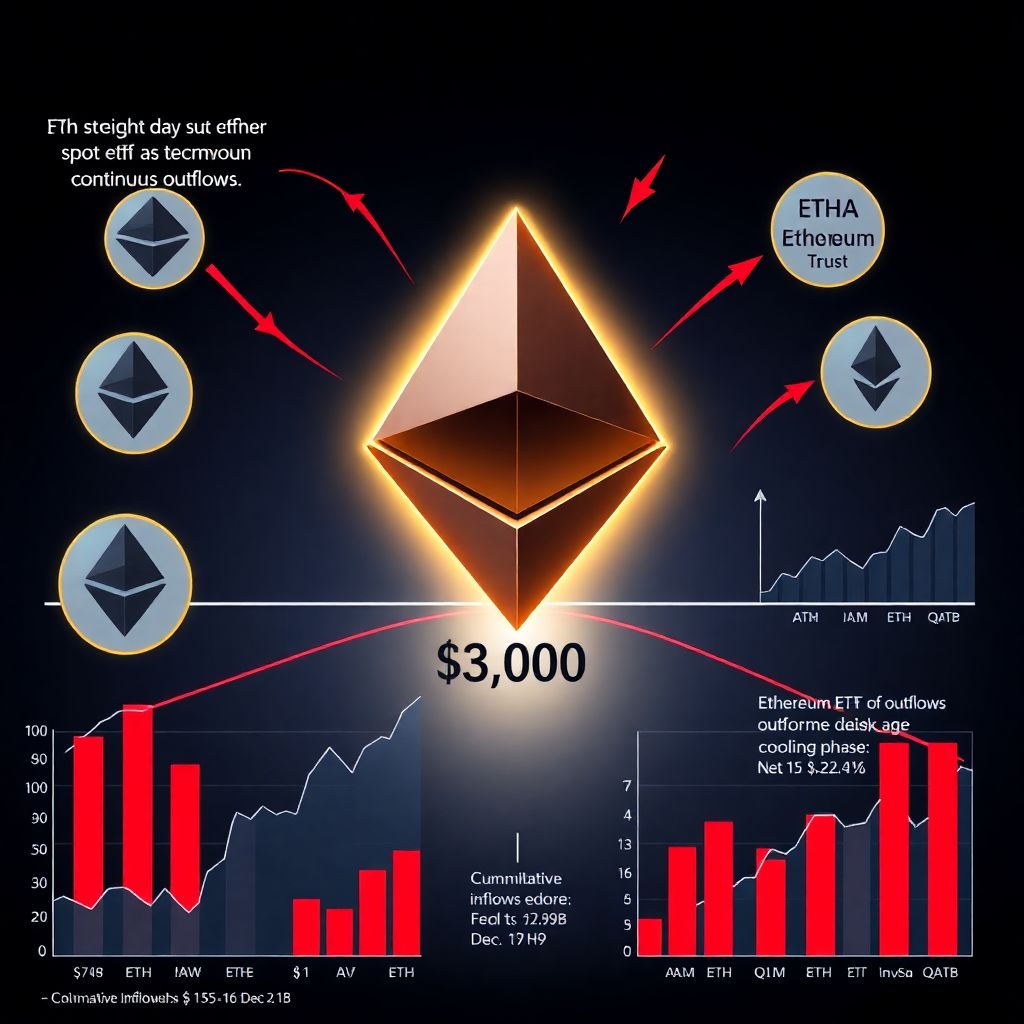
Ethereum spot ETFs log seventh straight day of outflows as ETH fails to retake $3,000
Ethereum exchange-traded funds continued to bleed capital on December 19, with the segment recording another day of net redemptions and extending a week‑long outflow streak. The persistent selling comes as Ether (ETH) struggles to regain the psychologically important $3,000 mark in a weakening crypto market.
On December 19, U.S.-listed spot Ethereum ETFs registered a combined $75.89 million in net outflows, marking the seventh consecutive trading session of redemptions. The entire withdrawal was driven by a single product: BlackRock’s iShares Ethereum Trust (ETHA), which posted $75.89 million in redemptions, while the remaining eight listed Ethereum ETFs saw no inflows or outflows at all.
As a result, total net assets under management in Ethereum ETFs slipped to $18.21 billion as of December 19. The sustained selling pressure has coincided with ETH’s inability to convincingly recapture the $3,000 level, reflecting a broader risk-off tone across digital asset markets.
Cumulative net inflows across all Ethereum funds have also been eroded over the past ten days. Aggregate inflows, which stood at $13.15 billion on December 10 — the last day of positive flows — have fallen to $12.44 billion, underscoring how quickly capital can reverse course in an ETF-driven market.
BlackRock’s ETHA is now in the midst of a pronounced cooling phase. December 19 marked its seventh straight session of net redemptions, capping off a period in which the fund has shifted from being the dominant magnet for new capital to the primary source of outflows. Despite the recent weakness, ETHA still holds the largest cumulative inflows of any Ethereum ETF at $12.67 billion, highlighting how much investor interest it attracted earlier in the cycle.
Other major Ethereum products were effectively sidelined during the latest session. Grayscale’s ETHE, Fidelity’s FETH, the Grayscale mini Ethereum trust, Bitwise’s ETHW, VanEck’s ETHV, Franklin’s EZET, 21Shares’ TETH, and Invesco’s QETH all reported zero net flows on December 19. The absence of activity suggests investors are currently either sitting on the sidelines or concentrating their repositioning in the most liquid fund, ETHA.
The ongoing outflow streak began on December 11, immediately after a short‑lived burst of optimism. On December 10, Ethereum spot ETFs attracted $57.58 million in net inflows, momentarily breaking the cautious tone that had been building in the market. The mood shifted quickly: December 11 brought $42.37 million in redemptions, followed by another $19.41 million in withdrawals on December 12.
Selling then intensified into the end of the week. December 15 and 16 each registered over $224 million in net Ethereum ETF redemptions — $224.78 million and $224.26 million, respectively — marking the heaviest two-day outflow period within the current streak. While withdrawals eased to $22.43 million on December 17, they picked up again to $96.62 million on December 18 before moderating to $75.89 million on December 19.
Trading activity also cooled alongside the outflows. Total value traded across Ethereum ETFs declined from $2.15 billion on December 18 to $1.71 billion on December 19. Over the full seven‑day stretch of redemptions, more than $685 million has exited Ethereum ETF products, underscoring a meaningful shift in sentiment among institutional and sophisticated retail participants who use these vehicles to gain ETH exposure.
Despite the recent pressure, the Ethereum ETF landscape remains dominated by a few large players. BlackRock’s ETHA holds the top spot in cumulative inflows at $12.67 billion, while Fidelity’s FETH has built up $2.64 billion in net inflows, positioning it as a strong secondary vehicle for investors seeking ETH exposure through traditional brokerage accounts. In contrast, Grayscale’s long‑standing ETHE fund has accumulated a substantial net outflow of $5.05 billion since it converted from a closed‑end trust structure, reflecting the unwinding of legacy positions and the impact of fee competition from newer issuers.
Bitcoin ETFs echo Ethereum’s weakness
The selling pressure is not confined to Ethereum. Bitcoin (BTC) ETFs also faced notable redemptions on December 19, reinforcing the idea that the latest move reflects broader risk reduction rather than an Ethereum‑specific event.
Bitcoin ETFs saw a combined $158.25 million in net outflows on the day. BlackRock’s iShares Bitcoin Trust (IBIT) accounted for the bulk of this weakness, recording $173.58 million in net redemptions. That selling was partially offset by inflows into Fidelity’s FBTC, which attracted $15.33 million, highlighting a degree of issuer rotation even as the overall category experienced withdrawals.
Total net assets under management for Bitcoin ETFs dropped to $114.87 billion as of December 19, down from $122.43 billion on December 10. Over the life of the products, cumulative net inflows into Bitcoin ETFs still stand at a robust $57.41 billion, but the recent pullback suggests investors are re-evaluating exposure following a strong run earlier in the year.
Flows into Bitcoin funds have been choppy in recent sessions. December 17 marked the strongest daily inflows of the week, with Bitcoin ETFs bringing in $457.29 million. That surge was short‑lived: just one day later, on December 18, net flows reversed sharply to $161.32 million in outflows, paving the way for continued selling on December 19.
Price action mirrors ETF sentiment
The ETF flow picture is closely aligned with spot price performance. Ether has repeatedly failed to reclaim the $3,000 level, meeting seller interest on each push higher. The inability to break and hold above this threshold has weighed on trader confidence and appears to be encouraging profit‑taking or de‑risking in ETF structures.
Bitcoin, meanwhile, is struggling to defend recent support zones, with rallies fading as investors lock in gains from previous months. The ETF redemptions add an additional headwind, as institutional and wealth‑management capital that entered via these vehicles can exit quickly in periods of uncertainty.
What is driving the outflows?
While short‑term price action and technical levels are influencing sentiment, several broader factors may be contributing to the current wave of redemptions:
1. Macro uncertainty
Shifts in expectations around interest rates, inflation trajectories, and risk assets in general can quickly alter demand for crypto ETFs. When bond yields rise or economic data points to tighter financial conditions, capital often rotates away from volatile assets like cryptocurrencies.
2. Position rebalancing after strong inflows
Both Ethereum and Bitcoin ETFs enjoyed substantial inflows earlier, particularly following their respective approvals and launches. After a period of strong performance, institutional investors may simply be rebalancing portfolios, trimming overweight positions in crypto back to target allocations.
3. Fee competition and product rotation
The ETF landscape is highly competitive. Investors may be rotating between products — for instance, out of higher‑fee legacy funds and into lower‑cost vehicles — which can appear as outflows even when overall exposure remains similar. Grayscale’s persistent ETHE outflows since conversion illustrate how fee structures and liquidity can influence flows.
4. Uncertain Ethereum narrative in the short term
Ether’s long‑term story — centered on staking yields, network upgrades, and its role in decentralized finance and scaling solutions — remains compelling for many. However, in the short term, the lack of a clear catalyst, slower on-chain activity relative to peak periods, or uncertainty around regulatory treatment can all dampen enthusiasm.
5. Correlation with Bitcoin and broader crypto risk cycles
Even though Ethereum has its own fundamentals, it remains highly correlated with Bitcoin. When BTC sentiment turns cautious and ETF flows reverse, Ethereum products often experience similar trends, as investors treat the asset class as a single risk bucket.
What the numbers mean for ETH investors
For long‑term Ethereum investors, the seven‑day ETF outflow streak is a notable signal but not necessarily a structural red flag. ETF flows are notoriously cyclical and can swing quickly in response to macro headlines, regulatory developments, or sudden price moves.
However, the recent data does highlight a few important points:
– Momentum has cooled: The market is moving from a phase of aggressive ETF‑driven accumulation to one of consolidation and selective profit‑taking.
– Liquidity remains strong, but participation is cautious: Trading volumes in the billions of dollars show that ETF markets are functioning efficiently, yet the lack of inflows suggests investors are waiting for clearer signals.
– Key price levels matter: ETH’s repeated rejection below $3,000 and BTC’s struggle to hold higher ranges are feeding back into ETF demand. A decisive breakout or breakdown from these zones could flip flows one way or the other.
Potential scenarios going into early 2026
As the market digests the latest wave of outflows, several paths are possible:
1. Stabilization and range‑bound trading
If macro conditions remain relatively steady and no major regulatory shocks emerge, ETH could trade sideways below or around $3,000 while ETF flows hover near neutral. In this environment, investors may focus more on selective accumulation, staking yields, and developments in scaling and real‑world applications.
2. Renewed inflow wave on macro or regulatory catalysts
A more dovish monetary policy outlook, strong risk‑asset performance, or positive regulatory clarifications could reignite demand for both Ethereum and Bitcoin ETFs. This, combined with a break above key resistance levels, could reverse the current outflow streak and restore bullish momentum.
3. Extended risk‑off phase
Conversely, a deterioration in global economic sentiment, renewed concerns about regulation, or a sharp correction in crypto prices could prolong redemptions. Under this scenario, ETF outflows may accelerate as investors reduce exposure across the asset class.
How short‑term traders and long‑term holders might react
Short‑term traders watching ETF flows often treat them as a near‑real‑time sentiment gauge. Persistent outflows can be interpreted as confirmation of a bearish or neutral trend, encouraging strategies that favor volatility trading, hedging with derivatives, or short‑term mean‑reversion plays around key levels like $3,000 for ETH.
Long‑term holders, on the other hand, tend to view these periods differently. They may see pullbacks in ETF demand and price as opportunities to increase exposure at more attractive valuations, particularly if they remain confident in Ethereum’s multi‑year roadmap, including scaling improvements, evolving fee dynamics, and growing institutional experimentation with onchain infrastructure.
The role of Ethereum ETFs in the broader ecosystem
Despite the recent streak of redemptions, Ethereum ETFs have already reshaped how traditional investors access the asset. They provide:
– Regulated market access for institutions and individuals who cannot or do not wish to hold native ETH.
– Portfolio integration through standard brokerage and retirement accounts, allowing ETH exposure to sit alongside equities and bonds.
– Price discovery and liquidity that increasingly interact with spot and derivatives markets, influencing volatility and intraday moves.
This integration means that ETF flows will likely remain a critical indicator for Ethereum’s market health, just as they have become for Bitcoin.
For now, the data tells a clear story: enthusiasm has cooled, capital is rotating out rather than rushing in, and ETH’s failure to break above $3,000 is reinforcing caution. Whether this proves to be a brief pause before the next leg higher or the start of a more prolonged consolidation phase will depend on how quickly the macro backdrop, regulatory environment, and onchain activity can deliver the next convincing narrative for investors.