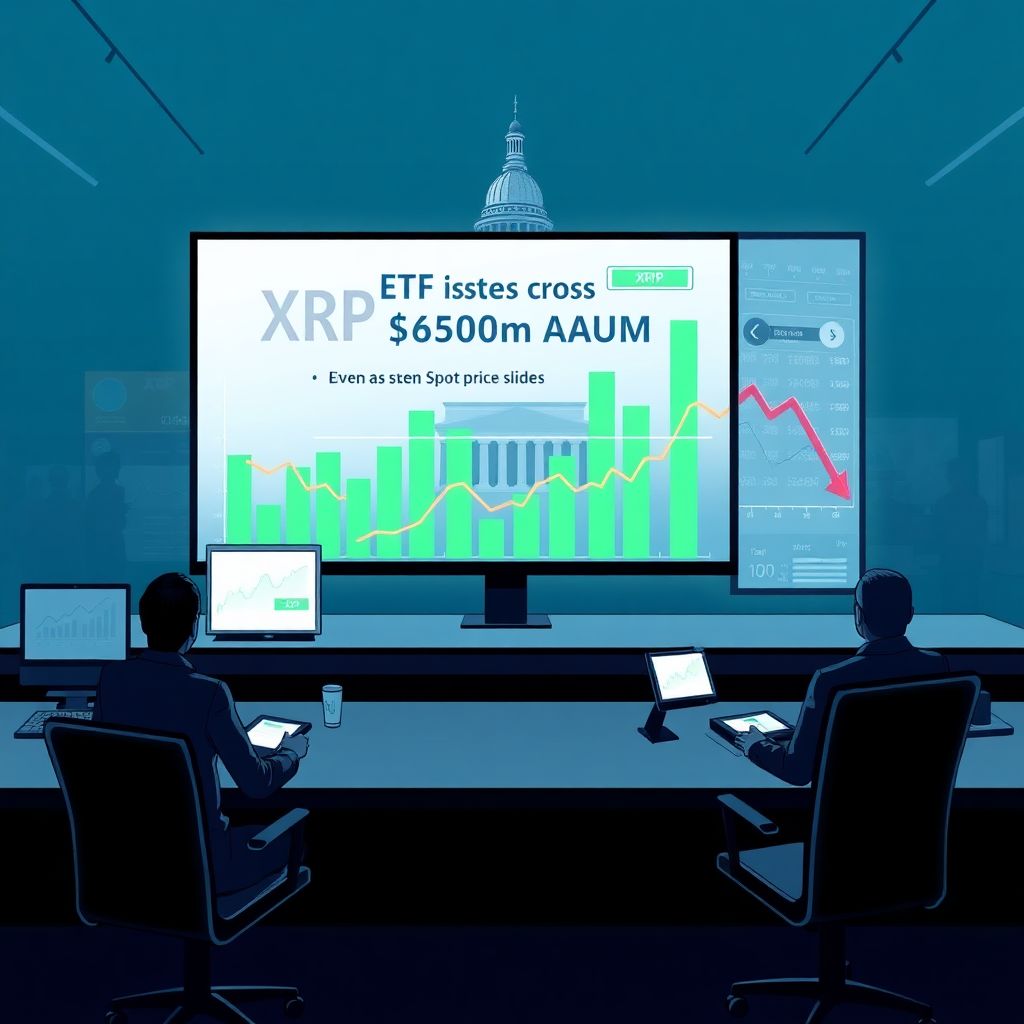
XRP ETFs cross $60m AUM even as token price slides
Exchange-traded funds tied to XRP have quietly passed a significant threshold, amassing more than $60 million in assets under management (AUM) by December 17, even as the underlying token continued to lose value on the spot market. This widening gap between growing ETF exposure and a weakening price has become one of the more notable dynamics in the XRP ecosystem in recent weeks.
At the time of the latest data, XRP was trading lower, extending a multi‑week downtrend. Market reports highlight that the token has been under sustained selling pressure for several months, with a series of lower highs and lower lows forming on higher‑time‑frame charts. The contrast between this technical picture and the steady increase in ETF assets has prompted questions about how much ETF demand is actually influencing short‑term price action.
Commenting on the situation, market commentator Chad Steingraber pointed out that the structure of exchange‑traded funds can naturally create a lag between inflows into the ETF and observable pressure on the spot market. ETF shares are bought and sold during normal trading hours on traditional exchanges. However, the actual creation and redemption process—where the ETF issuer adjusts its underlying holdings of XRP—typically occurs after the close of regular market trading.
According to Steingraber, this daily end‑of‑session mechanism is crucial. Fund managers calculate net inflows and outflows at the close, then execute the necessary XRP purchases or sales later, often in blocks and sometimes spread over time. As a result, a surge of ETF share buying during the day does not automatically translate into immediate XRP purchases on crypto exchanges. Any impact on spot liquidity and price can be delayed, fragmented, or partially offset by other trading strategies.
Institutional flow patterns also help explain the seeming disconnect. Large investors rarely rush into new products simply because they are available. Professional allocators and corporate treasuries typically operate under stringent investment mandates that require formal due diligence, risk reviews, and approvals. These processes can stretch across weeks or months, especially for products tied to volatile assets like cryptocurrencies.
Market analysts note that the recent climb to more than $60 million in XRP ETF AUM likely reflects staged capital deployment rather than a single wave of aggressive buying. Institutions often start with small test allocations, monitor performance and liquidity, then scale up exposure in increments. This phased approach means increases in AUM can be visible long before they add sustained, directional pressure on the token’s spot price.
Technically, XRP has been in a clear downtrend since mid‑year on many longer‑term charts. Traders focusing on daily and weekly time frames have pointed to a succession of failed breakouts and repeated tests of key support zones. Several widely used indicators—such as declining moving averages and weakening momentum signals—have been interpreted as warning signs of potential further downside if support levels fail to hold.
Recent price action has brought XRP back to critical support bands that previously served as springboards for short‑lived rallies. Analysts caution that a decisive break below these areas, especially if accompanied by rising volume, could shift market attention to lower price ranges and intensify bearish sentiment. Conversely, if buyers manage to defend these levels while ETF inflows continue, it could lay the groundwork for a more constructive medium‑term base.
Despite the milestone above $60 million, XRP ETFs still represent a relatively small slice of the broader crypto ETF landscape. Flagship products tied to larger digital assets hold substantially more capital, underscoring that institutional participation in XRP, while growing, remains in an early phase. For now, XRP ETFs appear to be niche vehicles rather than dominant drivers of the token’s global liquidity profile.
ETF managers themselves may be contributing to the muted price impact through their portfolio management techniques. Instead of buying large amounts of XRP in a single block, some issuers may opt for algorithmic execution, staggering purchases to minimize slippage and visibility. Others might employ hedging strategies or maintain cash buffers, allowing them to meet near‑term shareholder demand without immediately sourcing an equivalent amount of XRP from the market.
On‑chain data from the XRP Ledger offers a different angle on the current environment. Recent analytics point to a rising number of non‑empty wallets, suggesting that, alongside institutional ETF exposure, there is incremental accumulation occurring at the individual or smaller‑scale investor level. This pattern often emerges when some market participants view lower prices as an opportunity to build longer‑term positions rather than a signal to exit.
The coexistence of growing ETF AUM, an uptick in active wallets, and persistent downward price pressure paints a mixed picture. On one hand, rising institutional and retail engagement hints at a slow, structural broadening of XRP’s holder base. On the other, steady selling—possibly from earlier entrants taking profits, rotating into other assets, or reacting to macro uncertainty—continues to cap rallies and weigh on short‑term sentiment.
Market observers are now watching two key variables: whether end‑of‑day ETF purchases begin to show up more clearly in spot order books, and whether current support zones can withstand further testing if macro conditions or sector‑wide risk appetite deteriorate. A confluence of rising ETF demand, stabilizing technicals, and firm on‑chain activity could provide the foundation for a trend reversal. Absent that, ETF growth may simply coexist with a prolonged period of range‑bound or declining prices.
Why ETF inflows don’t guarantee immediate price gains
The current situation is a reminder that positive headline numbers for ETF inflows are not, by themselves, a guarantee of instant price appreciation. In traditional markets, ETF share volume can surge while the underlying asset moves only marginally, especially when market makers and arbitrageurs are actively smoothing out imbalances. A similar dynamic is increasingly visible in crypto.
Authorized participants—the institutions responsible for creating and redeeming ETF shares—can offset some of the fund’s exposure through derivatives, over‑the‑counter transactions, or cross‑asset strategies. That means a portion of the economic exposure to XRP might be managed or hedged without generating equivalent spot market demand at the moment inflows are recorded. For traders expecting a simple one‑to‑one relationship between ETF flows and price, this introduces an additional layer of complexity.
Moreover, ETF volume can include a significant amount of short‑term trading and arbitrage rather than net new directional positioning. High activity in the ETF does not necessarily meaningfully change the long‑term supply‑demand balance for XRP unless it is accompanied by consistent net creations of new ETF shares backed by physical XRP purchases.
Implications for XRP investors and traders
For longer‑term XRP holders, the steady climb in ETF AUM may be more meaningful as a structural signal than as a short‑term trading catalyst. Growing institutional interest, even from a relatively low base, can translate into deeper liquidity, more diversified ownership, and increased visibility among professional investors over time. These factors don’t typically move charts overnight but can influence how resilient an asset becomes in future market cycles.
Short‑term traders, in contrast, are likely to remain more focused on chart patterns, support and resistance, and intraday flows than on slow‑building ETF statistics. For them, the key questions center on whether ETF‑related buying appears around specific times—such as near traditional market closes—or at specific price zones, helping to define new floors or ceilings for the asset.
Risk management also takes on added importance in this environment. The presence of institutional capital via ETFs does not immunize XRP from sharp moves, liquidations, or broader crypto market drawdowns. Traders and investors may need to account for potential divergences between ETF behavior and spot markets, particularly during periods of stress when liquidity can quickly thin out.
Macro backdrop and sector context
The XRP ETF story is unfolding against a broader backdrop of shifting global monetary policy, evolving crypto regulation, and changing investor appetite for risk. Interest rate decisions, regulatory updates, and sector‑wide sentiment swings can all overshadow asset‑specific developments, including ETF milestones.
In a late‑cycle or uncertain macro environment, some institutions may favor cautious, incremental allocations to crypto, using ETFs as a relatively controlled on‑ramp rather than making large direct purchases of tokens on exchanges. This can further slow the translation of ETF AUM growth into immediate spot price effects, while still incrementally strengthening the asset’s institutional footprint.
Within the crypto sector itself, competition for capital remains intense. New product launches, narratives around other chains or tokens, and shifting perceptions of regulatory risk can divert or attract flows. XRP’s ETF progress therefore needs to be viewed not just in isolation but relative to the ongoing development of ETF markets for other major digital assets.
What to watch next
Looking ahead, several developments could reshape the balance between XRP ETF growth and spot price performance:
– Changes in ETF trading volume and creation/redemption activity that signal more aggressive physical XRP buying.
– Evidence that institutional due diligence cycles have matured, leading to larger second‑ or third‑wave allocations.
– Shifts in technical structure—such as a break above key moving averages or a confirmed trend reversal pattern—that might attract momentum traders back into the market.
– Continued expansion in the number and activity of non‑empty XRP wallets, supporting the case for gradual accumulation at lower prices.
– Regulatory or macro news that either boosts confidence in crypto exposure generally or triggers another round of de‑risking.
For now, XRP’s situation reflects a familiar tension: fundamental indicators of adoption and institutional engagement are slowly improving, while the price chart still bears the marks of a prolonged corrective phase. ETF assets exceeding $60 million highlight that large investors are beginning to take XRP more seriously as part of diversified crypto strategies. Whether that growing presence will eventually overpower the current selling pressure—and on what timeline—remains one of the central questions for the asset’s next chapter.