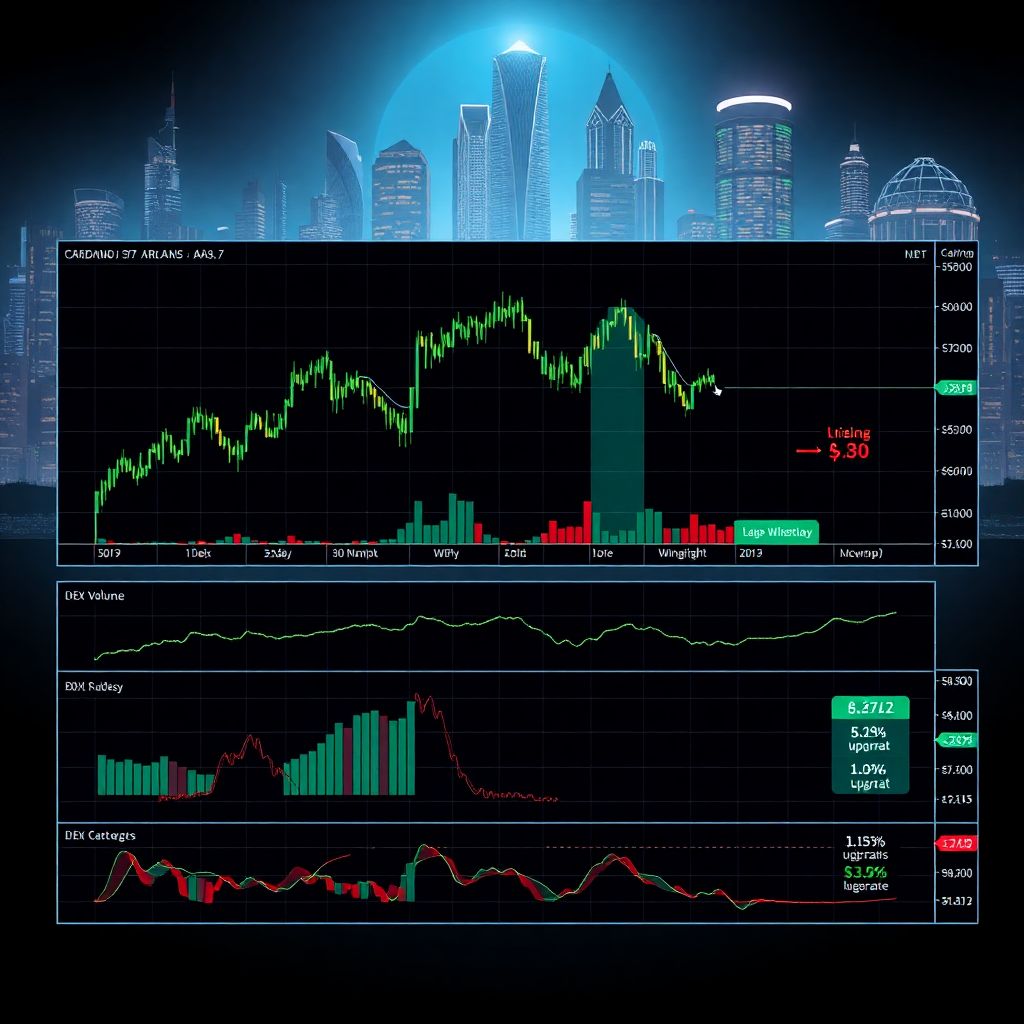
Cardano price is slowly carving out a bullish setup as activity on its decentralized exchanges spikes, hinting that selling pressure could soon give way to a sharp recovery.
After plunging more than 72% from its November peak, ADA has been stuck in a technical bear market and recently traded near $0.3720, its lowest point in over a year. Despite this grim backdrop, both on‑chain fundamentals and the chart structure suggest that downside momentum may be exhausting, opening the door to a relief rally.
DEX volume on Cardano is quietly accelerating
One of the clearest signs of renewed interest in the Cardano ecosystem is the rising volume on its decentralized exchanges. Following the launch of Midnight (NIGHT), a privacy‑focused sidechain and token ecosystem, trading activity on Cardano‑based DEXs has climbed meaningfully.
According to on‑chain data aggregations, Cardano’s total DEX volume has reached about $120 million so far this month, compared with roughly $100.2 million in November and $87 million in October. That means DEX activity has grown by almost 40% in just two months, even as the ADA price has remained under pressure.
Most of this turnover is being driven by Minswap, the leading DEX on Cardano, which handled more than $94 million in trades over the last 30 days. Other notable platforms contributing to the volume increase include SundaeSwap, WingRiders, and Splash Protocol. Rising liquidity and higher trading volumes are often early indicators that a network is attracting more builders, traders, and capital — factors that historically tend to precede price recoveries rather than follow them.
Why rising DEX activity matters for ADA price
Growing decentralized exchange volume is not just a technical footnote. For Cardano, it signals that users are engaging with the ecosystem instead of merely speculating on the ADA token price.
More active DEXs typically imply:
– Higher demand for ADA to pay transaction fees.
– Greater utility for tokens within the Cardano network, including new projects launching on‑chain.
– Improved liquidity, which can make it easier for large holders to enter or exit positions without causing extreme slippage.
If this trajectory continues, the network could see a feedback loop: more projects and users lead to higher DEX volume, which attracts more liquidity providers and developers, further reinforcing Cardano’s position as a serious smart contract platform rather than just another speculative asset.
Key catalysts: Midnight, Leios, and the Pentad initiative
Fundamentally, Cardano is entering a period where several major upgrades and initiatives are set to converge — each with potential implications for ADA’s valuation.
Midnight (NIGHT) mainnet launch
The upcoming mainnet rollout of Midnight is scheduled for the first quarter of next year. Midnight is designed as a data protection–focused network that brings enhanced privacy features to Cardano’s broader ecosystem.
The NIGHT token, which underpins this ecosystem, has already surpassed a market capitalization of $1 billion and a daily trading volume above $1.5 billion. This level of market interest suggests that investors are taking the Midnight launch seriously, and its full deployment could further cement Cardano’s position in the privacy and compliance‑friendly segment of Web3.
In practice, a successful Midnight launch could:
– Attract developers building privacy‑centric dApps, enterprise solutions, and regulated financial products.
– Drive more cross‑chain activity and asset transfers involving Cardano.
– Support greater demand for ADA due to network usage and interoperability.
Leios upgrade: parallel processing for higher throughput
Another major piece of Cardano’s roadmap is the Leios upgrade, which aims to dramatically increase the network’s throughput. By introducing parallel processing, Cardano will no longer process all transactions in a strictly linear fashion. Instead, it can handle multiple streams of transactions concurrently.
The result is a substantial boost in scalability, with the protocol targeting the ability to handle thousands of transactions per second. For DeFi protocols, NFT marketplaces, and gaming projects, this is critical: high throughput and low fees are prerequisites for real‑world, large‑scale adoption.
If Leios delivers on its goals, it may strengthen the investment case for ADA by:
– Making Cardano more competitive with other high‑throughput blockchains.
– Reducing congestion and transaction delays during periods of high activity.
– Encouraging more sophisticated applications that require reliable performance.
Pentad: a 70 million ADA push to close ecosystem gaps
Cardano Foundation and its partners are also driving the Pentad initiative, an ambitious plan aimed at addressing structural bottlenecks that have so far limited the network’s growth.
Pentad proposes to allocate 70 million ADA to support critical infrastructure and services that Cardano still lacks or needs to improve. The initiative focuses on five core areas, including:
– Tier‑1 stablecoins such as USD Coin (USDC) and Tether (USDT), which are essential for DeFi, payments, and hedging.
– Oracle networks capable of feeding reliable off‑chain data on‑chain.
– Institutional‑grade crypto wallets that meet compliance and security requirements of larger investors.
– Advanced analytics tools for better monitoring, transparency, and decision‑making.
– Other tooling and integrations that enhance developer experience and user adoption.
Bringing Tier‑1 stablecoins to Cardano is especially significant. Stablecoins are the backbone of most DeFi ecosystems; their presence tends to unlock lending platforms, derivatives, yield strategies, and more complex financial primitives. As these building blocks arrive, the underlying token (ADA) stands to benefit from added utility and ecosystem stickiness.
ADA ETFs: the institutional angle
On top of protocol‑level improvements, Cardano may also gain from a broader macro‑level catalyst: the potential approval of ADA‑based exchange‑traded funds (ETFs).
If regulators eventually greenlight spot or derivative ETFs tied to ADA, it would provide a new, regulated access point for institutional investors and traditional financial players. Historically, ETF approvals for major assets have tended to increase liquidity, reduce barriers to entry, and raise overall awareness.
For Cardano, such products could:
– Draw in capital from funds that are restricted from holding crypto directly.
– Stabilize order books via larger, more consistent flows.
– Increase the perceived legitimacy of ADA as an investable asset class.
While ETF approvals are not guaranteed and depend on regulatory developments, the mere possibility is increasingly part of the bullish narrative around the asset.
Technical picture: a falling wedge points to a possible breakout
From a purely technical standpoint, ADA’s daily chart paints a picture of persistent selling — but also suggests that a reversal might be approaching.
Over the past few months, the token has trended steadily lower and remained capped under the 50‑day moving average, which has acted as dynamic resistance. Every attempt to break above this moving average has been rejected, confirming sellers’ control.
However, within this downtrend, price action has carved out a falling wedge pattern. A falling wedge is typically recognized as a bullish reversal formation. It is defined by two downward‑sloping, converging trendlines:
– The upper trendline connects a series of lower highs.
– The lower trendline connects a series of lower lows, but the slope is less steep than the upper line.
As the range tightens and the two lines move toward a point of convergence, selling momentum often diminishes. Once buyers manage to push price above the upper trendline with convincing volume, the pattern is considered to have broken out.
In ADA’s case, a successful breakout from this wedge could trigger a swift move back toward the $0.50 region — a key resistance zone. This would represent roughly a 40% increase from the recent trading levels around $0.37.
What traders should watch in the coming weeks
For market participants looking to position around a potential rebound, several signals warrant close monitoring:
1. Break above the 50‑day moving average
A decisive daily close above the 50‑day MA would be the first sign that bearish control is weakening and that the falling wedge breakout may be underway.
2. Volume confirmation on breakout
If ADA pierces the upper wedge trendline, rising trading volume would help confirm the move. A breakout on low volume, by contrast, may indicate a false start.
3. Follow‑through toward $0.50
The $0.50 level is both a psychological barrier and a previous support/resistance zone. How price behaves around this area — rejection, consolidation, or clean breakout — will likely set the tone for the next leg.
4. On‑chain activity and DEX volumes
Continued growth in DEX activity, TVL, and new protocol launches on Cardano would support the thesis that the price recovery is being underpinned by real usage rather than pure speculation.
5. Updates on Midnight, Leios, and Pentad
Roadmap clarity and visible progress on these initiatives could attract fresh interest from both developers and investors, reinforcing any technical breakout.
Risk factors that could delay or invalidate the bullish scenario
Despite the constructive signals, several risks could prevent ADA from realizing its bullish potential in the near term:
– Macro headwinds: A broad risk‑off move in global markets, tighter monetary policy, or negative headlines in the crypto space could weigh on all digital assets, including Cardano.
– Regulatory pressure: Adverse regulatory decisions targeting staking, DeFi, or privacy‑focused technologies could disproportionately affect ecosystems like Cardano’s, especially given its push into regulated privacy via Midnight.
– Execution risk: Delays or technical setbacks related to the Midnight mainnet launch, the Leios upgrade, or Pentad’s rollout could dent investor confidence.
– Intense competition: Cardano operates in a crowded field of layer‑1 blockchains, many of which are also scaling and offering aggressive incentives to developers. Failure to differentiate or capture mindshare could limit upside.
Acknowledging these risks is crucial for forming a balanced view. While the setup leans bullish, crypto markets remain highly volatile and sensitive to both internal and external shocks.
Medium‑term outlook for ADA
Taken together, Cardano finds itself at an interesting crossroads. On the one hand, its price action still reflects the scars of a prolonged downtrend, with ADA far below its previous highs and sentiment relatively subdued. On the other hand, the combination of:
– A maturing DeFi ecosystem with rising DEX volumes,
– Major upcoming upgrades like Midnight and Leios,
– A strategic infrastructure push via Pentad,
– And the possibility of institutional access channels such as ETFs,
creates a backdrop in which a technical reversal becomes more plausible.
If the falling wedge plays out according to textbook expectations and is validated by stronger on‑chain growth, ADA could stage a meaningful rebound toward and potentially beyond the $0.50 mark in the months ahead. Whether this recovery evolves into a sustained uptrend will ultimately depend on Cardano’s ability to convert its roadmap and ecosystem plans into tangible, user‑driven adoption at scale.
For now, the market appears to be in a waiting phase — compressing in a narrowing price pattern even as fundamental activity beneath the surface quietly accelerates.