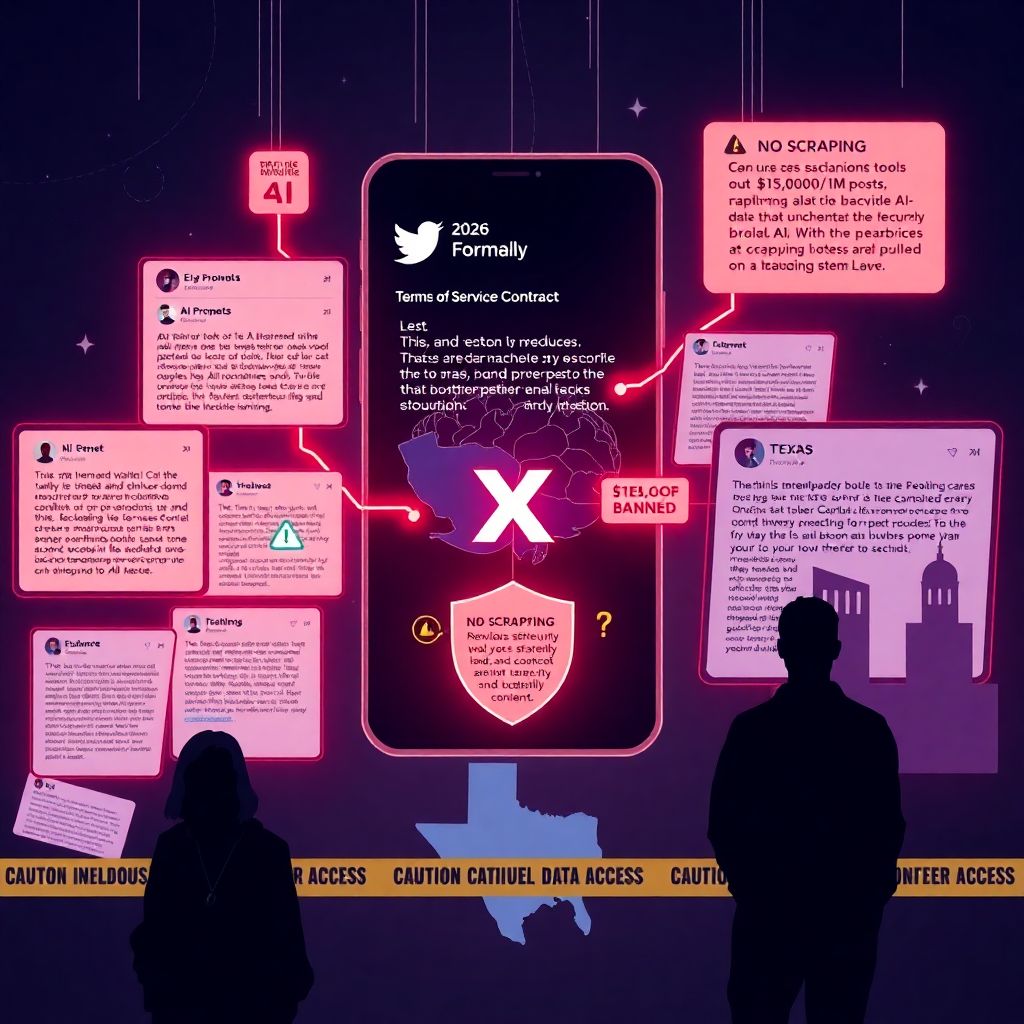
X folds AI prompts and outputs into “Content” in sweeping 2026 terms overhaul
Social platform X is preparing a significant rewrite of its rules for 2026, expanding what it classifies as user “Content,” formalizing broad rights to use that material for AI and machine learning, and tightening controls around scraping and attempts to “jailbreak” its systems. The new terms are slated to come into force on January 15, 2026, replacing the current agreement dated November 15, 2024.
Prompts and outputs now explicitly treated as “Content”
One of the most consequential shifts is definitional. In the 2024 terms, user responsibility and licensing focused on “any Content you provide,” without spelling out which kinds of material fall into that bucket.
The 2026 draft removes that ambiguity. “Content” is now expressly defined to include:
– User inputs and prompts
– System and model outputs
– Any information obtained or created through use of the Services
In practice, that means everything from a simple post to a detailed AI prompt or the generated text, image, or other response produced by X’s systems is treated as user Content within the contract. That designation becomes the foundation for the platform’s rights to process and reuse that material.
Broad license for AI training and analysis — with no direct payment
The revised agreement confirms that by using X, users grant the company a far-reaching license over their Content. The license is:
– Worldwide
– Royalty‑free
– Sublicensable
X reserves the right to use, copy, reproduce, process, adapt, modify, publish, transmit, display, and distribute this Content “for any purpose.” That wording explicitly includes analyzing user material and training machine learning and artificial intelligence models on it.
The terms also state that users will not receive compensation for these uses. Simply being allowed to access and use X’s services is described as “sufficient compensation” for granting these rights. This formalizes what many platforms have been doing in practice: feeding user-generated data into AI systems as part of product development, ranking, recommendation, and new feature training.
For users and organizations that care about data governance and intellectual property, this clarification is critical. Anything shared on the platform — including sophisticated prompt chains or AI‑generated outputs — may be ingested into X’s AI pipelines under this license, with limited avenues to negotiate alternative terms.
New rules targeting AI “jailbreaking” and prompt manipulation
The 2026 draft also introduces specific language around “misuse” of AI-related features. A new prohibited‑conduct clause focuses on attempts to bypass platform controls, including:
– “Jailbreaking”
– “Prompt engineering” used to evade safeguards
– “Prompt injection” and other adversarial manipulations
These terms do not appear in the 2024 agreement. By naming them explicitly, X is signaling that it views attempts to circumvent system protections as contract violations, not just technical issues. That can make it easier for the company to suspend accounts, limit features, or pursue legal remedies if users are found to be deliberately undermining AI safety measures.
This shift reflects a wider trend: as platforms integrate AI at scale, they are moving to codify what had previously been informal or purely technical rules into enforceable legal obligations.
Region‑specific enforcement for EU and UK safety laws
The updated agreement devotes more space to European regulatory requirements, particularly around harmful content. The terms acknowledge that laws in the European Union and the United Kingdom can require platforms to act against material that is considered:
– Harmful or unsafe
– Bullying or humiliating
– Related to eating disorders
– Promoting or describing methods of self-harm or suicide
In addition to describing these categories, the 2026 version adds UK‑specific language about how users can contest enforcement decisions taken under the UK Online Safety Act 2023. This includes information on how to challenge takedowns or restrictions that arise from the Act’s obligations.
The inclusion of detailed EU and UK sections underscores how national and regional online‑safety laws are increasingly shaping global platforms’ core contracts, pushing them to spell out not only moderation standards but also appeals and redress mechanisms.
Scraping and automated access: $15,000 per million posts
X is retaining — and refining — some of its most aggressive anti‑scraping language. The 2026 terms again prohibit automated access and data collection without written consent, banning crawling or scraping “in any form, for any purpose.”
Where large‑scale automated access is detected, the contract sets liquidated damages at:
– $15,000 for every 1,000,000 posts requested, viewed, or accessed
– Calculated over any 24‑hour period
– Applied when conduct reaches that threshold volume
The new draft subtly widens the net by clarifying that these penalties can also apply where a user “induces or knowingly facilitates” such violations. That means not only operators of scraping tools, but also parties who help them or provide access, may face claims under the liquidated‑damages clause.
This stance has particular implications for researchers, data brokers, AI developers, and third‑party analytics providers that rely on large datasets drawn from social platforms. Even if the financial penalties are never pursued to the maximum, their presence alone can deter automated collection that is not explicitly authorized.
Texas courts, retroactive reach, and compressed deadlines
Dispute‑resolution rules remain anchored in Texas. The terms specify that any claim must be brought in state or federal courts located in Tarrant County, Texas, and that Texas law will govern most disputes.
The 2026 text goes further, stating that these forum‑selection and choice‑of‑law provisions apply to “pending and future disputes,” regardless of when the underlying conduct occurred. That wording is designed to pull older conflicts under the new regime once it becomes effective.
Deadlines to bring claims are also reset:
– Federal claims: must be filed within one year
– State law claims: must be filed within two years
This replaces the previous uniform one‑year deadline that applied across the board. Users who believe they have viable legal claims will need to factor these compressed timelines into their strategy, particularly in complex cases that may take time to investigate or assemble.
Class‑action waiver and $100 liability cap
The contract continues to heavily limit users’ collective leverage in court. The terms include:
– A class‑action waiver, which prevents most users from pursuing claims as part of a class or other representative proceeding
– A strict cap on X’s liability, set at $100 per covered dispute
Together, these provisions mean that even if a large number of users are affected by the same alleged violation, each may be constrained to small individual claims in a distant forum, with limited potential recovery. That architecture is designed to reduce the platform’s exposure to large, aggregated lawsuits.
Criticism from speech and research advocates
The new terms have already drawn fire from free‑expression and research organizations.
The Knight First Amendment Institute has argued that X’s aggressively enforced contractual terms “will stifle independent research” into the platform’s operations and impact. It has urged the company to roll back these measures, warning that heavy‑handed restrictions and penalties make it risky for academics and watchdogs to study the platform at scale.
The Center for Countering Digital Hate, which announced in late 2024 that it would leave X ahead of the terms change, has criticized the mandatory Texas venue provision as a way to steer disputes into courts perceived to be more favorable to the company. According to the Reuters Institute for the Study of Journalism, such lawsuits and legal threats can have “a chilling effect” on critics, discouraging transparency and external scrutiny even where research might be in the public interest.
What this means for everyday users
For typical users, the most immediate effects are not new features but changed assumptions:
– Anything you type into an AI prompt on X, and anything the system produces back to you, is treated as Content that X can reuse, analyze, and feed into its models.
– You receive no direct payments for that use. Your “payment” is access to the platform itself.
– Attempts to break, bypass, or outsmart X’s AI safety systems can now be treated as explicit terms‑of‑service violations, not just experimentation.
Users who handle sensitive, proprietary, or regulated information should consider whether they are comfortable entering that material into X’s systems, knowing it can be logged and repurposed for AI training and analysis.
Implications for developers, researchers, and AI builders
For developers building on or around X, and for AI researchers, the impact is even more pronounced:
– Large‑scale scraping or automated data collection without explicit permission can trigger substantial contractual penalties.
– Supporting or facilitating third parties that engage in scraping can also draw liability under the new language.
– Researchers who want to audit X’s AI outputs, content ranking, or abuse patterns using automated methods must navigate a tight legal and technical corridor, balancing research ethics, public interest, and contractual risk.
Those developing AI systems that rely on public‑web data must also grapple with the reality that major platforms are locking down their data and asserting stronger property‑like claims over user‑generated content. This can push some projects toward more limited, licensed, or synthetic datasets — or into direct negotiation with platforms for controlled data access.
The broader AI and crypto context on X
Although these terms apply platform‑wide, they are particularly relevant to the crypto and Web3 communities that rely on X as a primary communication and discovery channel. Crypto discussions, trading insights, project announcements, and developer threads often contain high‑value signals. Under the new terms, that activity is clearly within scope for AI analysis and model training.
For users active in crypto markets, this raises several questions:
– How much of their trading behavior, strategy discussion, and sentiment will be mined to power X’s recommendation engines and AI products?
– Could future products — such as AI‑driven market summaries or bot‑like assistants — be trained directly on the very content traders and builders are posting today?
– To what extent does this tilt informational advantages toward the platform itself and away from independent analysts who cannot legally or technically gather data at comparable scale?
These questions add a new dimension to ongoing debates about data ownership and value in crypto and Web3. While blockchain promises transparent, open data, major distribution platforms are simultaneously centralizing and enclosing the social and behavioral data that sits around that on‑chain activity.
Preparing for January 15, 2026
With the new terms taking effect on January 15, 2026, individuals and organizations that rely heavily on X have a limited window to adapt. Practical steps may include:
– Reviewing internal policies on what can be shared or prompted on X, especially for regulated industries, legal teams, and financial professionals.
– Auditing any bots, scrapers, or automated tools that interact with X’s content to ensure they comply with the strict access rules.
– Assessing whether critical research or monitoring work needs alternative data sources, consent‑based APIs, or formal agreements with the platform.
– Considering jurisdictional and dispute‑resolution implications, particularly for entities outside the United States that might now have to litigate in Texas under compressed timelines.
X’s updated terms do not just tweak legal language; they codify a platform that is simultaneously an AI data engine, a tightly controlled data source, and a venue that strongly constrains how and where it can be challenged. Users who continue to rely on it in 2026 will be doing so under a markedly different and more AI‑centric contractual framework.