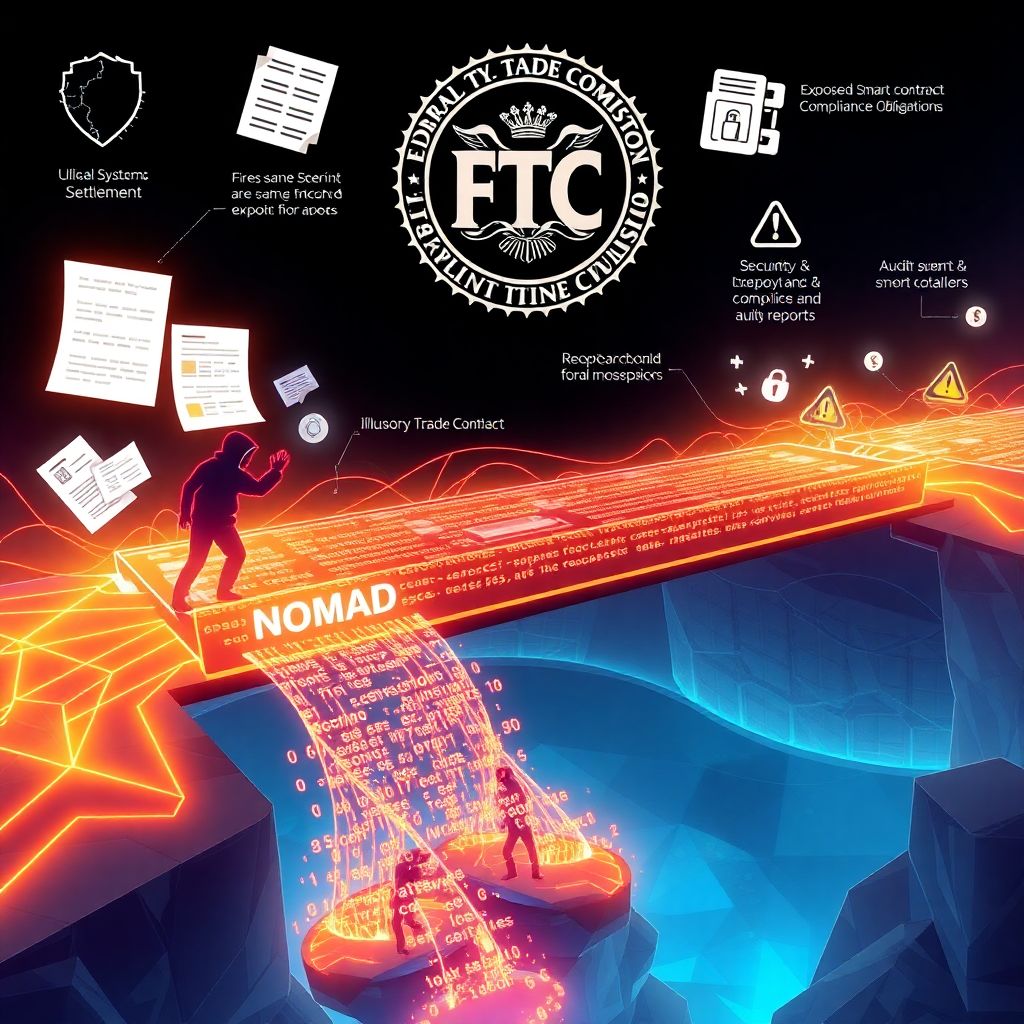
FTC Orders Nomad Bridge Operator to Compensate Users After $186M 2022 Exploit
The U.S. Federal Trade Commission has reached a proposed settlement with Illusory Systems Inc., the company behind the Nomad cross-chain crypto bridge, following a catastrophic 2022 security breach that wiped out almost all of the protocol’s funds.
According to the agency, the exploit led to the theft of roughly $186 million in digital assets, with users ultimately bearing losses of more than $100 million. Regulators say Illusory Systems misrepresented how secure Nomad was and failed to implement adequate safeguards that could have prevented—or at least limited—the attack.
Under the proposed order, Illusory Systems will be prohibited from making false or misleading claims about the security of its products and services. The company must also establish a comprehensive information-security program, undergo independent security audits every two years, and return any recovered funds that have not yet been distributed back to harmed users.
The FTC’s complaint describes a project that marketed itself as a secure way to move crypto assets between blockchains but did not live up to its own promises. Investigators concluded that Nomad lacked fundamental security controls, leaving the bridge exposed to a vulnerability that attackers were able to exploit in a highly visible, chaotic drain of funds.
Because these basic safeguards were not in place, a single flaw in Nomad’s smart contract upgrade opened the door to a free‑for‑all. Once the initial exploit transaction was spotted, scores of opportunists simply copied the same transaction format to siphon funds for themselves. Within hours, almost every asset locked in the bridge had been stripped out, leaving the protocol effectively insolvent.
The breach became one of the most notorious examples of a “copy‑paste” attack in decentralized finance. Instead of a single sophisticated hacker quietly exploiting a bug, the Nomad collapse looked more like a digital bank run, as participants rushed to replicate the exploit before the vulnerability was patched.
For the FTC, this incident is not just a story about a smart contract bug—it is a consumer protection issue. Regulators argue that Illusory Systems made assurances about security and reliability that were not supported by its internal practices, putting users’ assets at direct risk. In the agency’s view, marketing a product as safe while failing to implement and test appropriate protections crosses the line into deception.
The settlement therefore goes beyond a one‑time penalty. Illusory Systems will be required to formalize and document its security practices, including risk assessments, access controls, ongoing monitoring, and incident response procedures. These controls must be reviewed in independent assessments every two years, creating ongoing regulatory oversight rather than a one‑off enforcement action.
Crucially, the order also focuses on restitution. Any funds that Illusory Systems manages to recover—through asset tracing, negotiations with exploiters, or any other means—must be directed to compensate affected users, provided those funds haven’t already been returned under previous recovery efforts. That provision is designed to prioritize victims over the company’s own financial interests.
The Nomad case underscores a broader trend: crypto projects are increasingly being judged not only by technical performance, but by whether their public claims align with their actual risk management. Regulators are signaling that “DeFi” and “permissionless” are not shields against basic consumer protection standards, especially when platforms target everyday users rather than purely experimental developers.
For developers and operators of cross‑chain bridges and other DeFi infrastructure, the message is clear. Security cannot be treated as an afterthought or a marketing slogan. Regulators expect robust code review and formal testing before deployment, continuous monitoring for vulnerabilities, and clear disclosure of risks. Overpromising on safety, or implying guarantees that do not exist, can trigger enforcement even if a project is technically decentralized.
For users, the Nomad hack and subsequent FTC action are a reminder that smart contract risk and platform risk are intertwined. Bridges, in particular, are attractive targets because they often hold large pooled balances. Even if a project has reputable backers or a strong community, that does not guarantee that its security practices meet the standards regulators and security professionals consider baseline.
The enforcement also points toward a future in which crypto projects that interact with U.S. consumers may need to integrate more traditional compliance strategies. Formal security frameworks, regular third‑party audits, and transparent incident reporting—long standard in conventional finance and software—are increasingly being treated as expectations rather than optional extras in the digital asset world.
In the wake of cases like Nomad, more teams are reevaluating how they communicate with users about risk. Clear disclaimers, realistic descriptions of protections, and public security roadmaps can help set appropriate expectations. By contrast, vague promises of “bank‑grade security” or “bulletproof” systems, without evidence, may invite both regulatory scrutiny and public backlash if things go wrong.
The Nomad incident also fuels the ongoing debate over how to make cross‑chain interoperability safer. Some in the industry argue that bridges should reduce complexity, minimize trusted components, and limit the total value at risk in any single contract. Others advocate for alternative designs—such as native cross‑chain messaging or light‑client‑based bridges—that may be harder to exploit but are more difficult to implement.
Regardless of the technical path forward, the FTC’s action against Illusory Systems marks a significant moment: a major regulator directly tying a DeFi bridge exploit to consumer deception and long‑term compliance obligations. For affected Nomad users, the settlement offers at least the prospect that additional recovered funds could eventually make their way back. For the rest of the industry, it serves as a stark warning that security failures—especially when paired with aggressive marketing—can have consequences that extend far beyond an on‑chain exploit.