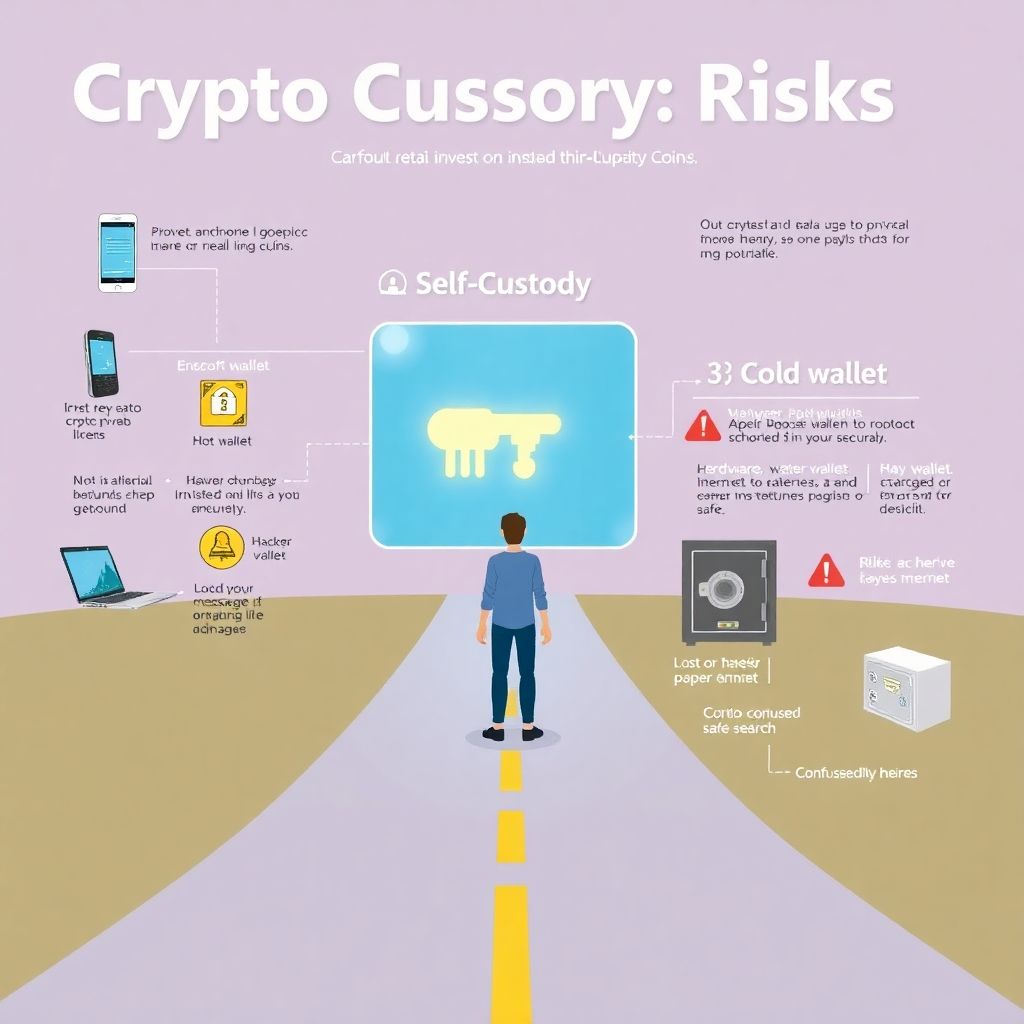
SEC Warns Retail Investors: Crypto Wallets Are Not as Simple as They Look
The U.S. Securities and Exchange Commission is sharpening its focus on how everyday investors store digital assets. In a new investor bulletin, the SEC’s Office of Investor Education and Assistance cautions that custody is one of the most misunderstood – and riskiest – aspects of owning crypto.
The document explains that crypto is not “held” in a wallet the way cash sits in a bank account. Instead, wallets store cryptographic keys that control access to assets recorded on a blockchain. Losing those keys, mishandling them, or placing them in the wrong hands can mean losing funds permanently, with no practical way to recover them.
Private keys: irreversible access, irreversible loss
According to the bulletin, crypto wallets generate two types of keys. The private key is a long, randomly generated alphanumeric code that functions much like a master password. It is used to sign and authorize transactions, proving that the wallet owner is the legitimate controller of the assets.
Once a private key is created, it cannot be altered or reset. If the private key is lost, forgotten, destroyed, or stolen, there is no central authority to restore access. The SEC stresses that in such a scenario, access to the crypto associated with that key is gone permanently. This finality is a defining characteristic of blockchain systems – and a major departure from traditional banking, where password resets and customer support are standard.
Public keys, by contrast, are derived from private keys and serve as an address for receiving funds. The SEC compares a public key to an email address: it is something that can safely be shared with others so they can send assets, but it does not give them spending power. A public key on its own cannot authorize a transaction.
Hot vs. cold wallets: convenience versus security
The guidance describes the two main categories of crypto wallets: “hot” wallets and “cold” wallets.
Hot wallets are connected to the internet – for example, mobile wallet apps, browser-based wallets, or wallets integrated into centralized exchanges. Their big advantage is convenience: they allow quick transfers, trading, and frequent access. But constant connectivity also makes them more exposed to hacking, malware, phishing, and other cyberattacks.
Cold wallets, on the other hand, are offline storage methods, usually hardware devices or even paper-based solutions that keep private keys off the internet. Because they are not continuously online, they tend to offer better protection against remote attacks. However, they introduce other risks: the device or written backup can be lost, physically damaged, or thrown away; owners can forget where they stored them; or heirs may never find them.
The SEC doesn’t endorse one model over the other but underscores that each choice involves a tradeoff between accessibility and security. Investors are urged to think carefully about how often they need to move their funds and how much risk they can tolerate.
Seed phrases: powerful backup, powerful liability
Many wallets generate what is called a seed phrase (or recovery phrase). This is usually a sequence of 12 or 24 words that can be used to reconstruct the wallet and regain access to funds if a device is lost, broken, or wiped.
The SEC notes that a seed phrase is effectively a skeleton key: anyone who obtains it can recreate the wallet and control all assets associated with it. For that reason, the bulletin advises investors to store seed phrases in a secure, offline location and never share them with anyone, including supposed “support agents” or unsolicited contacts.
The regulator also points out an often-overlooked risk: if a seed phrase is stored digitally in cloud backups, messaging apps, email, or unencrypted documents, it may be vulnerable to hackers or data breaches. The responsibility for securing this phrase lies entirely with the owner.
Self-custody vs. third-party custody: who holds the keys?
The SEC emphasizes that investors essentially face a fundamental decision: manage their own wallets and keys (self-custody) or entrust them to a third party (custodial solution).
Under self-custody, the investor personally controls the private keys. This offers maximum independence and removes reliance on financial intermediaries, but it shifts all operational, security, and recovery risk onto the individual. Mistakes such as sending funds to the wrong address, losing a backup, or falling for a scam can be irreversible.
With third-party custody, another entity – such as an exchange, a specialized custodian, or a broker – holds the keys on the investor’s behalf. In many cases, users only see balances in an account interface while the provider manages the underlying wallets. This setup can be more user-friendly and familiar to those used to bank accounts, but it introduces a different set of vulnerabilities.
Risks specific to third-party custodians
The bulletin urges investors who choose third-party custody to perform meaningful due diligence rather than relying on brand recognition or marketing alone. The SEC suggests examining several aspects of a custodian’s operations:
– Background and history: Check whether the business has faced complaints, enforcement actions, lawsuits, or regulatory sanctions.
– Regulatory status: Determine whether the firm is registered in any capacity with financial regulators and what obligations that imposes.
– Asset coverage: Confirm which crypto assets the platform actually supports and whether they might restrict withdrawals or transfers under certain conditions.
– Insurance policies: Verify if there is any insurance coverage for loss or theft of digital assets and what exactly that insurance does and does not cover.
The SEC also raises concerns about practices like rehypothecation – when custodians reuse client assets as collateral for their own borrowing or other financial activities. In some setups, customers’ funds may also be pooled or commingled rather than held in clearly segregated accounts. These practices can complicate recovery if the custodian runs into trouble.
The bulletin bluntly warns that if a custodian is hacked, abruptly shuts down, or files for bankruptcy, customers may lose access to their crypto or face lengthy, uncertain legal processes to try to reclaim it.
Security and privacy questions investors should ask
Beyond headline risk, the SEC encourages investors to probe a custodian’s operational resilience. Key questions include:
– What physical security controls protect hardware, servers, and backup devices?
– What cybersecurity measures are in place – for example, multi-signature approvals, cold storage ratios, intrusion detection, and regular security audits?
– How are employees screened and monitored to reduce insider threats?
– Does the custodian sell, share, or monetize customer data, and under what conditions?
The regulator stresses that data privacy is an often-ignored dimension of crypto investing. Personal information, transaction histories, and behavioral data can have value to advertisers, data brokers, or even malicious actors if not properly safeguarded.
Understanding fees: the hidden cost of custody
The SEC bulletin highlights that crypto custody can carry a complex fee structure. Investors may encounter:
– Annual or monthly asset-based custody fees
– Per-transaction fees for trades, deposits, and withdrawals
– Charges for transferring to an external wallet
– Setup fees when opening an account and closure fees when leaving the platform
The regulator advises investors to read fee disclosures carefully and consider how costs might accumulate over time, especially for smaller portfolios or frequent traders. Seemingly small percentages can significantly erode returns in a volatile asset class like crypto.
Why this guidance matters now
The timing of the SEC’s warning is not accidental. In recent years, multiple crypto exchanges, lenders, and custodial platforms have collapsed or frozen withdrawals, leaving customers unable to access assets they believed were safe. Some have entered bankruptcy proceedings where crypto holders are treated as unsecured creditors rather than owners of specific assets.
These events have highlighted that “not your keys, not your coins” is not merely a slogan but a real legal and practical risk. The SEC’s bulletin appears aimed at making retail investors aware that platform failure is not a remote possibility but a historically demonstrated risk.
Practical steps for safer crypto custody
For retail investors trying to navigate this landscape, the SEC’s guidance implicitly points toward some practical steps:
1. Inventory your exposure. Know exactly where your crypto is held – on exchanges, in mobile wallets, on hardware devices – and who controls the keys in each case.
2. Segment your holdings. Consider keeping only the amount needed for active trading in hot, custodial environments, while moving longer-term holdings to more secure cold storage or self-custody setups.
3. Test your backups. If you rely on seed phrases or hardware wallets, periodically verify that you can actually restore access using your backup process (without compromising security).
4. Beware of social engineering. Many losses result not from sophisticated hacks but from phishing, fake support contacts, and impersonation. Remember that legitimate providers will never ask for your seed phrase or full private key.
5. Plan for inheritance. Think about how trusted heirs or executors could access your crypto if something happens to you, without exposing keys to unnecessary risk in the present.
Balancing autonomy and protection
Crypto was built around the idea of financial self-sovereignty – the ability to hold and move value without permission from central authorities. The SEC is not disputing that technology exists; instead, it is underscoring that greater control also means greater responsibility.
Self-custody may appeal to those comfortable with technical details, backup strategies, and personal security practices. Others may reasonably prefer the familiarity of third-party platforms, accepting counterparty risk in exchange for ease of use and support. There is no one-size-fits-all answer, but there is a clear need for informed decision-making.
The core message of the bulletin is that crypto custody is not a trivial detail to be handled later. It is a foundational choice that shapes every other aspect of a person’s experience with digital assets – from how easily they can transact to how likely they are to recover from mistakes or market shocks.
What retail investors should take away
The SEC’s latest guidance can be distilled into a few key lessons for everyday investors:
– Crypto wallets do not hold coins; they hold keys. Losing those keys usually means losing funds forever.
– Hot and cold wallets each have distinct advantages and vulnerabilities; investors should align their choice with their risk tolerance and usage patterns.
– Seed phrases are critical backups but also critical attack vectors; they must be safeguarded with extreme care.
– Third-party custodians introduce counterparty, legal, and operational risks that are different from – but not necessarily smaller than – self-custody risks.
– Fees, security standards, and data practices vary widely among providers and merit close scrutiny.
In a market still marked by rapid innovation, regulatory uncertainty, and episodes of platform failure, the SEC’s bulletin is a reminder that owning crypto is not just about price speculation. It is equally about understanding how control is established, maintained, and sometimes irretrievably lost.