
Why Tax-Efficient DCA Matters More in 2025 Than Ever
Dollar-cost averaging (DCA) is nothing new: you invest a fixed amount on a regular schedule and let volatility work for you. But in 2025, just passively “setting and forgetting” can mean leaving real money on the table in taxes. With higher portfolio sizes, more active traders, and smarter tools, tax efficient investing strategies are no longer a “nice to have” — they’re part of core portfolio design.
Here we’ll unpack how to structure your buys and sells so your DCA stays tax-smart, not just consistent. We’ll move from basic ideas to specific tactics, compare different approaches, and finish with practical recommendations and current trends.
—
Core Idea: Tax-Efficient DCA in Plain English
What We’re Really Optimizing
Tax-efficient DCA is about doing two things at once:
– Keep your regular investment schedule
– Minimize the drag from capital gains taxes when you rebalance, sell, or switch strategies
You’re not trying to avoid tax forever. You’re trying to shift it: from short-term to long-term, from high-tax years to lower-tax years, and from realized gains to still-compounding assets.
The Basic Building Blocks
Three levers make the biggest difference:
– What you buy (tax-efficient ETF portfolio vs. high-turnover funds)
– How you buy (consistent DCA vs. lump sum vs. tactical timing)
– When and what you sell (loss harvesting vs. gain realization, lot selection)
Once you see DCA as a framework — not a rigid rule — you can adjust these levers without sabotaging your long-term plan.
—
Comparing Approaches: Classic DCA vs. Tax-Aware DCA
1. Classic “Blind” DCA
Traditional DCA:
– Same amount every month
– Same ticker(s)
– Reinvest all dividends automatically
– Sell whenever you need cash, without looking at tax lots
It’s simple and robust, but from a capital gains tax planning for stock trading standpoint it’s pretty inefficient. Over years, you accumulate a mess of purchase prices, and if you don’t control which lots you sell, the tax bill can surprise you.
2. Tax-Aware DCA With Lot Control
Here you still invest periodically, but you add rules:
– Turn on specific lot identification with your broker
– Prefer selling highest-cost lots to minimize realized gains
– Delay selling lots with big unrealized short-term gains, if possible
This version keeps the behavioral advantage of DCA but adds a tax “filter” whenever you touch the sell button.
Pros:
– Easy to implement with modern brokers
– Direct impact on how to reduce capital gains tax on investments
– No need to time the market
Cons:
– Requires discipline when raising cash
– Still can create tax friction if you trade frequently
3. Hybrid DCA + Tax-Loss Harvesting
Now we layer in tax loss harvesting (TLH). You still invest on a schedule, but you:
– Periodically scan for positions below cost
– Realize those losses
– Immediately swap into a similar (but not “substantially identical”) asset to keep exposure
This is where many people in 2025 bring in automation or the best robo advisor for tax loss harvesting, because doing it manually across multiple accounts can be tedious.
Pros:
– Converts volatility into usable tax assets (losses)
– Reduces current-year tax bill or offsets future gains
– Works naturally with ongoing DCA purchases
Cons:
– Wash-sale rules require careful substitute choices
– Benefits shrink in long bull markets with few pullbacks
– Some brokers still don’t handle cross-account wash sale logic well
—
Vehicles: What You Buy Matters as Much as When
Why ETFs Dominate Tax-Efficient DCA in 2025
For long-term DCA, structure is king. A tax efficient ETF portfolio for long term investors usually beats an equivalent mutual fund setup on after-tax returns. Reasons:
– In-kind creations/redemptions help ETFs minimize taxable capital gain distributions
– Broad, low-turnover index ETFs don’t churn underlying holdings much
– You keep most of the tax “action” under your control via your own sells
In contrast, an actively managed mutual fund can realize large gains internally, and you get a tax bill even if you never sold a share. Not ideal.
When Individual Stocks Still Make Sense
Individual stocks give you much more granular control of lots and tax outcomes:
– You can harvest losses at the single-stock level
– You can trim specific winners while retaining others
– You can tailor your capital gains tax planning for stock trading around your income expectations
But they add risk and complexity. In 2025, many serious DIY investors use a core of tax-efficient ETFs plus a “satellite” of individual names where they’re willing to do more active tax work.
—
Technologies and Tools: Pros and Cons
Manual Tax-Aware DCA
Doing it yourself is still possible, especially if you:
– Use spreadsheets or portfolio trackers
– Manually choose tax lots when selling
– Review your positions for loss harvesting a few times a year
Advantages:
– Full control and transparency
– No extra advisory fees
– Flexible across different brokers and accounts
Disadvantages:
– Time consuming
– Error-prone, especially with wash-sale rules
– Easy to miss opportunities in fast-moving markets
Robo-Advisors and Smart Brokers
In 2025 the line between “broker” and “robo” is blurry. A lot of mainstream platforms now offer:
– Automated TLH with intelligent replacement ETFs
– Smart selling algorithms that default to highest-cost lots
– Tax planning dashboards showing projected capital gains
Choosing the best robo advisor for tax loss harvesting depends on:
– Minimum account size and fee structure
– How they choose replacement funds (are they genuinely diversified alternatives?)
– Whether they coordinate across your taxable and tax-advantaged accounts
Upside:
– Always-on monitoring (24/7, no fatigue)
– Integrated with your DCA schedule
– Cleaner reporting for your accountant or tax software
Downside:
– You’re trusting a black box to prioritize your interests
– Strategies may be optimized for “average clients,” not your specific tax bracket
– Some services generate a lot of small trades, which can matter for bid/ask and spreads
—
Concrete Techniques to Make DCA More Tax-Efficient
Structuring Buys: More Than Just “Once a Month”
Your DCA schedule can be adjusted for tax without losing discipline. Consider:
– Front-loading in low-income years: Invest more early in the year or in sabbatical / career-change years to lock in long-term holding periods sooner.
– Smarter dividend handling: Instead of auto-reinvesting dividends into the same security, direct them into a cash sweep and deploy them according to your DCA plan. This reduces the number of micro-lots that complicate sales later.
Short paragraph: simply turning off automatic reinvestment in taxable accounts can materially simplify your tax picture.
Structuring Sells: Rules, Not Impulse
When you need to sell — to rebalance, fund a purchase, or de-risk — follow a hierarchy:
1. Sell positions with losses first (harvest while you raise cash)
2. Then sell long-term gains with minimal percentage gain
3. Only if you must, touch short-term gains
In practice, that means:
– Always use specific-lot identification
– Use your broker’s tools to preview estimated tax impact before confirming a trade
– Avoid “all-or-nothing” decisions; partial sales can balance cash needs and tax costs
—
Comparing Strategy Variants: Which Tax-Efficient DCA Fits You?
Variant A: Passive, ETF-Only, Minimal Maintenance
You: want simplicity, long horizon, limited time.
You set up:
– Automatic monthly buys into 2–5 broad ETFs
– No frequent rebalancing; maybe once a year
– Specific-lot selling and tax-aware withdrawals when needed
This is the lowest-effort way to tap into tax efficient investing strategies without going deep into optimization.
Variant B: Active DCA With Periodic TLH
You: comfortable with a bit of complexity or using an advisor.
Key habits:
– DCA into a diversified basket
– Quarterly scan for loss harvesting opportunities
– Use replacement ETFs or pairs (e.g., two similar broad market funds)
– Coordinate sales with your expected income and bonus/vesting schedule
This can materially reduce your annual tax drag if you’re in a high bracket and have volatile assets.
Variant C: High-Income, Multi-Account Optimization
You: have stock compensation, RSUs, options, and a big taxable portfolio.
Your approach might include:
– Using DCA primarily in tax-advantaged accounts (401(k), IRA), and more tactical buys in taxable
– Aggressive TLH in taxable combined with charitable gifting of long-term winners
– Intentional realization of gains in years when you expect lower ordinary income (sabbaticals, business transitions, relocation)
Here, DCA is just one layer in a broader, integrated tax plan.
—
Practical Recommendations: How to Choose Your Setup
Start With Your Tax Profile, Not With Products
Before picking funds or platforms, map three things:
– Your marginal tax bracket (now and in the next 3–5 years)
– Typical holding periods (are you really long-term or often changing your mind?)
– Your tolerance for complexity (do you realistically have time to manage this?)
Then align your DCA style:
– Low bracket + long-term: simple ETF DCA, minimal TLH needed
– High bracket + volatile portfolio: structured TLH and strict lot selection can pay off
– Uncertain income: flexible, with room to realize big gains in “low-income” years
A Short Checklist Before You Commit
– Are you using funds that are structurally tax efficient (broad ETFs, low turnover)?
– Have you enabled specific-lot identification at your broker?
– Do you know how to preview the estimated tax impact of a sale?
– Do you have a simple rule for when you harvest losses and when you don’t?
If you can’t answer these yet, that’s where to focus before chasing fancy strategies.
—
2025 Trends: What’s Changing Around Tax-Efficient DCA
More Automation, Less Blind Rebalancing
In 2025, most leading brokers now embed tax logic into:
– Rebalancing algorithms (they prioritize trades that don’t create big gains)
– DCA workflows (some suggest which asset is currently most tax-efficient to add to)
– Alerts (e.g., “you’re about to realize $X of short-term gains at Y% rate”)
The trend: less “blind” DCA, more guided DCA with tax overlays.
AI-Driven Capital Gains Forecasting
Another shift: AI tools can now simulate, with your actual positions, multiple “what if I sell X vs Y” scenarios and show five-year after-tax outcomes. That changes how sophisticated investors think about how to reduce capital gains tax on investments — it’s no longer guesswork, but scenario testing.
Short but important point: because these tools are becoming mainstream, investors who ignore tax effects are increasingly at a structural disadvantage.
Growing Emphasis on Policy and Location Arbitrage
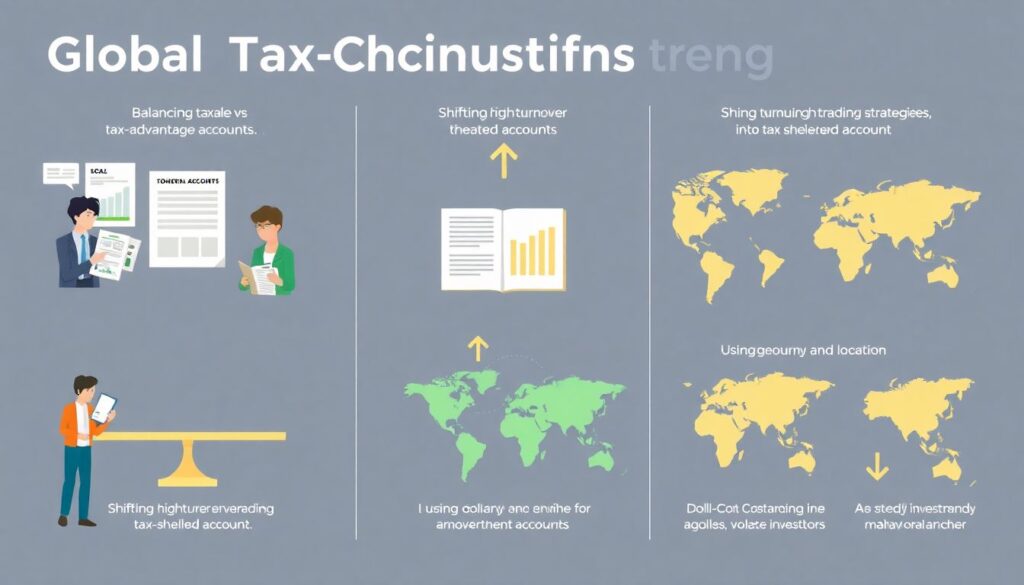
With tax debates active in many countries, more investors are:
– Balancing taxable vs. tax-advantaged accounts more deliberately
– Shifting high-turnover strategies into tax-sheltered accounts
– Using geography (moving states or countries) as part of their long-run tax playbook
DCA remains the behavioral backbone, but the where of contributions (which account, which jurisdiction) is getting as much attention as the when.
—
Putting It All Together
Tax-efficient DCA in 2025 isn’t about being clever every week. It’s about:
– Choosing tax-friendly vehicles (especially ETFs)
– Automating regular buys, but with enough flexibility to respond to tax realities
– Using tools — whether spreadsheets, brokers, or robos — to steer your sells and harvest losses intelligently
If you keep the core DCA habit but upgrade the tax layer, your portfolio becomes more resilient, your after-tax returns improve, and your future self gets to keep more of the compounding you worked for. That’s the real goal behind any tax efficient investing strategies — not perfection, but steadily reducing the friction between your plan and your actual outcome.