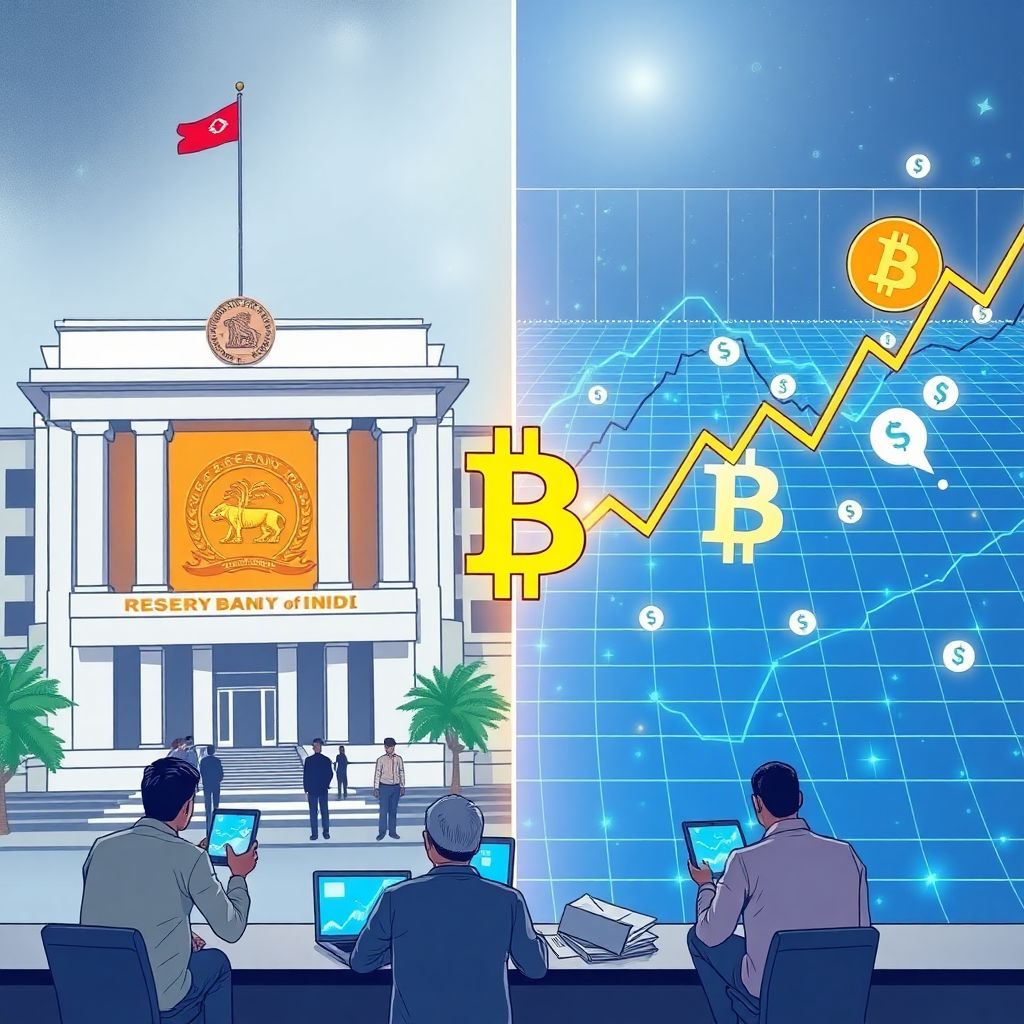
‘No intrinsic value’ – Then why does Bitcoin track RBI liquidity so closely?
Bitcoin is once again at the center of a heated policy debate in India. A recent statement from a senior Reserve Bank of India (RBI) official has reopened old questions about what Bitcoin actually represents – a speculative tech experiment or a parallel form of money that responds to the same forces as traditional finance.
At a media interaction in Mumbai, RBI Deputy Governor T. Rabi Sankar delivered an unambiguous message: in his view, stablecoins and cryptocurrencies do not qualify as proper money. He argued that, unlike sovereign currencies issued by central banks, stablecoins lack an explicit and enforceable promise to pay, which he considers a non‑negotiable attribute of any legitimate monetary instrument.
According to him, the advantages often promoted by stablecoin advocates are overstated, while the downside risks are clear and concrete. He cited concerns such as price volatility, the potential erosion of monetary sovereignty, and weaker control over capital flows. In his assessment, these instruments could undermine monetary stability, complicate fiscal management, disrupt traditional banking channels, and introduce new forms of systemic risk.
Sankar went further with his critique of cryptocurrencies like Bitcoin. He characterized Bitcoin less as money and more as a proof-of-concept for distributed ledger technology. From this perspective, Bitcoin is a technological showcase whose price is driven primarily by speculation rather than any intrinsic economic value or underlying cash flow.
The central bank’s broader stance remains consistent: it favors state-issued money, backed by public institutions and international organizations. In this model, legitimacy is derived from legal tender status, regulatory oversight, and the ability of monetary authorities to intervene during periods of stress.
These comments immediately triggered pushback from many Indian crypto users and industry participants. Critics argued that Bitcoin and stablecoins are not a serious threat to the rupee’s dominance in domestic payments, at least not in the near term. Instead, they are seen as parallel rails that can serve specific use cases more efficiently than legacy systems.
One argument that emerged repeatedly concerned remittances. Indians sending money across borders are already using dollar‑pegged stablecoins to bypass costly intermediaries, often achieving faster settlement and significantly lower fees when compared to traditional bank wires or money transfer operators. For them, stablecoins are less a theoretical risk and more a practical tool.
Others highlighted a strategic risk: by delaying or resisting a clear regulatory path for rupee‑denominated stablecoins, policymakers could unintentionally boost the dominance of foreign currency tokens. If households and businesses get comfortable using offshore, dollar‑backed stablecoins, India could find itself competing with private, foreign digital money for cross‑border trade, savings, and settlement.
A different set of voices stressed the potential of programmable, on‑chain payments. In their view, blockchains and smart contracts could complement domestic systems like UPI, especially in the realm of international payments and trade finance, where current Indian payment rails do not offer the same reach or flexibility. For these proponents, digital assets and central bank infrastructure are not mutually exclusive; they are building blocks that can be layered together.
Yet the most intriguing part of this debate does not lie in speeches or social media posts, but in data. Despite the RBI’s public skepticism, the central bank’s own liquidity operations appear to move in tandem with Bitcoin’s major bull and bear cycles. When RBI liquidity expands, Bitcoin prices have tended to climb. During periods of tighter liquidity, Bitcoin has often faced selling pressure or stagnation.
This correlation does not imply that the RBI is directly driving Bitcoin. The central bank is not buying BTC, nor is it managing its balance sheet with crypto markets in mind. Instead, both may be reacting to the same macroeconomic tides: global risk appetite, dollar liquidity, interest rate expectations, and the flow of capital into and out of emerging markets.
Still, the optics are uncomfortable. If Bitcoin is supposedly detached from real economic fundamentals and has “no intrinsic value,” why does it so often respond to the same liquidity conditions that shape equities, bonds, and other risk assets? Why do the inflection points in the RBI’s liquidity cycle map so neatly onto Bitcoin’s surges and crashes, more so than in many other asset classes?
One explanation is that Bitcoin has evolved into a high‑beta liquidity barometer. During periods of abundant money and low interest rates, investors search for yield and are more willing to allocate to speculative assets, including cryptocurrencies. As central banks, including the RBI, expand their balance sheets or ease financial conditions, risk‑on behavior intensifies, and Bitcoin becomes a prime beneficiary.
Conversely, when liquidity is drained from the system, borrowing costs rise and risk tolerance falls. In such phases, investors tend to rotate out of volatile assets and into safer havens or cash. That often translates into steep corrections in Bitcoin and other crypto assets, tracking the tightening path of central bank policies.
Another layer to this relationship is India’s growing role in the global crypto ecosystem. The country has a large, digitally native population, high smartphone penetration, and a strong appetite for alternative investments. Changes in domestic liquidity and banking conditions can therefore have an outsized impact on local trading activity, exchange volumes, and flows into or out of cryptocurrencies.
Regulatory uncertainty amplifies this sensitivity. When the cost and availability of credit in rupees change, participants who already operate on the margins of the formal financial system may respond more aggressively, using Bitcoin and stablecoins as parallel channels for savings, hedging, or cross‑border transfers. That behavior, at scale, can further intertwine domestic liquidity trends with crypto price action.
There is also a psychological dimension. Market participants increasingly treat Bitcoin as part of the wider macro landscape rather than as a niche curiosity. They watch interest rates, central bank balance sheets, and inflation dynamics as closely as they monitor on‑chain metrics. As a result, when they anticipate easier or tighter monetary conditions from the RBI, they reposition in Bitcoin alongside other assets, reinforcing the observed correlation.
All of this raises a deeper question for policymakers. If Bitcoin and stablecoins react systematically to monetary policy and liquidity cycles, can they really be dismissed as mere speculative fads, completely divorced from the financial system? Or are they emerging as shadow instruments that echo – and sometimes amplify – the very dynamics central banks seek to manage?
For the RBI, this tension sits at the heart of its digital strategy. On one side is the cautious rollout of a central bank digital currency and the defense of the rupee’s primacy. On the other side is a fast‑moving global market where individuals and firms can opt into alternative digital monies with a smartphone and a basic internet connection, often outside the direct reach of domestic regulation.
India’s policy choices over the next few years will help determine whether rupee‑linked digital assets, regulated stablecoins, and permissioned blockchain infrastructure can coexist with Bitcoin and global crypto markets in a managed framework – or whether a harder line will push more activity into opaque, offshore channels.
What is clear for now is that the narrative of “no intrinsic value” sits uneasily beside charts that show Bitcoin rising and falling in step with the RBI’s own liquidity cycle. Whether one sees Bitcoin as an asset, a proto‑currency, or just a speculative gauge of excess liquidity, it is already entangled with the same monetary forces that shape the broader economy.
Investors observing this pattern should understand both sides: the philosophical opposition of central banks to privately issued money, and the hard data showing how crypto markets respond to their every move. In that gap between rhetoric and reality lies the real story of Bitcoin’s evolving role in India’s financial landscape.
This analysis is for informational purposes only and should not be treated as financial or investment advice. Cryptocurrencies are highly volatile and risky assets, and anyone considering exposure should conduct thorough independent research and assess their own risk tolerance.