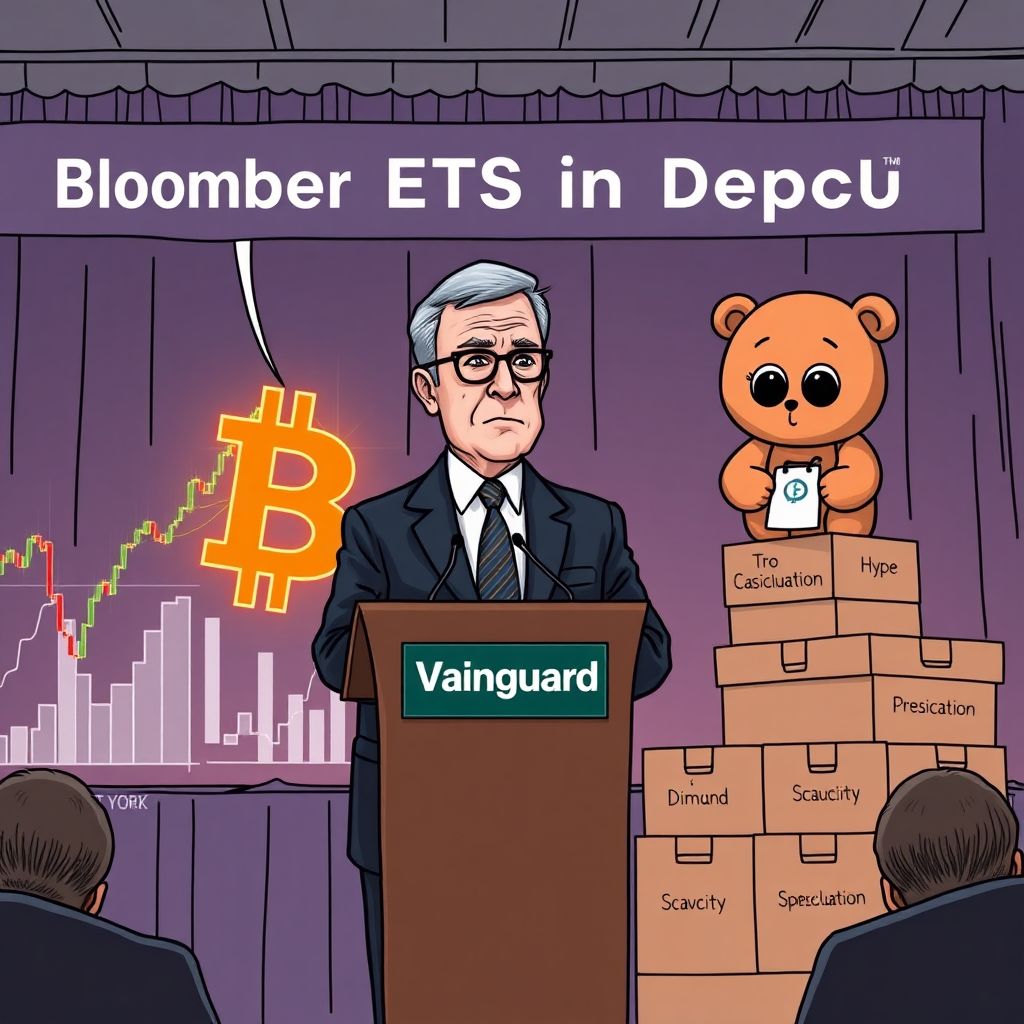
Vanguard Executive Dismisses Bitcoin as a “Digital Labubu” While Opening Door to Crypto ETF Trading
A senior Vanguard executive has compared Bitcoin to a fad collectible rather than a serious investment—just as the asset management giant quietly widens access to crypto-related exchange-traded funds (ETFs) for its clients.
Speaking at Bloomberg’s ETFs in Depth conference in New York, John Ameriks, Vanguard’s global head of quantitative equity, said Bitcoin does not meet the fundamental criteria the firm looks for in long-term holdings. He argued that, unlike traditional securities, Bitcoin lacks cash flow and the ability to generate compounding returns over time—two pillars of Vanguard’s investment philosophy.
Ameriks went so far as to label Bitcoin a “digital Labubu,” referencing a line of viral plush toys that have become speculative collectibles. By invoking Labubu—seen by many as a symbol of hype-driven buying rather than intrinsic value—he framed Bitcoin as a speculative plaything rather than a durable store of wealth or productive asset.
“It’s difficult for me to think about Bitcoin as anything more than a digital Labubu,” Ameriks said, underscoring his view that much of Bitcoin’s price is driven by sentiment and scarcity narratives rather than underlying economic output or earnings.
This rhetoric stands in stark contrast to the broader shift in U.S. policy and market infrastructure around digital assets. In recent months, regulators have approved multiple spot Bitcoin ETFs, institutional interest in crypto exposure has grown, and major financial firms have rolled out new products designed to make it easier for traditional investors to access cryptocurrencies through familiar wrappers.
Vanguard, long known for its conservative, low-cost, index-focused approach, has remained one of the most cautious major players in this space. The firm has declined to launch its own Bitcoin or crypto-native fund and has repeatedly said that digital assets do not align with its core investment framework. Its public stance emphasizes diversification, long-term compounding, and exposure to assets that generate income—criteria that Bitcoin currently fails, in the company’s view, to satisfy.
Yet, despite this skepticism, the firm has taken a pragmatic step: it now allows certain clients to trade crypto-linked ETFs through its brokerage platform. Rather than sponsoring or managing the funds directly, Vanguard enables access to third-party products that hold Bitcoin or other digital assets, or that track crypto-related indexes. This move expands clients’ options without Vanguard itself endorsing cryptocurrencies as a central component of a long-term portfolio.
The distinction is important. From Vanguard’s perspective, permitting trading is an operational and client-service decision, not a strategic pivot toward embracing Bitcoin as a core asset class. Investors who insist on adding crypto exposure can now do so within their existing Vanguard accounts, but they are doing it largely against the grain of the firm’s stated philosophy.
Ameriks’ comments highlight that internal skepticism remains strong. When he criticizes Bitcoin for lacking cash flow, he is pointing to a key difference between digital assets and instruments like stocks, bonds, or real estate. Equity investors benefit from dividends and earnings growth. Bondholders receive interest payments. Real estate generates rent. These cash flows can be reinvested, compounding returns over decades. Bitcoin, by contrast, offers no yield by itself; any “return” depends entirely on future buyers paying a higher price.
For a firm built around long-term retirement investing and predictable wealth accumulation, that distinction is central. Vanguard’s core message has always been that investors should avoid speculation, keep costs low, own broadly diversified funds, and stay the course. Bitcoin, with its high volatility and sentiment-driven cycles, sits uneasily within that framework.
From the viewpoint of many crypto advocates, however, Ameriks’ “digital Labubu” analogy misses the point. Supporters argue that Bitcoin’s value proposition is not about cash flows but about monetary properties: fixed supply, resistance to censorship, and independence from central banks. To them, Bitcoin is more akin to “digital gold” than to a stock or bond, and its role in a portfolio is as a hedge against inflation, currency debasement, or systemic risk.
This philosophical divide helps explain the tension between Vanguard’s product lineup and client behavior. Even as the firm publicly questions crypto’s long-term viability, demand for regulated, exchange-listed crypto exposure has risen. Some of Vanguard’s own clients—particularly younger, more tech-savvy investors—want at least a small slice of their portfolios in Bitcoin or other digital assets, whether as a hedge, a growth bet, or simply a way to participate in what they see as a structural shift in finance and technology.
By permitting trading in crypto ETFs without launching its own, Vanguard is effectively drawing a line: it will not promote or package Bitcoin as a core solution, but it will not entirely block clients who are determined to access it through regulated vehicles. In practice, this positions the firm somewhere between outright rejection and full adoption.
The “digital Labubu” remark is also revealing about how traditional finance views speculative manias. Labubu plush collectibles surged in popularity as limited-edition items, with resale markets driven more by scarcity, hype, and social trends than by any underlying utility. Equating Bitcoin with such a collectible implies that, in Ameriks’ estimation, its price is primarily a function of narrative and crowd behavior, not fundamentals. For risk-averse institutions, that level of narrative dependence is a red flag.
For individual investors, the mixed signals can be confusing. On the one hand, Bitcoin’s increasing integration into regulated financial products and brokerage platforms can look like validation. On the other hand, remarks from decision-makers like Ameriks serve as a reminder that many large asset managers still categorize crypto as speculation, not investment. Understanding this distinction is crucial when deciding how, or whether, to allocate to digital assets.
Investors using Vanguard’s platform need to recognize that access does not equal endorsement. The presence of crypto ETFs in a brokerage menu does not mean they play the same role as a broad-market index fund or a diversified bond ETF. Crypto exposure generally carries higher volatility, different risk drivers, and a less established regulatory and market history.
The broader policy environment also adds complexity. As regulators gradually build clearer frameworks for spot Bitcoin ETFs and other digital asset products, more traditional financial firms may follow Vanguard’s model: allow access, but remain philosophically hesitant. This “reluctant integration” could become a defining theme of the next phase of crypto’s relationship with mainstream finance.
For now, Ameriks’ characterization encapsulates Vanguard’s stance: Bitcoin is something many people are excited about, trade actively, and speculate on—but it is not, in the firm’s eyes, a productive asset that fits neatly into a disciplined, long-term compounding strategy. The fact that the company is opening the door to crypto ETF trading while simultaneously comparing Bitcoin to a viral toy captures the ambivalence that still pervades much of the traditional asset management industry.
Looking ahead, two questions loom large. First, will Bitcoin and other digital assets evolve in ways that address some of these institutional concerns—through yield-bearing structures, broader adoption, or more stable regulatory environments? Second, will firms like Vanguard adjust their frameworks if client demand and market infrastructure continue to grow, or will they continue to treat crypto as a peripheral, user-driven segment that sits outside their core investment canon?
Until those questions are answered, the gap between what asset managers say about Bitcoin and what they quietly allow their clients to do with it is likely to persist. Ameriks’ “digital Labubu” remark is less an offhand joke than a concise summary of how many in traditional finance still see the world’s largest cryptocurrency: eye-catching, heavily traded, and potentially lucrative for some—but a far cry from the kind of income-generating, compounding asset that underpins the investment philosophy of firms like Vanguard.