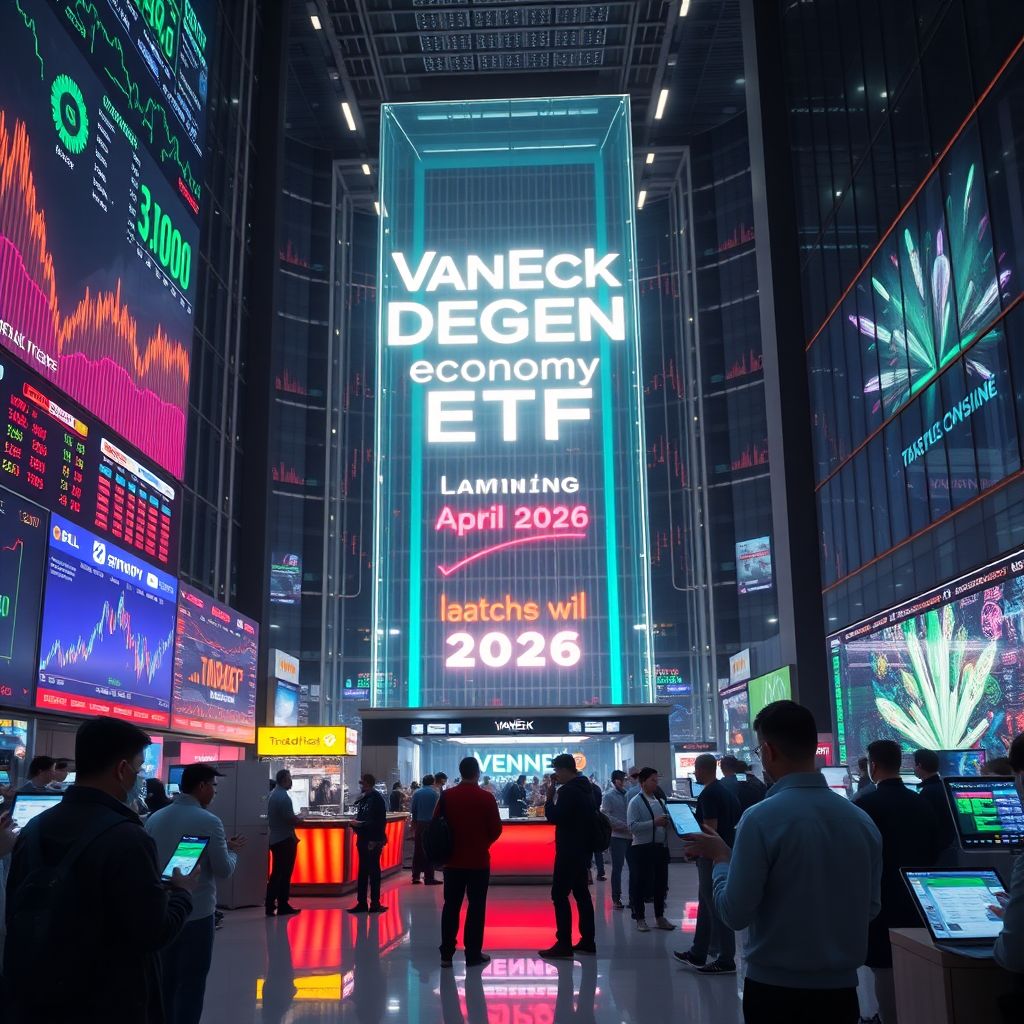
Morning Minute: VanEck Bets on ‘Degen’ Culture With New ETF
GM.
Wall Street is no longer pretending it doesn’t understand “degen” culture. It’s trying to package it, index it, and sell it.
Asset manager VanEck is taking a very direct step in that direction: the firm is converting its existing Gaming ETF into a new product called the VanEck Degen Economy ETF—designed to track listed companies at the heart of speculative digital trading, gig work, online betting, and casino-style entertainment.
The fund, set to roll out in April 2026, is being pitched as a window into the “degen economy” that has grown out of millennial finance habits, mobile trading apps, and borderless digital gambling. Rather than focusing only on pure-play casinos or gaming studios, the index behind the ETF will span a broader ecosystem of firms that monetize attention, risk, and continuous digital engagement.
What the “Degen Economy” ETF Is Targeting
According to VanEck’s framing, the Degen Economy ETF will hold publicly traded companies whose core business models resemble what has long been described in crypto as “degen” behavior:
– High-frequency, speculative trading platforms
– Online and mobile sportsbooks and digital casinos
– Gig and creator economy platforms that turn side hustles into primary income streams
– Digital entertainment and gaming firms that blur the line between play and financial risk
This is not a crypto ETF in the traditional sense: it doesn’t directly hold Bitcoin, Ethereum, or meme coins. Instead, it is built as an equity basket around the infrastructure and platforms that make speculative and gig-driven behavior possible at scale.
The underlying thesis is that a new class of companies has emerged at the intersection of finance, entertainment, and technology—firms whose revenues grow as users trade more, bet more, scroll more, and hustle more. VanEck’s rebrand is an explicit attempt to bundle that trend into a single, tradable ticker.
From Gaming ETF to Full-Blown Degen Index
VanEck’s move is essentially a repositioning of its Gaming ETF, which previously focused on traditional video game publishers, esports, and betting operators. The new “Degen Economy” label reflects a shift in narrative as much as in holdings:
– The old strategy: capture the upside of gaming and digital entertainment.
– The new strategy: capture the broader cultural and economic shift in how younger generations treat risk, work, and money.
By bringing gig platforms, trading apps, and digital wagering outfits under one umbrella, VanEck is formally recognizing that what used to be seen as separate sectors—fintech, online gambling, gaming, creator tools—are converging into a single behavioral pattern: always-on, mobile-first, and unapologetically speculative.
Why Wall Street Suddenly Loves “Degen”
For years, “degen” was a term thrown around in crypto circles to describe traders who pile into volatile assets, chase yield, and gamble on memes with little regard for traditional fundamentals. Now, that same culture is being translated into a marketing hook for a mainstream financial product.
There are several reasons for the shift:
1. Demographic reality: Younger investors are more comfortable with risk, have grown up around online games and loot boxes, and often view markets as another game interface.
2. App-based finance: Zero-commission trading platforms flattened the barrier to entry, turning options, leverage, and derivatives into something accessible on a smartphone.
3. Normalization of gambling: Online sportsbooks and in-app betting have become routine, with live odds integrated directly into sports broadcasts and social feeds.
4. Content-driven speculation: Viral memes and social media narratives move prices, and the platforms that enable this attention economy have become powerful businesses in their own right.
VanEck is not simply tolerating this reality; it’s leaning into the language, using “Degen Economy” as the official branding for an ETF. That marks a new phase in the relationship between legacy finance and internet-native culture: what started as an inside joke in crypto is now being repurposed as a sellable theme.
What Companies Could Fit the Degen Profile?
VanEck has not yet published a final list of constituents, but the types of firms likely to fit the “degen economy” narrative include:
– Brokerage and trading platforms that monetize order flow, options activity, and retail trading volume.
– Online betting and casino operators offering sports wagering, digital slots, and live-dealer experiences.
– Gaming and interactive entertainment companies with in-game purchases, loot mechanics, or casino-style features.
– Gig and creator platforms where individuals monetize content, rides, deliveries, or freelance work through flexible, task-based arrangements.
– Payment and fintech firms that support microtransactions, instant payouts, and 24/7 access to funds and markets.
What ties them together is not a specific sector code, but a shared dependence on behavioral engagement—time spent in apps, bets placed, trades executed, content produced, and rides completed. The ETF is effectively an index of attention extraction and risk monetization.
Millennial Finance and the Rise of “Speculative Living”
One of the deeper ideas behind a “degen economy” narrative is that many younger adults no longer separate speculative behavior from everyday life. Trading meme coins, flipping NFTs, betting on sports parlays, and running a side hustle are part of the same continuum: a search for upside in a world of stagnant wages and rising costs.
Millennial and Gen Z investors often:
– Treat markets as entertainment as much as as investment.
– Blend social identity with trading choices, from meme stocks to fan tokens.
– Look for asymmetric upside—small stakes, big potential outcomes—rather than slow, predictable compounding.
This psychological shift is exactly what the ETF is trying to quantify: not just the companies themselves, but the way consumers interact with risk as a lifestyle.
Gig Work as a Pillar of the Degen Economy
The inclusion of gig platforms in the index is telling. On the surface, gig work looks like flexible employment rather than speculation. But in practice, it shares several traits with degen-style risk-taking:
– Income volatility: Earnings can swing sharply based on demand, platform changes, or algorithm tweaks.
– Constant optimization: Workers chase “hot zones,” surge pricing, and bonus structures, much like traders chase short-term volatility.
– App dependency: Most gig work is mediated by opaque platforms whose rules can shift with little notice.
By grouping these platforms together with trading apps and betting firms, VanEck is implicitly saying: this is all part of the same digital hustle culture, where individuals are always trying to extract a bit more upside from fragmented, uncertain opportunities.
Digital Gambling: From Vice to Growth Story
Once confined to casinos and betting shops, gambling has migrated fully into mobile apps, streaming overlays, and integrated sports products. The “degen” label fits this transition perfectly:
– Users can place live bets during games, cash out early, or ladder complex parlays.
– Algorithms push tailored offers to high-engagement users.
– Gamified interfaces make betting feel like another game mode, not a separate financial decision.
For investors, the sector has become a high-growth story as regulations loosen in more jurisdictions and cultural taboos fade. For VanEck, it’s a core pillar of the Degen Economy ETF: a predictable, scalable way to monetize risk appetite.
How This Fits Into the Broader Crypto and Meme Landscape
While the fund does not primarily hold tokens, it sits next to a broader macro environment where crypto, memes, and high-beta tech stocks behave as a single risk complex. Degen culture originated in crypto, but has spread into:
– Meme equities and short squeezes
– NFT-style digital collectibles and gaming assets
– Social tokens, fan tokens, and creator coins
– Leveraged ETFs and structured products aimed at retail traders
The ETF is a kind of equity-side reflection of that universe. Rather than owning the speculative instruments, it owns the picks-and-shovels: the businesses profiting from that speculative behavior. That makes the product a way for more conservative institutions to participate in a space they might not be allowed to enter directly.
Why This Matters for Investors
The launch of a Degen Economy ETF is more than a branding stunt. It signals that:
1. Speculation is now an investable theme: What used to be dismissed as “gambling” is being reframed as a legitimate growth sector.
2. Cultural trends are driving product design: Asset managers are no longer only slicing the market by geography or sector, but by social behavior and internet culture.
3. Wall Street is willing to speak the language of its youngest customers: Using the term “degen” in an official product name would have been unthinkable a decade ago. Today, it is a deliberate way to connect with a demographic that grew up online.
For investors, the ETF could serve as a focused bet on the growth of speculative and gig-based platforms. But it is also, by definition, tied to a part of the economy that can be extremely cyclical and sentiment-driven. When risk appetite cools, these companies can suffer disproportionate drawdowns.
Risks Behind the “Degen” Branding
The word “degen” carries a certain self-aware humor in crypto circles, but it also points to very real risks:
– Regulatory uncertainty: Gambling, trading, and gig work are all under ongoing regulatory scrutiny. Policy shifts can quickly reshape the business environment.
– Reputation risk: Platforms built on addictive engagement may face backlash similar to what social media giants confronted around mental health and data practices.
– Concentration of behavior: The ETF is effectively concentrated in a single macro factor—user appetite for risk. If that factor reverses, correlations within the basket may spike.
Packaging this into an ETF doesn’t remove those risks; it simply makes them easier to access in a single trade. The “degen” label may be playful, but the volatility associated with the underlying theme is likely to be serious.
What This Says About the Future of Finance
The VanEck Degen Economy ETF is a snapshot of where finance is heading:
– Products will track *how* people behave, not just what industries they work in.
– Internet-native terms—once considered slang—will increasingly appear in official filings, marketing decks, and ticker names.
– The line between investing, speculating, and entertainment will continue to blur as platforms compete for attention.
In that sense, the ETF is both a bet and a mirror. It’s a bet that speculative, gig-driven lifestyles will not only persist, but become a defining economic force. And it’s a mirror reflecting what has already happened: a generation that treats markets as part casino, part social network, and part second job.
As April 2026 approaches and VanEck’s Degen Economy ETF comes to market, the question will not be whether there is demand. The real question is how long the degen era lasts—and whether an index built on that culture can ride the wave without being consumed by its inevitable crashes.