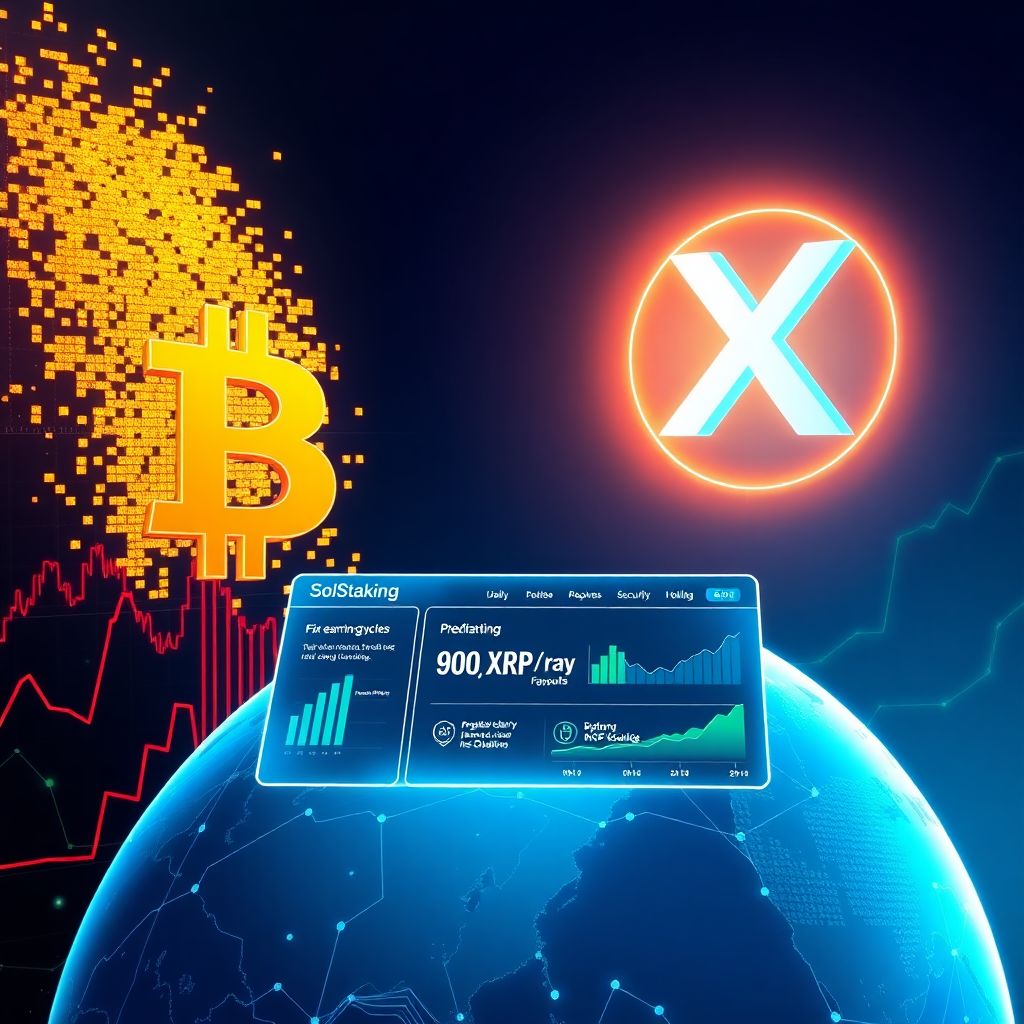
Bitcoin Out, XRP In: Why Yield-Hungry Investors Are Turning to SolStaking for 900+ XRP a Day
As crypto markets swing violently from one extreme to another, a new playbook is forming among more strategic investors. Instead of betting purely on explosive price moves, they are increasingly turning to assets with clearer regulation and real-world utility – and then pairing them with structured yield platforms to generate daily income.
In that context, XRP is rapidly moving into the spotlight, and SolStaking is positioning itself as one of the most talked‑about platforms for those who want to earn predictable returns while still holding their XRP long term.
—
From Bitcoin to XRP: A High-Profile Portfolio Shift
The shift is not just theoretical. A well-known crypto entrepreneur, Crypto X AiMan, recently revealed that he had liquidated his entire Bitcoin position and moved 100% of his capital into XRP.
What made this move remarkable was the timing: it took place during intense selling pressure affecting both BTC and XRP, not during a bull‑market euphoria. In other words, it wasn’t a momentum chase; it was a strategic rotation.
According to AiMan, this was not a short-term trade, but a conviction-based decision built on three pillars:
– XRP’s improved regulatory position in the United States
– Ripple’s expanding network of institutional partners in banking and payments
– The ongoing global shift toward ISO 20022, a new financial messaging standard that could favor assets like XRP
In his view, XRP stands out as one of the few large-cap digital assets that combine regulatory clarity with a concrete role in cross-border settlement.
—
Regulatory Clarity: XRP’s Edge in a Tougher Environment
One of the main reasons more investors are reevaluating XRP is its status following its legal showdown with the U.S. Securities and Exchange Commission (SEC). A key ruling recognized that XRP, when traded on exchanges, does not constitute a security.
In a world where regulators are increasingly scrutinizing digital assets, that level of legal definition matters. For portfolio managers and individual investors alike, assets that come with fewer unanswered legal questions are inherently more attractive. Regulatory clarity doesn’t eliminate risk, but it reduces one major category of uncertainty.
Bitcoin, while often treated as a commodity and widely accepted as non-security, does not come with the same kind of recent, explicit courtroom outcome that XRP has. For some, that difference is becoming more important as compliance and regulation move to the center of the crypto conversation.
—
Beyond Speculation: Ripple’s Global Payments Footprint
Another driver behind the XRP pivot is Ripple’s growing role in the traditional financial system. Ripple’s technology is used by a wide range of banks, remittance services, and payment providers to facilitate faster, cheaper cross-border transactions.
For a growing number of investors, XRP is no longer viewed solely as a speculative token that might go up or down on hype. Instead, it is increasingly seen as a liquidity bridge – a digital asset that can move value across borders quickly and with relatively low fees.
This real-world utility helps distinguish XRP from many altcoins whose value propositions remain mostly narrative-based. The idea is straightforward: if institutions continue to adopt Ripple-powered solutions, the asset that underpins a portion of that infrastructure could benefit in the long term.
—
ISO 20022: A Structural Shift in Global Payments
The transition to ISO 20022 – a new global standard for financial messaging – is another structural theme drawing attention. ISO 20022 aims to make payment data richer, more standardized, and easier to process across borders and systems.
As more banks and financial institutions migrate to this standard, some analysts and investors view XRP as well-positioned to integrate into this new landscape. The asset is often discussed in the context of next-generation payment rails, particularly for high-speed cross‑border settlement.
While ISO 20022 itself does not “choose” winners, assets and technologies that can plug into this upgraded environment, and that are already oriented toward international payments, are naturally placed under the spotlight. For XRP advocates, this migration is a tailwind rather than a side note.
—
Volatility is High, But Yield Demand is Higher
At the same time, markets have become more chaotic. Single-day price swings of several percent – or more – are now common across major cryptocurrencies. Many investors are becoming less comfortable with an approach that relies purely on buying and waiting for capital gains.
This has led to growing demand for models that provide:
– Predictable, scheduled income
– Reduced dependence on market timing
– The ability to keep long-term exposure to chosen assets
This is where structured yield platforms enter the picture, and why SolStaking is getting increasing attention, particularly among XRP holders.
—
SolStaking: Yield-Focused Stability in an Unstable Market
SolStaking is positioning itself as a stability-oriented yield platform designed for investors who want to keep their crypto exposure while smoothing out their cash flows. Rather than trying to “beat the market” through trading, users opt into predefined earning cycles with set parameters.
Key elements of SolStaking’s model include:
– Fixed earning cycles with preset returns
Users choose from a menu of earning plans, each with clear terms – including duration and projected daily rewards. This structure is intended to remove guesswork and reduce the urge to constantly trade.
– Automated daily payouts
Once a plan is activated, payouts are processed automatically every 24 hours. Investors don’t need to manage bots, run hardware, or monitor complex strategies. The focus is on simplicity and predictability.
– Multi-asset support, centered on XRP
Although the platform supports multiple assets, XRP has become one of the standout options, especially for those who share AiMan’s long-term thesis.
– Security-first architecture
SolStaking emphasizes institutional-grade security measures, such as cold storage for reserves, risk management layers, and protection mechanisms designed to shield user funds from common threats in the crypto space.
For some users, certain staking cycles are reportedly generating returns north of 900 XRP per day, depending on the size of their stake and the chosen plan. That kind of steady, asset-denominated income is especially appealing in turbulent markets.
—
How SolStaking’s Earning Plans Work in Practice
Although exact details depend on the specific plan, the general process is straightforward:
1. Select an asset and plan
The user chooses XRP (or another supported asset) and then picks an earning cycle with predefined duration and expected daily returns.
2. Lock the stake
The user allocates a chosen amount of XRP into the plan. During the cycle, this allocation is locked and used within SolStaking’s internal yield strategies.
3. Receive daily payouts
Every 24 hours, earnings in XRP are credited automatically to the user’s account, according to the agreed parameters. Users can monitor their accumulation in real time.
4. End of cycle
At the conclusion of the cycle, the user typically regains access to the initial stake, plus any accumulated rewards that were not withdrawn along the way.
The crucial point is that users know the earning framework in advance, rather than trying to navigate constantly changing market conditions or short-lived DeFi incentives.
—
Dual Strategy: Hold XRP for the Future, Earn XRP Today
For long-term XRP believers, platforms like SolStaking enable a two-track strategy:
– Long-term upside
By holding XRP directly, investors maintain exposure to any potential appreciation that might come from increased adoption, favorable regulation, or macro trends in the payments space.
– Short-term stability
Through fixed earning cycles, they can generate regular income in XRP, smoothing their cash flow regardless of day-to-day price volatility.
This dual approach is particularly attractive for those who don’t want to be forced into selling their holdings during market downturns just to access liquidity. Instead of liquidating, they aim to let their holdings work for them, generating consistent yield.
—
Understanding the Risks: Yield is Never Free
Despite the appeal of daily income and structured plans, it’s important to recognize that no yield platform is without risk. Investors should consider:
– Platform risk – The possibility of technical failures, security breaches, or operational mismanagement.
– Market risk – Even if users earn 900+ XRP per day, the dollar value of those rewards can fluctuate dramatically with the token price.
– Liquidity constraints – Locked cycles mean funds cannot be instantly withdrawn, which can be a downside if an investor needs urgent access to capital.
Because of these factors, many experienced users treat SolStaking and similar platforms as part of a diversified strategy rather than an all-or-nothing bet. Proper due diligence, risk limits, and portfolio balance remain essential.
—
Who SolStaking May Be Best Suited For
While each investor’s situation is unique, SolStaking’s structure tends to align with several types of users:
– Income-focused holders
Those who prioritize regular yield over aggressive trading and prefer predictable schedules.
– XRP conviction investors
Individuals who already believe in XRP’s long-term role and want to deepen their position while generating steady rewards.
– Time-constrained participants
People who don’t have the bandwidth or desire to manage complex DeFi protocols, monitor countless yield farms, or operate dedicated hardware.
– Risk-aware optimizers
Investors who accept volatility but want to counterbalance it with more stable, rule-based earning strategies.
—
The Bigger Picture: A New Strategy for the Next Crypto Cycle
AiMan’s decision to go all-in on XRP is a vivid symbol of a broader shift. Assets backed by regulatory clarity and tangible real-world use cases are gaining trust. Speculative plays without such foundations are increasingly viewed as higher risk, especially in a maturing regulatory landscape.
Simultaneously, extreme price swings have nudged many participants toward a hybrid strategy:
– Keep core exposure to long-term conviction assets like XRP
– Layer on structured yield through platforms such as SolStaking to generate reliable daily income
As the crypto industry adapts to evolving regulations, interoperability standards like ISO 20022, and increasing institutional involvement, platforms focused on predictable yield may play a growing role in how both retail and professional investors manage their portfolios.
—
Conclusion and Disclaimer
The combination of XRP’s strengthening regulatory stance, its integration into real-world payment systems, and the emergence of structured yield solutions like SolStaking is reshaping how many investors think about digital assets. Instead of choosing between speculative upside and stability, they are attempting to blend both.
However, every strategy carries risks, and no platform or asset can guarantee returns. This text is for educational and informational purposes only and does not constitute investment, financial, or legal advice. Anyone considering XRP, SolStaking, or any other crypto-related product should conduct independent research, assess their risk tolerance, and, if needed, consult a qualified professional before making decisions.