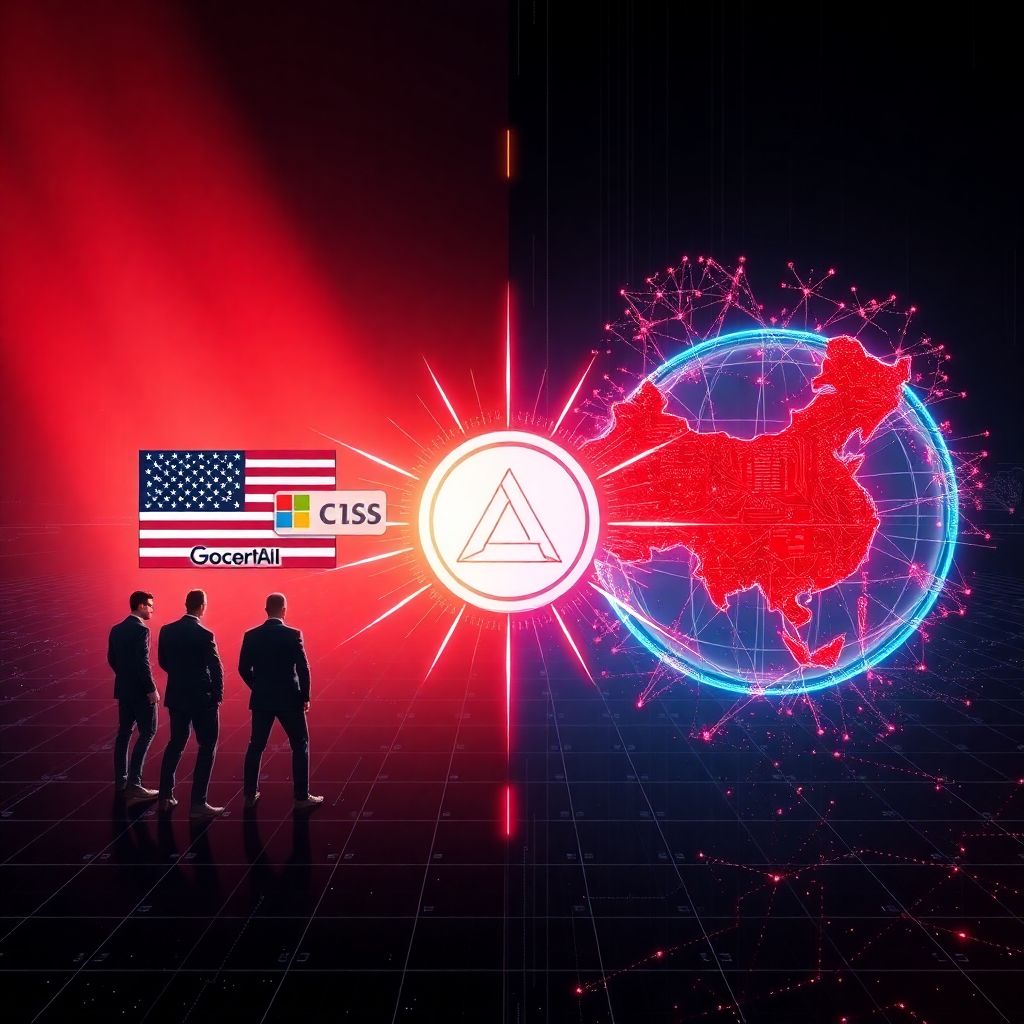
US Tech Titans Form Alliance to Counter China’s Open‑Source AI Surge
Some of the most powerful technology companies in the United States are closing ranks around a new initiative designed to reshape the future of artificial intelligence—and to blunt China’s growing advantage in open‑source AI.
Anthropic, OpenAI, and Block have jointly launched the Agentic AI Foundation, a new industry group focused on “agentic” AI systems. They are backed by heavyweights including Google, Microsoft, Amazon Web Services (AWS), Bloomberg, and Cloudflare, signaling a rare moment of unity among firms that usually compete aggressively with one another.
The timing is not accidental. China has rapidly moved ahead of the U.S. in terms of open‑source AI adoption, particularly measured by downloads and usage of open models and tools. That shift has triggered alarm across the American technology sector, where many fear that if China sets the base standards for open AI infrastructure, U.S. companies will be forced to build on top of someone else’s foundations.
Donating Core Protocols to the Linux Foundation
As part of this new push, Anthropic and OpenAI have contributed key technical specifications and protocols to the Linux Foundation, the long‑standing non‑profit that stewards many of the world’s most important open‑source projects.
Among the most important contributions is the Model Context Protocol (MCP), a framework designed to let AI agents connect to tools, data sources, and services in a standardized way. Rather than being locked into a single vendor’s ecosystem, developers can use MCP to build agents that work across platforms and providers.
Cloudflare’s Chief Technology Officer, Dane Knecht, underscored the strategic importance of this kind of openness, calling standards and protocols like MCP “essential to enabling a thriving developer ecosystem for building agents.” In his words, they provide a path for people to build cross‑platform agents “without the fear of vendor lock‑in.”
By placing these protocols under the umbrella of the Linux Foundation, the companies are effectively ceding unilateral control over them and committing to an open governance model. That move is intended to reassure developers, enterprises, and regulators that the emerging agentic AI ecosystem will not be dictated solely by any single corporate player.
The Strategic Paradox Facing U.S. AI Firms
U.S. AI companies now face a difficult balancing act.
On one hand, their business models increasingly depend on closed, pay‑as‑you‑go APIs that keep the most advanced models proprietary. Those APIs generate recurring revenue, investor confidence, and the resources needed to train even larger and more capable systems.
On the other hand, if the foundational layers of AI—core protocols, tool interfaces, model formats, and agent frameworks—are defined and dominated by China’s open‑source ecosystem, American firms risk losing long‑term influence. Whoever owns the “plumbing” of AI can shape how applications are built, how data flows, and which models get favored by default.
This is the paradox: keep everything closed and risk ceding the base layer to rivals, or open critical infrastructure and accept that value will shift toward services, integration, and higher‑level offerings rather than pure model access.
The Agentic AI Foundation, and the decision to donate MCP and similar protocols, represents an attempt to navigate that tension. By opening the scaffolding while still monetizing the most advanced models and enterprise tools, U.S. firms hope to keep developers in their orbit while preventing a foreign actor from writing the basic rules of the game.
Why “Agentic” AI Is the New Battleground
The focus on “agentic” AI reflects where many insiders believe the next phase of competition will unfold. Traditional large language models answer questions or generate content. Agentic systems go a step further: they can plan tasks, call tools, access APIs, interact with other software, and autonomously execute multi‑step workflows.
In practice, that might mean AI that can:
– Schedule and complete business processes end‑to‑end
– Coordinate between cloud services, databases, and internal tools
– Act as a semi‑autonomous assistant for knowledge workers
– Monitor systems and take corrective action without constant human prompts
If agents become the primary way people and organizations interact with AI, then the standards governing how those agents talk to tools, models, and platforms will be strategically vital. That is precisely the layer U.S. firms are now trying to keep open and vendor‑neutral.
China’s Open‑Source Momentum
China’s momentum in open‑source AI is not just a symbolic concern. Chinese teams have been rapidly releasing models, frameworks, and tools that are freely downloadable and modifiable. Many of these projects have seen explosive adoption, especially in regions looking to reduce dependence on U.S. technology providers.
In practical terms, that leads to:
– Local ecosystems building directly on Chinese models and standards
– Tooling and libraries that default to non‑U.S. infrastructure
– A growing community of developers whose habits and expectations are shaped outside U.S. influence
If left unchecked, this could mirror what happened in other technology domains where early open standards determined decades of market structure. The U.S. companies behind the Agentic AI Foundation appear determined not to repeat that mistake in the AI era.
Why the Linux Foundation Matters Here
Choosing the Linux Foundation as the steward for these AI protocols is more than a symbolic gesture. The organization has a long history of managing critical infrastructure technologies in a way that feels neutral and predictable to governments, corporations, and individual developers alike.
By placing the Model Context Protocol and related specifications into that environment, the founding companies are signaling that:
– No single vendor should own the core agent standards
– Contributions from a wide range of stakeholders will be welcomed
– Long‑term stability and interoperability are higher priorities than short‑term lock‑in
This approach is meant to make it easier for enterprises to commit to building on top of these standards, knowing they won’t be trapped if one particular provider changes direction or pricing.
Implications for Developers and Startups
For developers, the shift toward open agent standards could reduce friction dramatically. Instead of rewriting integrations for each cloud provider or AI vendor, they can target a common protocol and swap models or services as needed.
That means:
– Faster experimentation with different model providers
– Lower switching costs between clouds or AI platforms
– More competition on performance, safety, and price rather than ecosystem captivity
Startups may particularly benefit. With standardized interfaces, a small team can assemble powerful agentic systems by combining multiple services, without worrying that a single vendor will suddenly cut off access or force a migration to incompatible tools.
How Big Tech Still Plans to Make Money
Opening key protocols does not mean giving away the store. The major firms involved still have clear paths to monetization even as they push for open standards:
– Charging for access to their most powerful proprietary models
– Offering managed agent platforms with security, compliance, and governance features
– Providing enterprise‑grade tooling, monitoring, and orchestration around open protocols
– Bundling AI capabilities into existing cloud and productivity suites
In other words, they are trying to shift the battleground away from control over simple APIs and toward differentiated services that sit on top of a shared, open infrastructure layer.
Geopolitics and Regulatory Pressure
The formation of a U.S.‑led, openly governed foundation for agentic AI also speaks to rising geopolitical tensions around advanced technologies. Governments are increasingly wary of single‑country or single‑company control over strategic digital infrastructure.
By backing open standards in a recognized neutral forum, U.S. tech firms gain several advantages:
– They can argue that the AI ecosystem is not a closed American sphere, but an open, global one.
– They can respond to regulatory concerns about monopolistic behavior by pointing to shared governance and interoperability.
– They create a more credible alternative to rival ecosystems attempting to set their own de facto standards.
This stance may prove useful as policymakers around the world craft rules governing AI safety, data flows, and competition.
The Risk of Fragmentation Still Looms
Despite the push for common standards, the risk of fragmentation remains real. Competing protocols, region‑specific regulations, and incompatible implementations could splinter the AI landscape into multiple, partially overlapping ecosystems.
If, for example, China promotes its own agent frameworks optimized for domestic infrastructure, and other regions follow suit with their preferences, developers may still be forced to navigate a patchwork of standards. The Agentic AI Foundation’s success will depend on gaining enough traction globally that it becomes the default choice rather than just another option.
What This Means for the Future of AI
The decision by Anthropic, OpenAI, Block, and their powerful allies to back open agent standards marks a turning point in how U.S. tech giants think about AI strategy. Instead of treating every layer as proprietary territory, they are selectively opening the plumbing to ensure they remain central to the next wave of innovation.
If their gamble pays off, the AI world could see:
– A robust, interoperable ecosystem of tools and agents
– More competition and innovation at the application layer
– Reduced dependence on any single national or corporate standard‑setter
If it fails, and China’s open‑source AI infrastructure continues to set the pace, American firms may find themselves competing on someone else’s terms.
For now, the message from the Agentic AI Foundation is clear: in the emerging era of agentic AI, the battle is not just about who has the biggest model—it’s about who defines the rules that every model, agent, and application must follow.