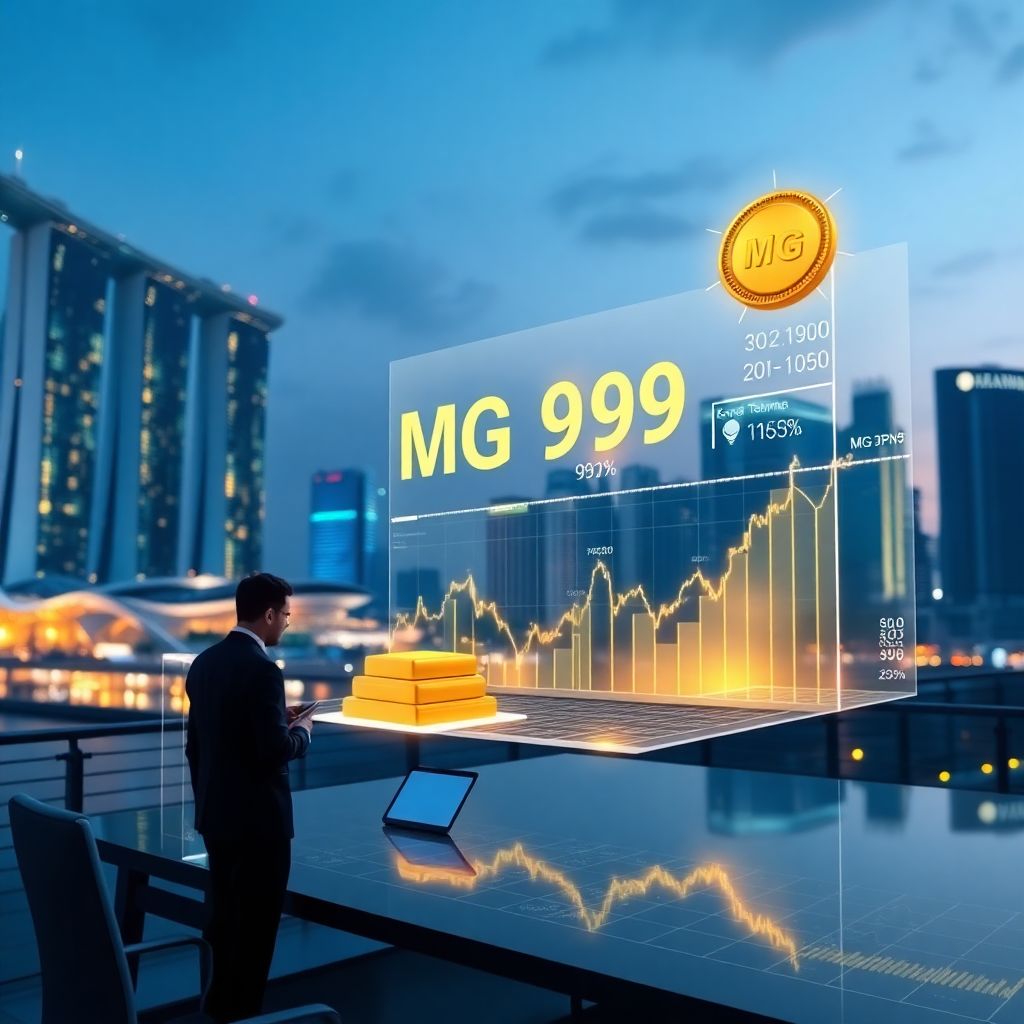
Standard Chartered-backed Libeara launches MG 999 tokenized gold fund in Singapore
Libeara, a blockchain-based infrastructure provider supported by Standard Chartered’s innovation arm SC Ventures, has introduced a new tokenized gold investment product in Singapore, targeting professional and institutional investors seeking alternative access to the precious metal.
The fund, branded MG 999, has been structured in collaboration with FundBridge Capital and offers synthetic, tokenized exposure to the price of gold rather than direct ownership of physical bullion. Instead of storing bars in a vault, investors receive digital tokens issued on Libeara’s ledger that are designed to closely track the spot price of gold.
How MG 999 delivers tokenized exposure to gold
Each MG 999 token is constructed to mirror gold’s market performance, giving investors price exposure similar to a traditional gold-backed fund without the operational burden of moving and holding physical metal. According to the fund’s structure, the tokens themselves are not claims on specific gold bars; rather, they represent synthetic exposure to gold’s price, engineered through the fund’s internal mechanisms and asset allocation.
FundBridge highlights that this model removes many of the conventional costs associated with gold investing, such as transportation, insurance, and storage in secure vaults, while still allowing investors to participate in price movements. By putting the fund on a blockchain-based ledger, transaction records become transparent and tamper-evident, which can support more efficient auditing and reporting.
FundBridge’s leadership has emphasized the importance of merging traditional fund governance practices with emerging digital infrastructure. The MG 999 framework is designed to operate within a fully regulated fund environment, adhering to established compliance standards while using tokenization to represent real-world assets on-chain.
Institutional-only product with a synthetic structure
MG 999 is currently restricted to institutional and accredited investors in Singapore, aligning with regulatory expectations for complex or novel financial products. Retail investors are excluded at this stage, reflecting both the sophistication required to understand synthetic structures and regulators’ caution around emerging digital-asset instruments.
Unlike physically backed exchange-traded products or gold funds that hold allocated bars, MG 999 does not store bullion in a vault. Its value proposition lies in delivering a digital instrument whose performance is tied to gold’s spot price. This makes it more akin to a structured or derivative-based exposure than a direct ownership model, although it is wrapped inside a regulated fund format rather than a traditional derivative contract.
Part of a broader wave of real-world asset tokenization
The launch of MG 999 underscores a growing trend among established financial institutions: the tokenization of real-world assets such as government bonds, money market funds, treasuries, and precious metals. Tokenization refers to representing ownership or exposure to these assets via digital tokens on a blockchain, with the goal of improving settlement efficiency, transparency, and market access.
For banks and asset managers, tokenization is increasingly viewed as a way to modernize financial market infrastructure without discarding existing regulatory and governance frameworks. Instead of building parallel systems, players like Libeara and FundBridge are attempting to embed blockchain rails into familiar fund structures, giving institutional investors a bridge between traditional finance and digital-asset technology.
SC Ventures, Standard Chartered’s venture and digital innovation unit, has been steadily expanding its footprint in digital assets across Asia. It holds majority stakes in Zodia Custody and Zodia Markets, both designed to serve institutional players with regulated custody, trading, and related services. MG 999 fits this broader strategy by adding a tokenized real-asset fund to the group’s ecosystem.
Differentiation from physically backed gold products
The timing of MG 999’s introduction is notable given that Standard Chartered has recently participated in creating a separate, physically backed gold fund in Singapore, where the bank serves as custodian for bullion stored in a high-security facility near Changi Airport. That product is oriented toward investors who want direct exposure to allocated metal, held in custody on their behalf.
By contrast, MG 999 targets institutions comfortable with a synthetic exposure model and with the use of tokenized instruments for portfolio construction. Rather than choosing vault storage and bar allocation, investors are instead opting for digital tokens whose value should move in line with spot gold, and which can potentially be integrated more seamlessly into digital trading and settlement workflows.
This dual approach highlights how financial institutions are segmenting the gold investment market: investors seeking tangible assurance of specific bars stored under custody can choose physically backed structures, while those prioritizing flexibility, efficiency, or on-chain integration can consider synthetic, tokenized funds like MG 999.
Rising global demand for safe-haven assets
MG 999’s debut comes against a backdrop of heightened global interest in gold. Central banks in multiple regions have been increasing their gold reserves in response to concerns over the long-term dominance of the US dollar, ongoing geopolitical tensions, and the perceived need to diversify reserve holdings.
Market observers have also pointed to periods of trade friction and tariff policies, including those associated with previous US administrations, as drivers of demand for safe-haven assets. In uncertain macroeconomic conditions, gold is often viewed as a hedge against currency debasement, inflation, and geopolitical shocks. For institutions, having multiple channels to access gold exposure—physical and synthetic, traditional and tokenized—can support more nuanced risk management.
Lending component tailored to Singapore’s jewelry sector
One of the most distinctive aspects of MG 999 is its built-in lending component directed at Singapore’s jewelry industry. Mustafa Gold, a major local jewelry retailer, has been named as the fund’s inaugural borrower. Through the structure, Mustafa can borrow against the value of its gold jewelry inventory while keeping the products available for sale on showroom floors.
This approach effectively turns jewelry stock into collateral for working capital loans, using the fund as an intermediary. For retailers operating in a capital-intensive business where large amounts of value sit in display cases, the ability to unlock liquidity without removing items from stores is strategically valuable.
Mustafa’s founder, Mustaq Ahmad, described gold-linked tokens as both unique and complex, but stressed that products like MG 999 can help retailers tap digital innovation to manage cash flow more efficiently. For the fund, the lending activity also creates an underlying economic use case, rather than having the tokens exist solely as a speculative trading instrument.
Why tokenized gold appeals to institutions
For institutional investors, tokenized gold funds such as MG 999 can offer several potential advantages:
– Operational efficiency: Digital tokens may settle faster than traditional fund units and can be integrated into automated workflows, reducing back-office friction.
– Programmability: Smart contract features can enable automated distributions, redemptions, or collateral management, which can be particularly useful in complex portfolios.
– Transparency: Blockchain-based records can provide a real-time, auditable history of token issuance and transfers.
– Portfolio integration: For institutions already experimenting with digital assets, a tokenized exposure to a well-understood asset like gold can serve as a lower-risk entry point compared to more volatile cryptocurrencies.
However, these benefits are balanced by new considerations, including smart contract risk, dependence on the underlying technology stack, and the need for robust governance to ensure that tokenized exposure truly reflects the asset it is meant to track.
Regulatory and risk considerations
Although MG 999 operates within a regulated fund framework and is limited to professional investors, tokenized products still face heightened regulatory scrutiny. Supervisors typically focus on issues such as custody of digital tokens, cybersecurity, valuation methodologies, and the legal enforceability of investor rights.
For investors, understanding the difference between physically backed and synthetic structures is essential. In a synthetic model like MG 999, exposure is dependent on the fund’s internal design, risk management practices, and the solvency of the issuer and counterparties. While this is similar to many traditional structured products, the added layer of blockchain technology introduces both innovation and complexity.
Risk management for such products will often involve careful due diligence on the fund manager, the technology platform, and the legal structure of the tokens, as well as ongoing monitoring of market, credit, and operational risks.
The strategic significance for Singapore
Singapore has been positioning itself as a hub for both wealth management and well-regulated digital-asset innovation. The arrival of MG 999 strengthens its role as a testbed for institutional-grade tokenized products, especially in the realm of precious metals and real-world assets.
By hosting both a physically backed gold fund and a tokenized synthetic gold fund associated with the same major bank, Singapore offers investors a choice of structures within a consistent regulatory environment. This diversity of options may help attract more global capital to the city-state’s asset management and digital-asset ecosystems.
Outlook: Tokenization’s next phase
MG 999 illustrates how tokenization is moving beyond experimental pilots into specialized, use-case-driven products. Where early projects focused mainly on the technology, newer offerings like this one attempt to solve concrete problems: lowering logistics costs, unlocking working capital for retailers, and giving institutions more flexible instruments for managing exposure.
If investors and regulators grow comfortable with tokenized structures, similar models could be extended to other commodities, trade finance assets, or inventory-backed lending across sectors. In that scenario, gold may prove to be a proving ground for a broader wave of real-world asset tokenization, with Singapore and players like Libeara and FundBridge at the center of that evolution.