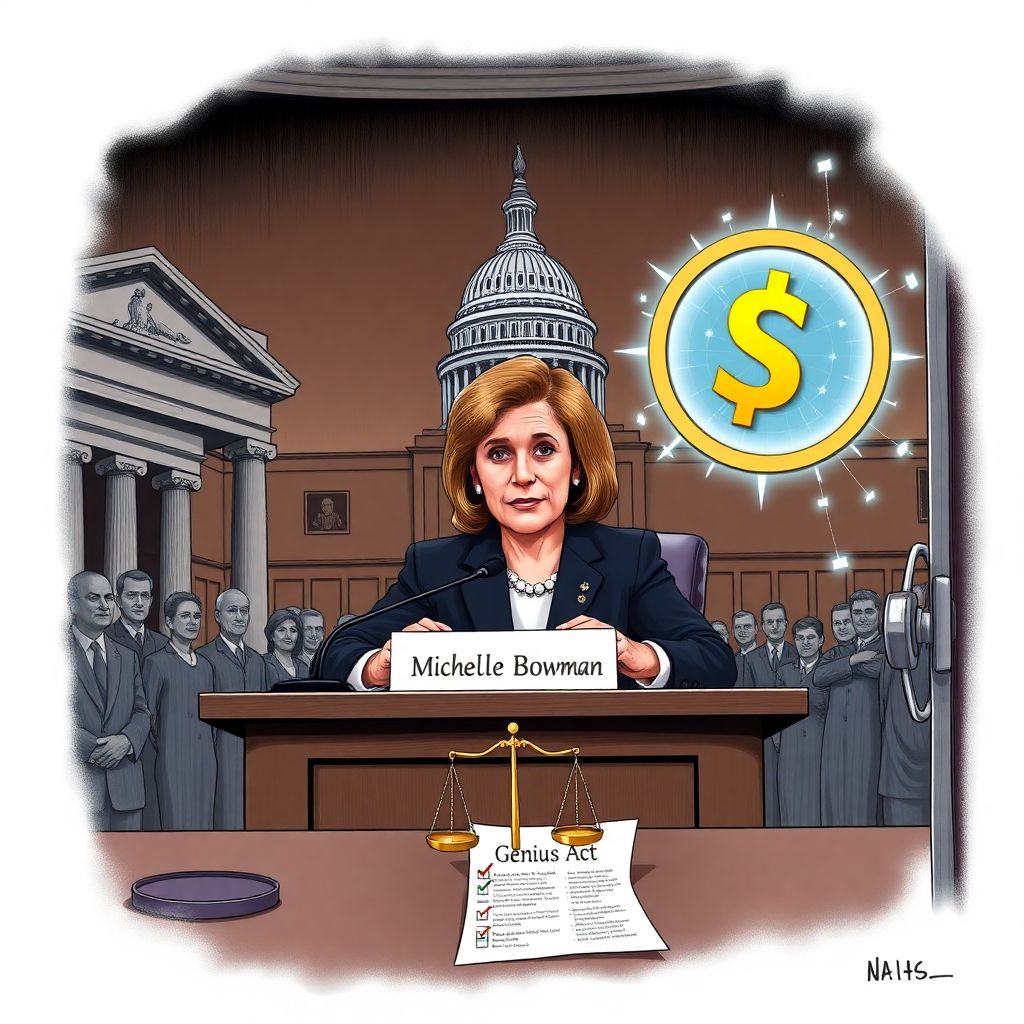
Fed Governor Michelle Bowman is heading to Capitol Hill with a clear message for both Wall Street and the crypto industry: traditional banks and digital asset firms can coexist, but only under stricter, consistently enforced rules.
In prepared testimony for a House Financial Services Committee hearing, Bowman plans to urge lawmakers to tighten oversight of both banks and stablecoin issuers. Her goal, she says, is to foster “healthy competition” between regulated financial institutions and rapidly growing crypto players by ensuring they operate under comparable standards.
As the Federal Reserve’s lead banking supervisor, Bowman frames her approach as a balance between innovation and prudence. “As a regulator, it is my role to encourage innovation in a responsible manner,” she notes, stressing that supervisors must constantly upgrade their tools to monitor and manage new risks that emerging technologies introduce to the banking system.
According to Bowman, those new technologies—from tokenized deposits to blockchain-based payments—have the potential to make financial services more efficient, cheaper, and more inclusive. They can expand access to credit and lower transaction costs. But she also argues that such innovation must not become a way to sidestep rules that apply to banks, especially around capital, liquidity, and governance.
A central focus of her testimony will be stablecoins—digital tokens that aim to maintain a fixed value, typically pegged to the US dollar. Bowman intends to work with other regulators to design capital, risk management, and diversification standards for stablecoin issuers under the newly enacted Genius Act. The law, as she describes it, forces issuers to operate with bank-like discipline if they want bank-like credibility: formal registration, clear oversight, and strict dollar-for-dollar reserve backing.
Under the Genius Act, stablecoin issuers must demonstrate that each token is fully supported by high-quality, liquid assets, such as cash or short-term Treasuries, held in segregated accounts. That requirement is meant to reduce the risk of runs—sudden waves of redemptions that could destabilize both the crypto markets and, in a severe scenario, parts of the wider financial system. The message from regulators is straightforward: if a company wants to issue something that looks and behaves like money, it must be prepared to live up to the standards expected of money-creating institutions.
Bowman’s comments land in the middle of a heated turf battle between banks and crypto firms over access to the core of the financial system—specifically, banking charters. A federal or state charter is more than just a license; it provides direct connectivity to payment rails, deposit insurance (when applicable), and a strong signal of legitimacy to customers and markets.
Crypto firms argue that obtaining charters would give them clear regulatory expectations and predictable compliance obligations, allowing them to innovate within a well-defined framework rather than in legal gray zones. They contend that more tailored charters for digital asset firms would encourage investment, professionalize operations, and help weed out bad actors who rely on regulatory ambiguity.
Traditional banks, however, are wary of granting charters too freely. Their concern is that a wave of “charter-lite” institutions could emerge—entities that benefit from the credibility and infrastructure of the banking system without shouldering the same level of scrutiny, capital requirements, or supervisory intensity. From the banks’ perspective, that would amount to regulatory arbitrage: new players competing with fewer constraints while still relying on the same underlying financial plumbing.
Bowman positions herself somewhere between these two camps. She does not reject the idea that crypto-native firms or fintechs could hold charters. Instead, she emphasizes that any institution performing core banking functions—taking deposits, issuing money-like liabilities, offering payments and lending—must be subject to comparable rules. In other words, charters should not be used as shortcuts or branding tools; they are commitments to a demanding regulatory regime.
Beyond stablecoins and charters, Bowman also plans to brief lawmakers on the Federal Reserve’s broader capital reform agenda, including the long-running Basel III “Endgame” process. This initiative aims to refine how large banks measure risk and determine their minimum required capital. She stresses that her priority is “bottom‑up” calibration—building rules from detailed data and institution-level analysis rather than starting with a political or arbitrary capital target and working backward.
The Fed is currently recalibrating capital surcharges for systemically important banks and reassessing a moderated version of a prior proposal advanced during the Biden administration. These surcharges are extra cushions imposed on the largest, most interconnected firms, intended to reflect the outsized impact their distress could have on the financial system. Bowman’s approach suggests she wants capital rules robust enough to withstand stress, but not so blunt that they choke off lending or push risk into less regulated corners of finance.
Her broader message is that neither side of the financial ecosystem—legacy banks or crypto platforms—will get to opt out of the “hard work” of risk management. Both must hold sufficient capital, operate under transparent rules, and build internal systems capable of surviving volatility, whether that comes from traditional credit cycles or from sudden price swings in digital assets.
Behind these policy debates lies a deeper question: who will ultimately control the digital infrastructure of money? Stablecoins, if widely adopted for payments or savings, could influence everything from how quickly funds move globally to how monetary policy is transmitted. If left unchecked, they could create parallel systems of value that compete with bank deposits and, in extreme scenarios, affect demand for central bank liabilities.
Bowman seems acutely aware of this strategic dimension. By pushing for consistent, high-quality regulation and insisting on strong reserve backing, she is effectively trying to integrate stablecoins into the existing financial architecture rather than letting them evolve as an unregulated alternative. That approach seeks to capture their efficiency benefits while limiting their ability to undermine financial stability or monetary sovereignty.
Her stance also intersects with ongoing global discussions about central bank digital currencies (CBDCs). While her testimony focuses on private stablecoins rather than a Fed-issued digital dollar, the underlying concerns are similar: how to modernize payments and money without creating new systemic vulnerabilities or eroding trust in the financial system. Stricter rules for private issuers could, over time, shape the competitive landscape between stablecoins and any future CBDC.
Another key angle in Bowman’s remarks is consumer protection. Stablecoins are often marketed as “safe” or “cash‑like,” but in the absence of clear rules, users can be exposed to opaque reserve practices, legal uncertainties, and operational failures. By requiring registration, standardized disclosures, robust reserves, and diversification of assets, regulators aim to reduce the gap between what users think they are buying and what they actually hold.
From an industry perspective, tougher standards can be both a burden and a long-term benefit. In the short run, smaller or undercapitalized issuers might struggle to meet new requirements, potentially leading to consolidation. But for firms willing to comply, clear rules can provide a foundation for sustainable growth: institutional investors, large merchants, and global payment processors are more likely to engage with stablecoins that operate under a framework resembling traditional financial regulation.
Bowman’s emphasis on “healthy competition” is also a signal that regulators do not want to freeze the status quo. Banks are being pushed to modernize their own offerings—experimenting with tokenized deposits, instant settlement solutions, and digital identity tools—while crypto firms are being pulled toward the discipline and transparency long familiar to regulated lenders. The aim is less about picking winners and more about ensuring that whichever model prevails does so within guardrails that protect the broader system.
At the same time, her comments hint at a growing recognition that simply banning or sidelining crypto is neither realistic nor necessarily desirable. Stablecoins already play a significant role in digital asset markets, facilitate cross‑border transfers, and sit at the heart of many decentralized finance protocols. Rather than trying to roll back those developments, Bowman is advocating for a framework that brings them closer to the regulatory perimeter.
For lawmakers, the hearing will highlight several unresolved policy choices: How stringent should reserve requirements be? Should stablecoin issuers be allowed to invest in riskier assets for yield? What role should federal versus state regulators play? And how should charter regimes evolve to accommodate new types of financial institutions without fragmenting oversight?
Bowman’s answers lean toward conservatism on risk but openness on structure. If institutions want to issue money-like claims widely used by the public, they must be prepared to hold conservative assets, weather stress scenarios, and submit to ongoing scrutiny. But if firms can meet those conditions, she appears open to a more diverse ecosystem that includes banks, fintechs, and crypto-native companies side by side.
In essence, Bowman is trying to referee an increasingly crowded and complex financial arena. Her core principle is that innovation does not exempt anyone from the fundamentals of prudence. Whether a firm runs on legacy mainframes or blockchains, whether it calls its liabilities deposits or stablecoins, the expectation is the same: no one gets to skip the equivalent of “leg day” when it comes to capital, risk controls, and regulatory accountability.