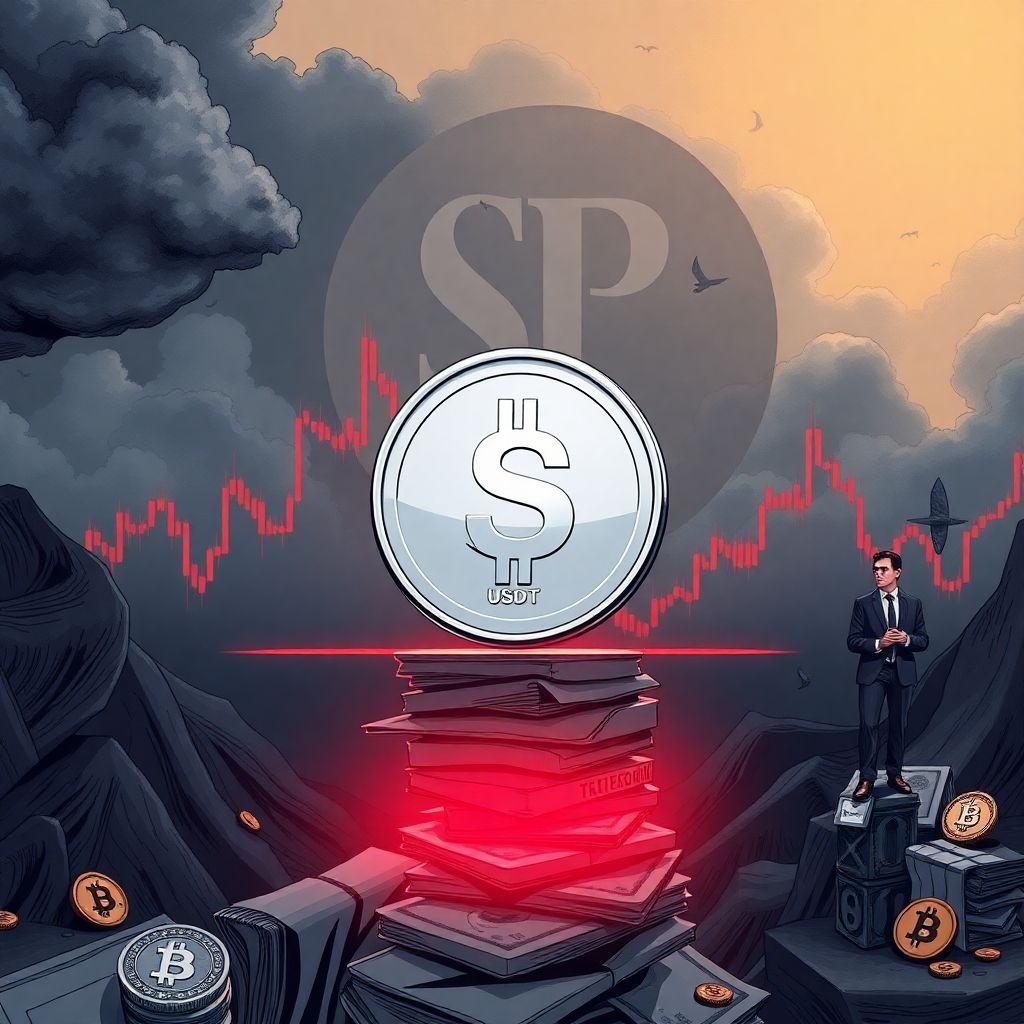
S&P Global Ratings has lowered its assessment of Tether’s flagship stablecoin USDT, warning that its ability to maintain a strict 1:1 peg to the U.S. dollar is “weak” because of the assets backing it—most notably Bitcoin and other higher‑risk holdings.
According to the credit ratings agency, USDT could become “undercollateralized” if the value of its reserve assets drops sharply. While USDT is marketed as a dollar‑pegged token, S&P argues that the growing share of volatile assets in Tether’s reserves introduces a meaningful risk that the stablecoin may not be fully backed in the event of a severe market downturn.
A central concern is Tether’s increasing exposure to Bitcoin. Unlike cash, bank deposits, or short‑term U.S. Treasuries, Bitcoin is extremely volatile. A rapid decline in its price—especially if it coincides with falling values of other riskier assets in Tether’s portfolio—could erode the effective coverage of USDT in a short span of time. S&P warned that a major crypto sell‑off could therefore make it more difficult for Tether to honor redemptions at par for all token holders simultaneously.
S&P’s revised view doesn’t mean USDT is currently off its peg, but it does signal that the coin’s resilience under stress is, in the firm’s opinion, limited. The “weak” stability score reflects both market risk in the reserves and the lack of detailed, independently verifiable information on how those reserves are managed.
The ratings agency also criticized Tether for what it called insufficient transparency. S&P noted that Tether does not provide granular, consistent disclosures about several critical elements, including who its custodians are, which institutions hold its bank accounts, and the precise nature and terms of its counterparties. This opacity, S&P suggests, makes it difficult for analysts and users to fully assess the stability and liquidity of the reserves.
Tether has historically pushed back against such critiques, insisting that USDT is fully backed and that its portfolio is conservatively managed. The company regularly publishes reserve breakdowns and has highlighted large holdings in U.S. Treasuries. However, S&P’s downgrade indicates that professional credit assessors are not fully convinced by the level of disclosure, the composition of reserves, or the potential performance of those reserves under extreme market stress.
At the heart of this dispute is the question of what truly makes a stablecoin “stable.” Many market participants assume that if a token mostly trades around $1, it is safe. But S&P’s rating focuses less on current market price and more on structural resilience. It asks: if a crisis hits—such as a sudden Bitcoin crash, a loss of confidence in a major counterparty, or a wave of mass redemptions—will the issuer still be able to redeem every token for a dollar, quickly and without disruption?
In S&P’s view, the answer for USDT is uncertain. A significant decline in Bitcoin’s value, combined with drawdowns in other high‑risk holdings, could reduce the buffer provided by reserves. If that buffer shrinks too far, Tether might be forced to sell assets at unfavorable prices to meet redemption demands, potentially amplifying losses and putting the peg under pressure.
The downgrade has broader implications for the crypto ecosystem, as USDT remains the largest and most widely used stablecoin in terms of trading volume and liquidity. It serves as the primary quote currency and settlement asset on many exchanges, especially outside the United States. Any serious doubt about its collateral quality can ripple through trading venues, DeFi protocols, lending platforms, and over‑the‑counter markets that rely on USDT as a key unit of account.
For institutional investors and sophisticated traders, S&P’s assessment is likely to feed into risk management and treasury decisions. Some may respond by diversifying into other stablecoins that emphasize conservative reserves and stronger regulatory oversight, such as those issued by U.S.‑regulated entities and backed primarily by cash and short‑term government securities. Others may simply adjust how much USDT they are willing to hold on‑exchange or in long‑term strategies.
Retail users, meanwhile, may not immediately feel the impact; USDT’s price is still hovering close to $1 across major markets. But the underlying message from S&P is that stability should not be gauged purely by short‑term price behavior. Users who treat USDT as a cash equivalent—parking savings or operating capital in the token—are implicitly taking on exposure to Tether’s reserve strategy, including its Bitcoin holdings and less transparent counterparties.
The episode also illustrates a broader shift in how traditional finance evaluates digital assets. Rather than treating all stablecoins as interchangeable, ratings agencies and regulators are beginning to distinguish between models: those built on conservative, transparent reserves and strong governance, and those relying more heavily on yield‑generating or higher‑risk assets to boost returns. This differentiation may shape which tokens gain favor with banks, fintech platforms, and institutional investors over the coming years.
For Tether, the downgrade poses both a reputational challenge and a strategic crossroads. The company could respond by further de‑risking its balance sheet—reducing exposure to Bitcoin and other volatile instruments—and publishing more detailed, frequent, and independently verified disclosures about its reserves, custodians, and counterparties. Such steps might not only improve its standing with S&P, but also reassure regulators and large clients.
On the other hand, Tether may choose to continue its current approach, arguing that its profits, flexibility, and track record of surviving past market shocks validate its model. That stance, however, would likely cement a perception gap between USDT and more conservatively structured stablecoins, particularly in the eyes of regulators and traditional financial institutions who prioritize transparency and lower risk.
For users and businesses deciding whether to hold or accept USDT, the practical takeaway is to treat it as an instrument with real, measurable risk—not as a perfect substitute for dollars in a bank account. Key questions to consider include: How much of your portfolio relies on USDT? Could your activities function smoothly if you had to switch to another stablecoin? And how sensitive is your strategy to a temporary or sustained deviation from the dollar peg?
Ultimately, S&P’s downgrade does not spell immediate disaster for Tether or for USDT. But it underscores the fragile balance at the core of the stablecoin model: to be truly stable, backing assets must be not only sufficient in value but also liquid, low‑risk, and transparently documented. As regulators worldwide move toward formal stablecoin frameworks, the market is likely to reward issuers that meet these standards—and scrutinize those that do not.